
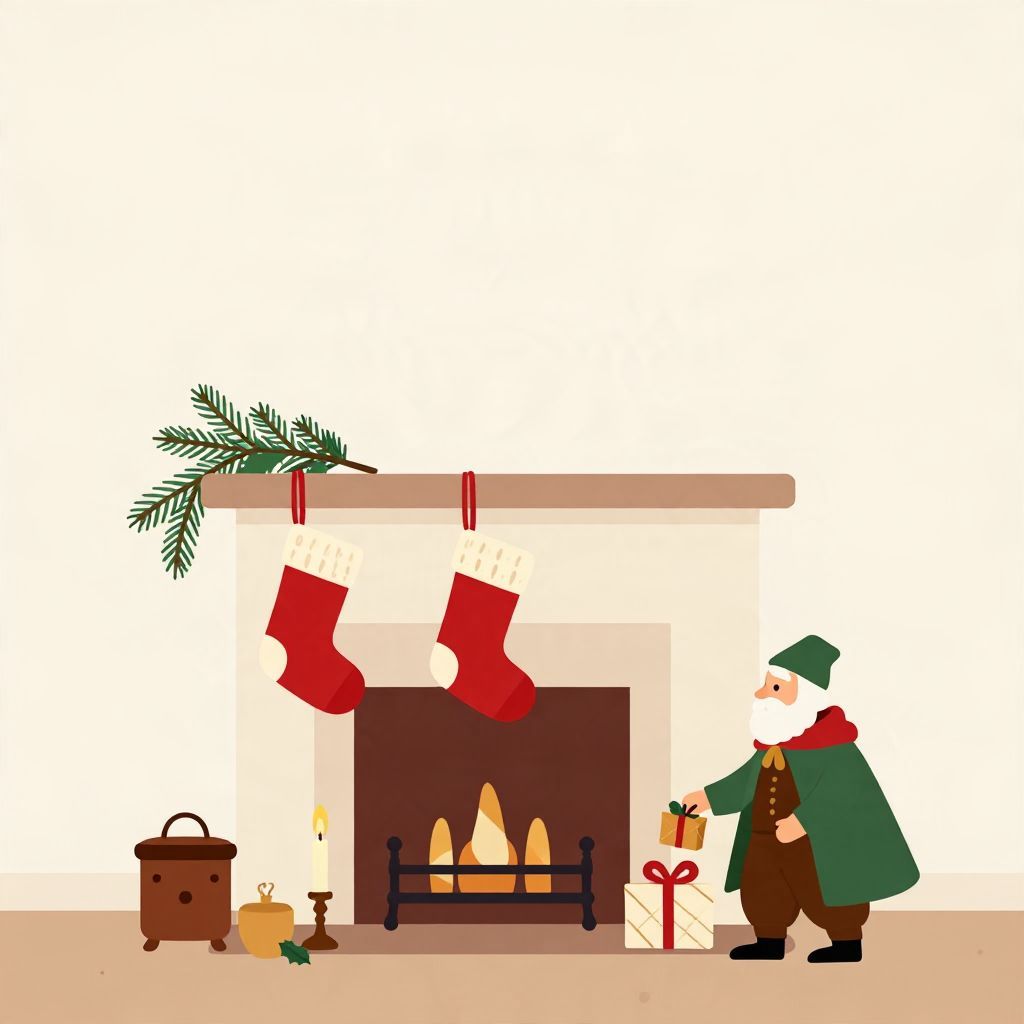
What is a Christmas stocking? It is a decorative sock or sock-shaped bag hung up at Christmas, usually for small gifts, sweets, fruit, or treats. Today it is one of the most familiar parts of Christmas morning, but its meaning comes from a long mix of folklore, Christian custom, and later family tradition.
The Christmas stocking is often linked to the legend of Saint Nicholas, yet its exact origins are not tied to one single moment. Instead, the custom grew over centuries in Europe and became especially popular in the English-speaking world in the 19th and 20th centuries.
What Is a Christmas Stocking?
A Christmas stocking is a stocking-shaped container, traditionally hung by a fireplace, bed, or mantel on Christmas Eve so that it can be filled with small gifts by Christmas morning. Its historical roots lie in European winter gift-giving customs, especially stories associated with Saint Nicholas, but the modern stocking is a later domestic Christmas tradition.
Where Did the Christmas Stocking Come From?
The best-known origin story comes from medieval and early modern legends about Saint Nicholas, a fourth-century bishop from Myra in Asia Minor, later celebrated across Europe as a gift-giver. The stocking tradition is usually connected to a tale in which Nicholas secretly provided dowries or money to needy girls by dropping coins into stockings or shoes left to dry near a hearth.
The Saint Nicholas legend
There are several versions of the story, and historians treat them as folklore rather than verified biography. In one common telling, a poor father could not afford dowries for his daughters, and Nicholas helped by tossing gold coins into the home, where they landed in stockings or shoes. The story helped shape the idea that hidden gifts could appear overnight at Christmas.
From shoes to stockings
Early customs may have involved shoes, boots, or other containers rather than the modern stocking. In many European households, people left footwear near the fire or doorway, and over time the image of a hanging stocking became more common. The shift probably reflects both practicality and symbolism: stockings were household items, easy to hang, and closely tied to the idea of winter clothing and warmth.
How Did the Tradition Develop Over Time?
The Christmas stocking did not emerge as a fixed custom in one country or century. It developed gradually from religious feast-day gift giving, local folklore, and family-centered Christmas celebrations. By the 18th and 19th centuries, especially in Britain and the United States, stockings had become a recognizable part of Christmas Eve ritual.
Medieval and early modern Europe
Gift-giving at midwinter was common in many European societies long before modern Christmas. Christian feast days, especially those linked to saints, often included charity and small presents. Saint Nicholas Day, observed on or around December 6, became especially important in parts of Europe, and the saint’s reputation as a protector of children and giver of gifts made him a natural figure for Christmas customs.
In this period, the Christmas season was not always centered on one standardized family celebration. Customs varied widely by region, church tradition, and social class. The stocking tradition likely drew from these broader winter practices rather than from a single official religious source.
19th-century Christmas and the home
The modern Christmas stocking became much more visible in the 19th century, when Christmas itself was reshaped into a more domestic, child-centered holiday. In Britain and the United States, Christmas moved increasingly into the home, with emphasis on family gatherings, decorated interiors, and gifts for children. Literature and popular culture helped spread the image of stockings hung for Santa Claus or Father Christmas.
This was also the era when many Christmas customs were standardized. The tree became widespread, cards became popular, and stockings turned into a familiar part of the holiday scene. The custom suited the new ideal of a cozy family Christmas: small gifts could be hidden, discovered in the morning, and shared with excitement.
Why Are Christmas Stockings Hung by the Fireplace?
The fireplace became the classic place to hang stockings because it was one of the most important spaces in the home. In older houses, the hearth was central for heat, cooking, and family life. Folklore also placed Santa Claus or Saint Nicholas entering through the chimney, which made the fireplace a natural symbolic location for gift delivery.
Practical and symbolic reasons
- Visibility: Stockings hung by the fire were easy to see on Christmas morning.
- Space: They were small enough to fit in crowded homes and could hold modest gifts.
- Folklore: The chimney linked the home to the magical arrival of gifts.
- Domestic ritual: Hanging stockings made Christmas Eve feel ceremonial and suspenseful.
Not every household used a fireplace, and not every stocking had to be hung there. Beds, doors, and stair rails also served as hanging places. But the fireplace became the dominant image in English-language Christmas tradition because it combined practicality with storybook symbolism.
What Did Christmas Stockings Originally Contain?
Historically, stockings were usually meant for small, inexpensive gifts rather than large presents. Common items included fruit, nuts, sweets, coins, small toys, and simple trinkets. In many families, the stocking was a way to give children a morning surprise before the larger gifts were opened.
Small gifts and seasonal foods
In earlier centuries, winter treats were especially valued because many foods were seasonal or difficult to preserve. Oranges, apples, nuts, and candy became classic stocking fillers in later Christmas traditions. These items were not only festive but also practical, since they were compact, portable, and affordable.
Over time, commercial gift culture expanded what could go into a stocking. By the late 19th and 20th centuries, stockings might contain marbles, dolls, pencils, soaps, or small manufactured toys. The basic idea remained the same: a stocking was a container for modest gifts that added delight without replacing the main holiday presents.
How Did Santa Claus Become Part of the Stocking Tradition?
Santa Claus became closely associated with Christmas stockings through the blending of Saint Nicholas traditions, Dutch and English folklore, and modern American Christmas culture. In the United States, the figure of Santa gradually took on the role of the overnight gift-bringer, and stockings became one of the most recognizable signs of his visit.
From Saint Nicholas to Santa Claus
The name “Santa Claus” developed from Dutch traditions surrounding Sinterklaas, itself derived from Saint Nicholas. As these customs evolved in North America, they merged with British Father Christmas imagery and with new literary and artistic depictions of a jolly gift-giver. By the 19th century, Santa was often imagined entering homes at night to leave presents in stockings.
This connection was reinforced by children’s stories, poems, and illustrations. The exact details varied from place to place, but the basic idea was clear: stockings were the first evidence that Santa had visited.
How Has the Christmas Stocking Changed in Modern Times?
Modern Christmas stockings are usually larger, more decorative, and more personalized than earlier versions. Many families buy embroidered stockings with names on them, while others make or reuse handmade versions. The custom has also become more commercial, with specialized stocking fillers sold in shops each holiday season.
From household object to holiday decoration
Originally, a stocking was simply a stocking or sock. Today it is often a festive ornament made of felt, wool, velvet, or synthetic fabric, sometimes far larger than an ordinary sock. Its visual role has become as important as its practical one. Even when it is not filled, it signals Christmas in the home.
Modern stockings also reflect changing family life. Some households use them for children only; others give them to adults too. Some include humorous or luxury items, while others preserve the older pattern of small, inexpensive gifts. The tradition remains flexible, which is one reason it has lasted so long.
Is the Christmas Stocking a Religious Tradition?
The Christmas stocking has religious roots, but it is not a formal church ritual. It belongs more to popular Christian culture and domestic custom than to liturgy. Its deepest historical connection is to Saint Nicholas, a Christian saint remembered for charity and generosity, especially toward children and the poor.
At the same time, the stocking tradition has become broadly cultural rather than strictly religious. Many families who do not observe Christmas as a religious feast still use stockings as part of seasonal celebration. This shows how a custom can move from devotional legend into wider social practice.
Why Has the Christmas Stocking Endured?
The Christmas stocking has lasted because it combines suspense, generosity, and imagination in a simple form. It is inexpensive, easy to adapt, and suitable for both religious and secular households. Most importantly, it turns gift-giving into a ritual of discovery, especially for children.
Historically, the stocking also fits a broader pattern in winter celebrations: small gifts, hidden surprises, and household-centered festivity. Its popularity grew as Christmas itself became more focused on family life, childhood, and the pleasures of the home. That is why the stocking remains one of the most recognizable symbols of Christmas today.
In Short: What Is a Christmas Stocking?
A Christmas stocking is a decorative stocking hung at Christmas to be filled with small gifts, and its history reaches back to European Saint Nicholas legends, winter gift customs, and the domestic Christmas traditions of the 19th century. It is both a folk custom and a symbol of Christmas morning anticipation.
For readers interested in related holiday history, you may also enjoy what an Advent calendar is and how Christmas is celebrated in China.