
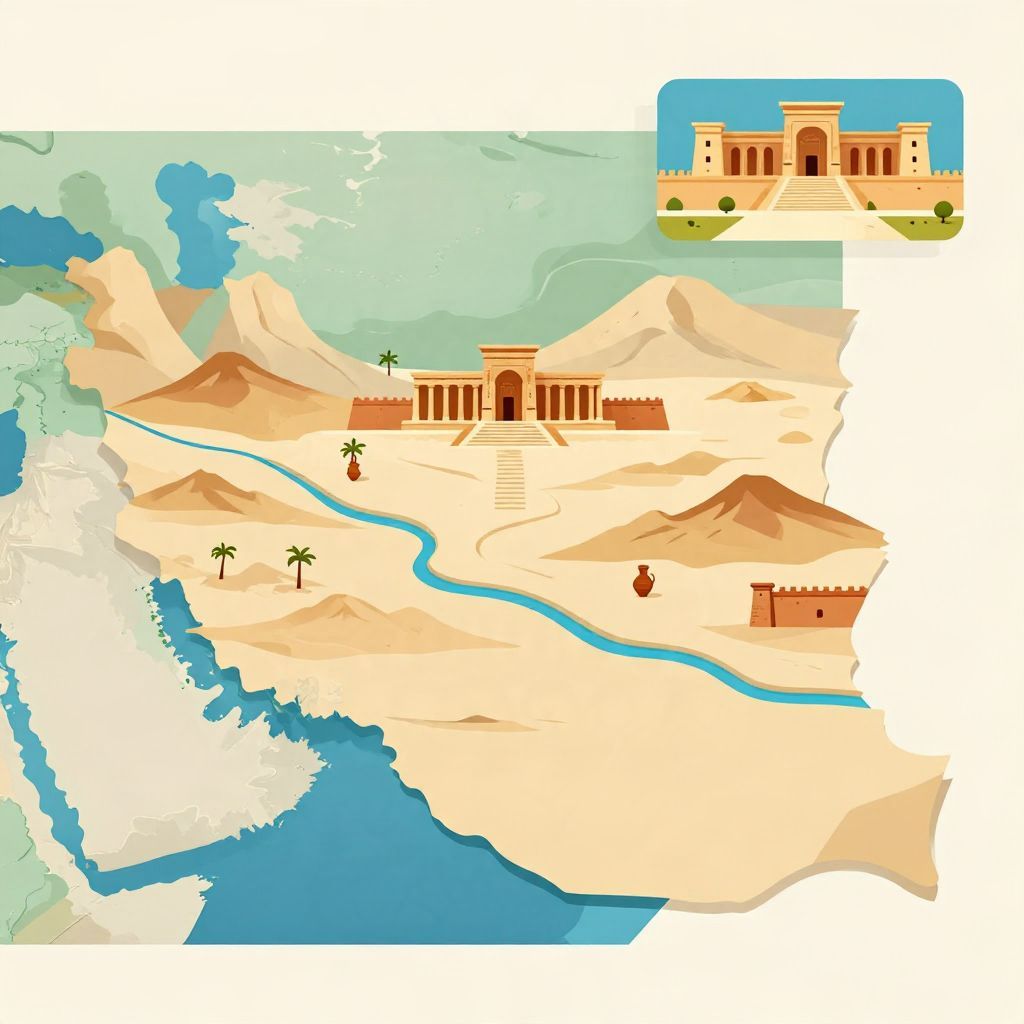
Where was Persia? In historical terms, Persia was a region centered on the Iranian plateau in western Asia, especially the area around modern-day Iran. Over time, the name referred both to a specific southwestern region of ancient Iran and, more broadly, to the Persian Empire and Persian-speaking lands.
Because “Persia” changed meaning across centuries, the answer depends on the period being discussed. Ancient Persian power began in southwestern Iran, but the empire later stretched from the Mediterranean to the Indus Valley, making Persia as much a political and cultural world as a single place.
Where Was Persia?
Persia was located mainly in what is now Iran, on the Iranian plateau in southwestern Asia. In antiquity, the name originally referred to Persis or Fars, a region in southwestern Iran. Later, especially in Greek and European usage, “Persia” came to mean the broader empire ruled by Persian dynasties.
Persia on the Map: Ancient Region and Modern Country
The original Persian homeland lay in the southwest of the Iranian plateau, near the Persian Gulf. This region is today called Fars Province in Iran. From there, the Persians rose to regional power in the 6th century BCE under the Achaemenid dynasty. So if you are asking where Persia was geographically, the most precise answer is: in ancient southwestern Iran, expanding later into a vast empire.
Key geographic features
- Iranian Plateau: the highland region that forms the core of historic Persia and modern Iran.
- Persian Gulf: the body of water south of Persia, important for trade and imperial access.
- Zagros Mountains: a major western mountain chain that shaped settlement, defense, and movement.
- Mesopotamia: to the west, a rich river valley often contested by Persian rulers.
- Central Asia and the Indus region: eastern areas reached by Persian imperial expansion.
Why the Name “Persia” Can Be Confusing
The word “Persia” was used differently by different peoples. Greeks used it for the empire they encountered, while the Persians themselves often used names connected to Parsa or to their ruling dynasty. In modern times, the country officially used “Persia” in many international contexts until 1935, when the government requested the name Iran be used more widely.
Persia vs. Iran
“Persia” and “Iran” are related but not identical terms. Iran is the broader historical and modern name of the country, while Persia is the older name commonly used in Western languages, especially for the ancient empire and its cultural legacy. Today, historians often use “Persia” when discussing the Achaemenid, Parthian, or Sasanian periods, and “Iran” when referring to the country across its longer history.
The Ancient Persian Homeland
The Persians were one of several Iranian-speaking peoples who moved into or developed within the Iranian plateau over many centuries. By the early first millennium BCE, they were established in southwestern Iran. Their homeland was not a single city but a region of plains, mountains, and trade routes that connected inland Iran to the Gulf and to Mesopotamia.
Fars and Persis
The ancient region called Persis by the Greeks corresponds roughly to modern Fars. This was the heartland of the early Persians and the source of the name “Persia.” Important early centers included Pasargadae, associated with Cyrus the Great, and later Persepolis, the ceremonial capital of the Achaemenid Empire.
How Persia Became an Empire
Persia became a major power in the 6th century BCE when Cyrus the Great united Persian lands and overthrew the Median kingdom. He and his successors built one of the largest empires of the ancient world. From its base in Iran, the empire expanded west into Anatolia and Egypt and east into Central Asia and the Indus region.
Major stages of Persian imperial history
- Achaemenid Empire (c. 550–330 BCE): founded by Cyrus the Great; famous for administrative organization and vast territorial reach.
- Hellenistic period (after 330 BCE): Alexander the Great conquered the Achaemenid Empire, but Persian culture and local power structures persisted.
- Parthian Empire (c. 247 BCE–224 CE): ruled much of Iran and Mesopotamia, often in rivalry with Rome.
- Sasanian Empire (224–651 CE): another major Persian empire centered in Iran, known for strong statecraft and conflict with Byzantium.
How Far Did Persia Stretch?
At its greatest extent, Persia was far larger than modern Iran. The Achaemenid Empire reached from the Balkans and Egypt in the west to the Indus Valley in the east. It included Anatolia, the Levant, Mesopotamia, parts of Central Asia, and much of the Iranian plateau. In that sense, Persia was both a homeland and an imperial system spanning three continents.
Important imperial centers
- Susa: a major administrative center in southwestern Iran.
- Persepolis: a ceremonial and symbolic capital of the Achaemenids.
- Babylon: a key imperial city after Persian conquest of Mesopotamia.
- Ctesiphon: a major capital under later Persian dynasties near the Tigris River.
Persia in Relation to Neighboring Regions
Persia sat at the crossroads of the ancient Near East, Central Asia, and South Asia. To the west were Mesopotamia and Anatolia; to the south was the Persian Gulf; to the east lay the Iranian plateau’s routes toward Afghanistan and the Indus. This location helped Persia become a bridge between cultures, religions, and trade networks.
Why location mattered
Persia’s geography gave it strategic advantages. Mountain barriers offered defense, while fertile river valleys and trade routes supported administration and commerce. Control of routes through Iran also linked the Mediterranean world with India and Central Asia. This made Persia influential not only militarily, but also economically and culturally.
Persian Culture Beyond the Borders of Persia
Persian influence extended far beyond the ancient homeland. Even after empires fell, Persian language, court culture, literature, and administrative traditions remained important across the Middle East and Central Asia. In later centuries, Persian became a major literary and diplomatic language from Iran to parts of India.
Lasting cultural legacy
- Language: Persian evolved over time, eventually becoming modern Farsi, Dari, and Tajik in different regions.
- Religion: Zoroastrianism was central in ancient Persian religious life, though later Persian lands became predominantly Muslim after the 7th century.
- Art and architecture: imperial Persian styles influenced palaces, reliefs, and urban design.
- Administration: Persian models of provincial rule influenced later empires.
What Happened to Persia?
Persia did not disappear in a single moment. The ancient empires ended through conquest, dynastic change, and political transformation, but the land, people, and cultural traditions continued. After the Arab conquests in the 7th century CE, Persian-speaking societies remained central in the Islamic world. The name “Persia” survived in European usage for centuries, even as “Iran” became the preferred national name in the 20th century.
So, Where Was Persia?
Persia was primarily in modern-day Iran, especially the southwestern region of Fars, and later it referred to a much larger empire centered on the Iranian plateau. Its history is tied to one of the world’s great imperial traditions, stretching from a regional homeland near the Persian Gulf to a civilization that shaped the ancient Near East for centuries.
If you want to understand Persia in its wider historical setting, it also helps to explore neighboring regions and empires such as Asia Minor and the fate of Babylon, both of which were deeply connected to Persian expansion and rule.