
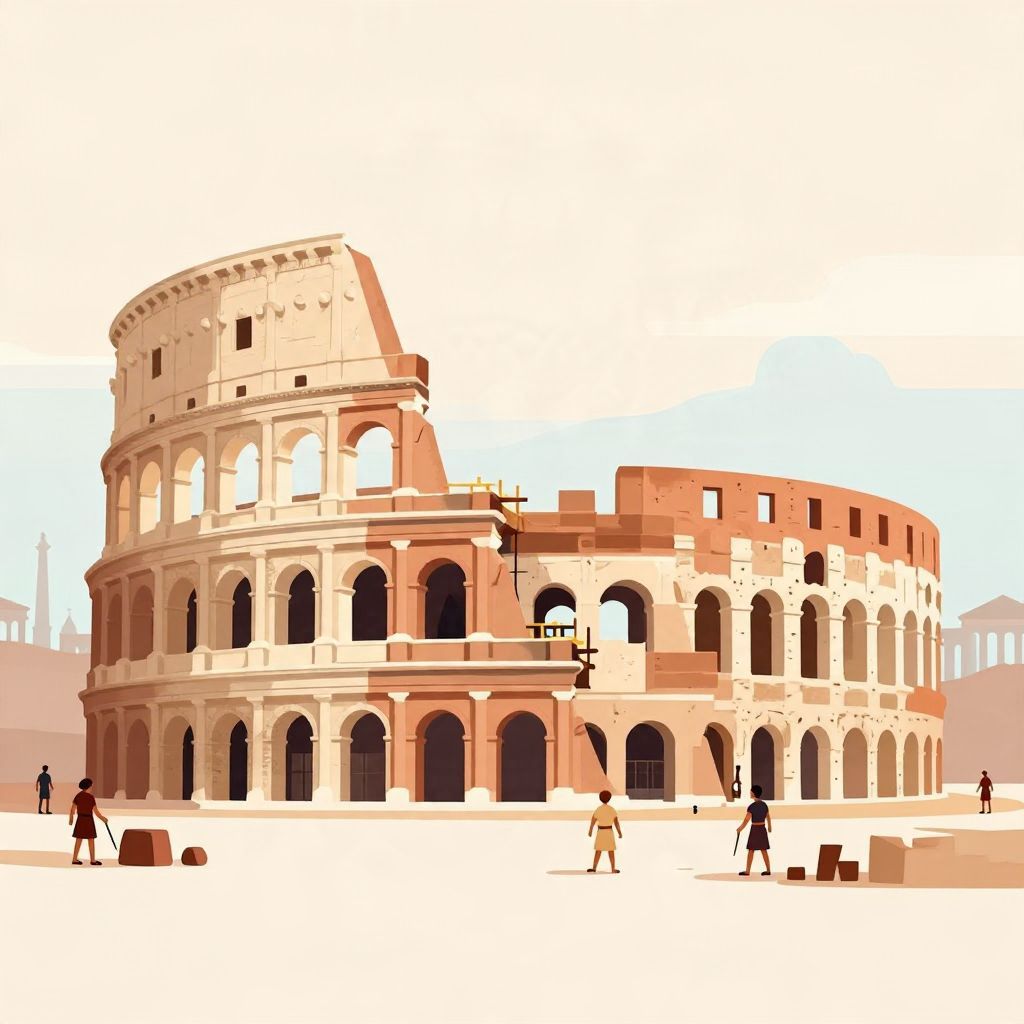
How long did it take to build the Colosseum? The short answer is about eight years, from roughly AD 72 to AD 80. Built under the emperors Vespasian and Titus, the amphitheater rose quickly by Roman standards, though finishing work likely continued after the official opening.
The Colosseum was not just a building project; it was a political statement, a public entertainment venue, and a symbol of imperial power in the heart of Rome. Its fast construction reflected both Roman engineering skill and the Flavian dynasty’s desire to win public support after a period of civil war.
How long did it take to build the Colosseum?
The Colosseum took about 8 years to build, beginning around AD 72 and opening in AD 80. Most historians place the start under Vespasian and the dedication under Titus. Some decorative and structural details may have been completed afterward, but the main amphitheater was essentially finished by the opening ceremonies.
The origins of the Colosseum
The Colosseum’s story begins with the turmoil of the Year of the Four Emperors in AD 69, when Rome was shaken by civil war and rapid changes in leadership. Vespasian, founder of the Flavian dynasty, came to power after that instability and sought to present himself as a restorer of order. One of his most visible projects was a massive public amphitheater for the Roman people.
Why build it there?
The site chosen for the Colosseum was politically meaningful. It stood on land that had been part of Nero’s Domus Aurea, the extravagant imperial palace complex built after the great fire of AD 64. By reclaiming this space for public use, Vespasian signaled a break from Nero’s private luxury and a return of the city to its citizens.
That choice was symbolic as well as practical. The location was central, visible, and tied to imperial authority. Building a great amphitheater there allowed the new regime to advertise generosity, legitimacy, and control.
The construction timeline
The building process moved remarkably fast, especially given the size of the structure. Roman builders used a highly organized labor force, advanced engineering methods, and materials that allowed construction to proceed efficiently. While exact month-by-month records do not survive, the broad timeline is well established.
Key stages of construction
- AD 72 — Construction begins under Vespasian.
- AD 72–79 — The main structure rises, including the outer shell, seating tiers, and major internal systems.
- AD 79 — Vespasian dies; Titus continues the project.
- AD 80 — The Colosseum is inaugurated with games and public spectacles.
- After AD 80 — Additional finishing work and later modifications continue over time.
The opening in AD 80 is often treated as the completion date, but ancient monumental buildings were sometimes used before every last detail was finished. In the Colosseum’s case, the basic amphitheater was ready for public events, even if some elements were still being refined.
Who built the Colosseum?
The Colosseum was built by Roman engineers, architects, craftsmen, and a large labor force coordinated by the imperial administration. Ancient sources do not give a full roster of builders, and modern scholarship cannot name most of the workers involved. What is clear is that the project depended on Roman state power and extensive technical expertise.
Materials and methods
Roman builders combined travertine stone, tuff, brick-faced concrete, and iron clamps to create a durable and flexible structure. The use of concrete and standardized construction techniques helped speed the work. The amphitheater’s arches, vaults, and corridors also made it possible to move large numbers of people efficiently, both during construction and later during events.
Labor likely included skilled specialists as well as unskilled workers. Some of the workforce may have included enslaved people, prisoners, and paid laborers, though the exact breakdown is not known. What matters historically is that the project reflects the scale and organization of the Roman imperial system.
Why did it take only eight years?
Eight years is a short time for a structure of this size, but Roman construction could move quickly when the state prioritized a project. The Colosseum benefited from imperial funding, a highly developed building tradition, and a clear political purpose. It was not a private undertaking; it was a public monument backed by the empire itself.
Reasons for the rapid pace
- Imperial financing provided steady resources.
- Standardized Roman building techniques reduced delays.
- Large-scale labor organization allowed multiple tasks at once.
- Political urgency pushed the Flavians to complete the project quickly.
The speed of construction also made sense politically. Public games and spectacles were a way to build loyalty, and the new dynasty needed visible achievements. The amphitheater became a tool of legitimacy as much as a venue for entertainment.
What happened at the opening?
The Colosseum opened in AD 80 under Titus with elaborate games that reportedly lasted for many days. Ancient writers describe gladiatorial contests, animal hunts, and other spectacles, though the precise details of the festivities are not always consistent across sources. The important point is that the opening was designed as a grand public celebration of imperial generosity.
These games were not just entertainment. They reinforced social hierarchy, displayed imperial wealth, and connected the emperor to the Roman people. In that sense, the opening of the Colosseum was as political as it was cultural.
Was the Colosseum really finished in AD 80?
That depends on what “finished” means. The amphitheater was sufficiently complete for public use by AD 80, but monumental buildings often continued to receive additions, repairs, and decorative work after inauguration. Later emperors, especially Domitian, made further changes to the complex.
Understanding ancient building completion
For Roman monuments, inauguration and final completion were not always the same thing. A building could be opened to the public while artisans were still refining details or adding features. So the best historical answer is that the Colosseum was built in about eight years and inaugurated in AD 80, with later modifications continuing afterward.
The Colosseum’s historical significance
The Colosseum is significant not only because of its size, but because it reveals how Rome projected power. It combined engineering, spectacle, and politics in one immense public space. As an amphitheater, it became one of the most recognizable symbols of ancient Rome and of the empire’s ability to mobilize resources on a huge scale.
What the Colosseum tells us about Rome
- Rome could organize labor and materials on an extraordinary scale.
- Emperors used architecture to shape public opinion.
- Entertainment was closely tied to politics and social control.
- Public monuments could signal a new regime’s legitimacy.
The building also reflects the Flavian effort to redefine Rome after civil conflict. Where Nero had built for personal display, the Flavians built for public use. That contrast helped the dynasty present itself as practical, restorative, and aligned with the wider citizen body.
How the Colosseum fits into Roman history
The Colosseum was part of a broader Roman tradition of amphitheaters, but it was larger and more ambitious than most. Its construction marked a high point in imperial urbanism, when architecture was used to shape civic life and imperial identity. Over time, the arena would witness changing forms of entertainment, shifting political power, and the long transformation of Rome itself.
Even after antiquity, the Colosseum remained a powerful historical symbol. Earthquakes, stone removal, and centuries of reuse altered its appearance, yet its core structure survived. That survival is one reason it remains such an important link to the ancient world.
So, how long did it take to build the Colosseum?
The best historical answer is that the Colosseum took about eight years to build, from AD 72 to AD 80. It was begun by Vespasian, opened by Titus, and later modified by subsequent emperors. Its rapid construction shows how Roman engineering and imperial ambition worked together to create one of the ancient world’s most enduring monuments.
If you want to explore more, you may also be interested in how old the Colosseum is and how long it took to build Rome.