
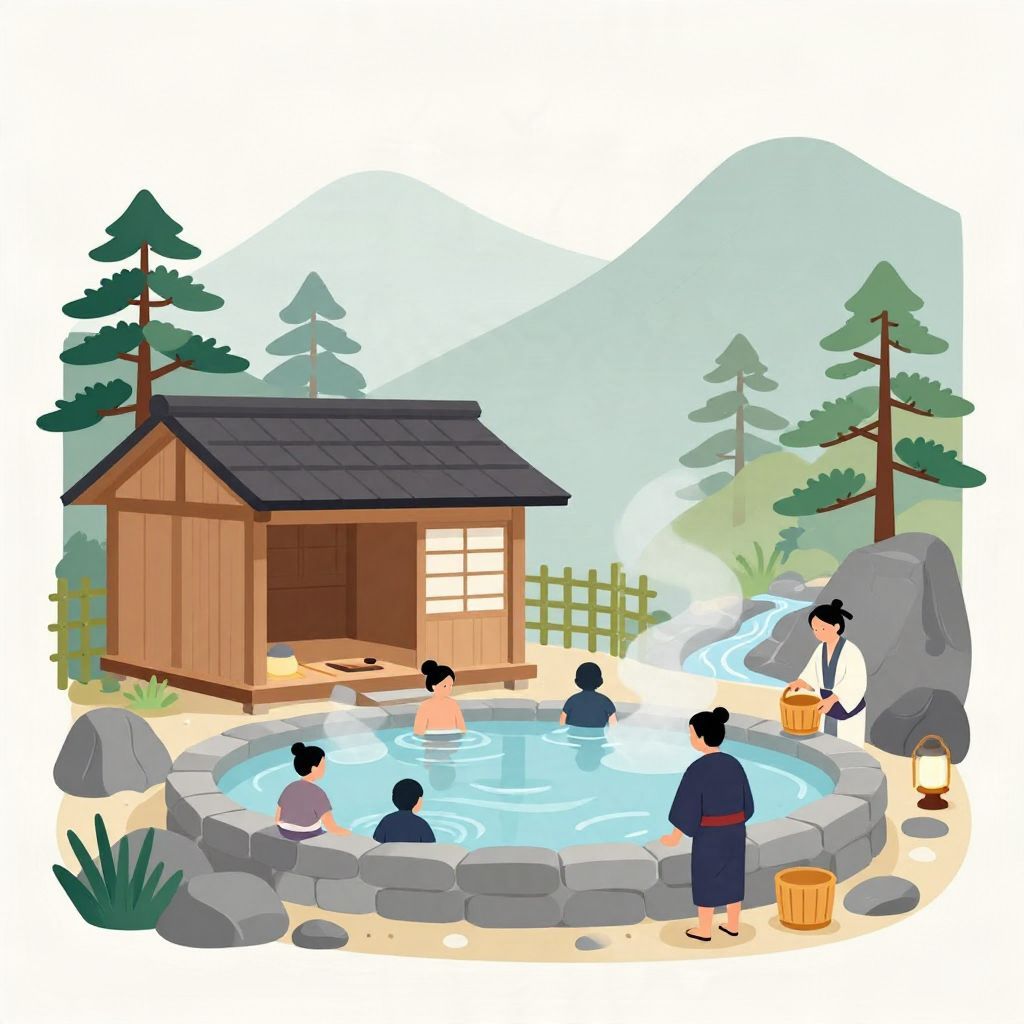
What is onsen in Japan? In the simplest sense, an onsen is a natural hot spring, and by extension the bathing culture built around those mineral-rich waters. But onsen are more than a place to wash: they are a long-lived Japanese tradition shaped by geology, religion, medicine, travel, and leisure.
The history of onsen reaches back centuries, with roots in both practical bathing and sacred landscapes. Over time, hot springs became associated with healing, pilgrimage, and regional identity, eventually evolving into one of Japan’s best-known cultural experiences.
What Is Onsen in Japan?
An onsen is a natural hot spring in Japan, usually defined by water heated geothermally and containing certain minerals. The word can refer to the spring itself, the bath facilities that use it, or the broader custom of soaking in hot spring water. Historically, onsen have been valued for relaxation, health, and spiritual purification.
The Origins of Onsen in Japanese History
Japan’s onsen culture developed because the country sits on a volcanically active archipelago with abundant geothermal activity. Hot springs were known long before modern tourism, and many early communities likely used them for warmth, washing, and relief from pain. Written evidence appears later, but the practice itself is much older than the surviving records.
Early references and ancient beliefs
Classical Japanese texts from the 8th century already mention hot springs, showing that they were important by the Nara period. In early Japan, natural features such as mountains, springs, and waterfalls were often understood through religious ideas. Hot springs could be seen as places where the sacred and the healing met, especially in traditions influenced by Shinto and Buddhism.
At this stage, onsen were not simply recreational baths. They were part of a worldview in which nature held spiritual power. Water that emerged from the earth was especially significant because it seemed to come from hidden, life-giving forces beneath the surface.
Legends versus history
Many Japanese hot springs are associated with legends about emperors, monks, or miraculous cures. These stories are important as cultural memory, but they should not be treated as straightforward historical fact. In many cases, the legend was created or expanded later to give a spring prestige, attract visitors, or connect the site to a respected religious or political figure.
That does not make the stories meaningless. Instead, they reveal how people understood onsen: as places of restoration, legitimacy, and local pride. The line between folklore and history is especially important in onsen culture, where reputation has long mattered.
Why Onsen Became Important in Japan
Onsen became important because they combined practical use with symbolic meaning. Their warm water offered comfort in cold seasons, and mineral baths were widely believed to help with fatigue or illness. Just as importantly, onsen fit into Japanese religious and social life as places of cleansing, retreat, and communal gathering.
Healing and medicine
For much of Japanese history, hot springs were linked to therapeutic benefits. People visited them for aches, skin conditions, exhaustion, and recovery after travel or labor. Traditional medicine did not always separate physical and spiritual healing, so bathing in mineral water could be understood as both bodily treatment and purification.
Modern science does not confirm every traditional claim made about onsen, and different springs have different mineral compositions. Still, the association between hot springs and wellness has been central for centuries. This is one reason onsen remained popular even as Japan modernized.
Purification and religion
Bathing has long been tied to purification in Japanese culture. In religious terms, water could remove impurity and restore balance. While onsen were not the same as ritual ablution, they shared this wider cultural logic. A hot spring was not just a luxury; it was a place where the body and spirit could be renewed.
Onsen in the Medieval and Early Modern Periods
During the medieval period, hot springs became more closely tied to pilgrimage, temple networks, and regional travel. By the Edo period (1603–1868), onsen had become a familiar part of domestic tourism and local economies. Roads improved, travel expanded, and hot spring towns grew into destinations for rest and sociability.
Travel culture in the Edo period
The Tokugawa shogunate restricted some forms of movement, but it also helped create a stable society in which travel for pilgrimage, commerce, and leisure became more common. Famous hot springs attracted samurai, merchants, pilgrims, and commoners alike. Guidebooks and travel culture helped spread the reputation of particular springs far beyond their immediate regions.
In this period, onsen were no longer only about healing. They became places to escape daily routine, enjoy scenic surroundings, and participate in a shared culture of travel. Inns and bathhouses developed around the springs, turning some locations into thriving resort towns.
Regional identity and famous springs
Many of Japan’s best-known onsen towns rose to prominence because they offered more than hot water. They had temples, mountain scenery, seasonal beauty, or a reputation for effective waters. Over time, specific springs became associated with local specialties and distinctive atmospheres, helping create the idea that each onsen has its own character.
This regional diversity remains one of the defining features of Japanese hot spring culture. Unlike a single standardized bathing tradition, onsen developed as a network of local places with different histories and meanings.
How Onsen Changed in the Modern Era
From the late 19th century onward, onsen were reshaped by modernization, transportation, public health ideas, and tourism. Railways made it easier to reach remote hot spring towns, and new forms of accommodation turned many onsen areas into organized resorts. At the same time, the government and medical professionals became more interested in regulating bathing and defining what counted as a legitimate hot spring.
Meiji-era modernization
In the Meiji period (1868–1912), Japan rapidly adopted new institutions and technologies. Onsen were not abandoned; instead, they were reframed in modern terms. Some were promoted for health and recreation, while others were developed as tourist destinations for a growing urban population. The old association with healing remained, but it was now often expressed through modern language and infrastructure.
This period also saw greater attention to classification. In modern Japan, an onsen is generally defined by legal and geological criteria, not just by local custom. That distinction matters because not every bath using heated water qualifies as a true onsen.
From local retreat to national culture
By the 20th century, onsen had become one of the most recognizable parts of Japanese domestic leisure. Families traveled to hot spring towns for holidays, company groups used them for retreats, and regional tourism campaigns promoted them as symbols of relaxation and hospitality. Television, rail travel, and guidebooks further strengthened the image of the onsen as a distinctly Japanese experience.
What Makes an Onsen an Onsen?
In modern Japan, an onsen is not just any bath with hot water. It usually refers to water that emerges naturally from underground and meets specific temperature or mineral standards. This legal distinction helps separate onsen from heated tap-water baths, public sentō, and other bathing facilities.
Natural water and mineral content
Japanese law has historically defined hot springs by measurable characteristics such as temperature and dissolved minerals. This means that an onsen is tied to geology as much as culture. The water may be clear, cloudy, sulfurous, salty, or iron-rich, and these differences shape both the appearance and the reputation of each spring.
Because of this, the word onsen can describe a wide range of experiences. Some springs are rustic and outdoor, while others are part of large modern resorts. Some are famous for dramatic scenery, while others are valued for quiet, local use.
Bathing customs and etiquette
Onsen culture also includes social rules. Bathers typically wash before entering the communal bath, enter nude in gender-separated spaces, and speak quietly to preserve a relaxed atmosphere. These customs are not ancient in exactly the same form everywhere, but they reflect long-standing Japanese ideas about cleanliness, shared space, and respect for others.
For visitors, these rules can feel unfamiliar, but they are part of what makes onsen historically distinctive. The bath is not only about the water; it is also about behavior, atmosphere, and social order.
Onsen, Tourism, and the Japanese Imagination
Today, onsen are both a living tradition and a major part of Japan’s tourism industry. They appear in literature, film, travel writing, and regional branding. Yet their popularity is not merely modern marketing. It rests on a long history in which hot springs were linked to health, landscape, and escape from ordinary life.
Why onsen still matter
Onsen continue to matter because they connect several layers of Japanese history at once. They preserve older ideas about purification and healing, reflect the development of travel and leisure, and showcase the country’s volcanic geography. They also remain socially meaningful as places where people slow down, share space, and step outside daily routine.
In that sense, onsen are not just historical relics. They are a tradition that has adapted across centuries while keeping a recognizable core.
The Historical Meaning of Onsen in Japan
Historically, onsen in Japan have meant far more than “hot spring.” They represent a meeting point between nature and culture, religion and medicine, local identity and national tourism. Their history shows how a natural resource can become a lasting social institution through custom, belief, and adaptation.
So, when people ask what onsen is in Japan, the most accurate answer is this: it is a natural hot spring tradition that has grown over centuries into a distinctive part of Japanese life, shaped by geology, spirituality, healing practices, and travel culture. For readers interested in broader Japanese cultural history, the story of onsen offers a clear example of how everyday practices can carry deep historical meaning.