
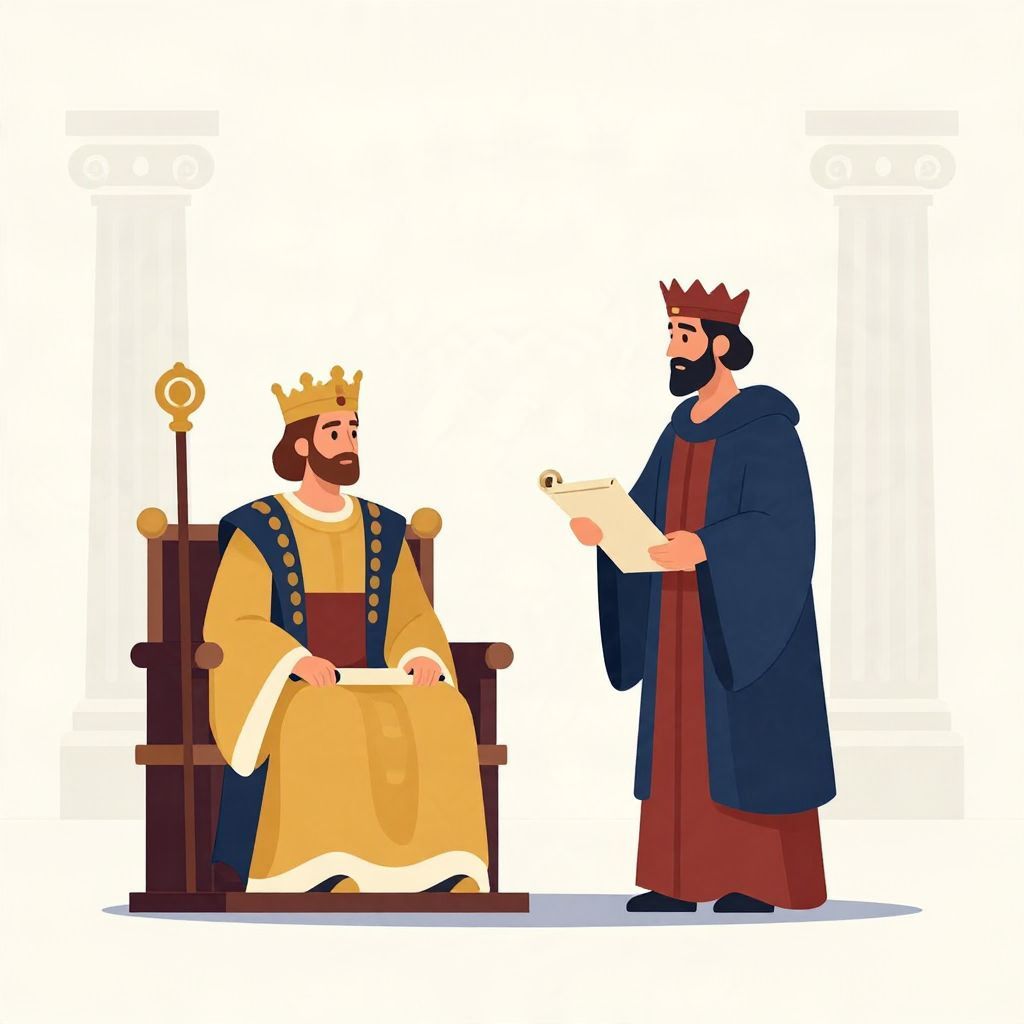
What is a royal advisor? In history, a royal advisor was a trusted person who helped a king, queen, emperor, or other ruler make decisions. Advisors could be nobles, clergy, scholars, military leaders, or household officials, depending on the time and place. Their influence ranged from informal counsel to real political power.
Because monarchies lasted for thousands of years across many cultures, the role of a royal advisor changed a great deal. Sometimes advisors simply offered guidance; at other times they shaped policy, controlled access to the ruler, or even governed in the ruler’s name.
What Is a Royal Advisor?
A royal advisor is someone appointed or accepted to counsel a monarch on government, war, diplomacy, law, religion, finance, or court affairs. The title was not always fixed: in many societies, the role was defined by function rather than by a single official office. A royal advisor could be powerful, temporary, or purely ceremonial.
The Origins of Royal Advisors in Ancient Monarchies
Royal advising is as old as monarchy itself. Once rulers accumulated land, tribute, and military power, they needed people to interpret laws, manage resources, negotiate with rivals, and help maintain authority. Early kingdoms in Mesopotamia, Egypt, China, India, and the Mediterranean all developed court circles of counselors around the throne.
Ancient courts and early counsel
In ancient Egypt, pharaohs relied on viziers and senior officials to administer the state. In Mesopotamian kingdoms, scribes and high-ranking administrators helped manage taxation and diplomacy. In imperial China, emperors depended on scholar-officials and ministers, especially as bureaucratic systems became more formalized. These were not always called “royal advisors” in modern English, but they performed that role.
Why rulers needed advisors
- To gather information from across a kingdom
- To manage taxes, food supplies, and records
- To advise on war, peace, and alliances
- To interpret law, custom, and religious duty
- To help rulers project legitimacy and authority
How Royal Advisors Worked in Medieval Europe
In medieval Europe, royal advisors became especially important because kings often ruled through a mix of personal authority, noble support, and church influence. The monarch’s household, council, and court were central political spaces. Advisors might include bishops, earls, legal experts, household officers, and trusted favorites who had the ruler’s ear.
The king’s council
Many medieval rulers governed with a council of leading men. In England, for example, the royal council evolved over time and helped shape later institutions such as Parliament and the privy council. In France and other kingdoms, councils also advised on administration and justice. The exact makeup of these bodies changed with the strength of the monarchy and the political culture of each realm.
Churchmen as advisors
Clergy were often among the most educated people in medieval Europe, so bishops and abbots frequently served as royal advisors. They could read Latin, draft letters, manage archives, and understand canon law. Their influence was not purely spiritual: churchmen could help legitimize a ruler, negotiate with the papacy, or advise on succession and marriage.
Royal Advisors and the Power of the Court
Courts were not just palaces; they were political systems. Access to the monarch mattered enormously, and royal advisors could become gatekeepers. A person who controlled audiences, carried messages, or filtered petitions might wield influence far beyond their formal title. In some kingdoms, this made the advisor almost as important as the ruler.
Favorites, ministers, and counselors
Historians often distinguish between different kinds of court figures. A “counselor” offered advice, a “minister” carried out policy, and a “favorite” gained influence through personal closeness to the monarch. These categories often overlapped. A favorite might become a minister, while a minister might be dismissed if the ruler lost trust in them.
When advisors became too powerful
Royal advisors were sometimes resented by nobles, courtiers, or the public. If a king seemed to rely too much on one person, critics might accuse that advisor of manipulating the throne. This tension appears repeatedly in history, from medieval courts to early modern monarchies. In some cases, such figures were removed, exiled, or executed when political winds changed.
Famous Types of Royal Advisors Across History
Although the exact title varied, several kinds of royal advisors appear again and again in world history. Their roles reveal how monarchy depended on specialized knowledge and personal trust.
Viziers and chief ministers
In Islamic and other court traditions, the vizier was often a top minister who assisted the ruler in administration and policy. The office could be highly powerful, especially in large empires where the monarch could not oversee everything personally. Viziers helped coordinate officials, military matters, and provincial administration.
Scholars and legal experts
Some rulers relied on learned advisors to interpret religious law, customary law, or state regulations. In many societies, legal expertise was essential because the ruler’s decisions had to appear just and legitimate. Scholars could also help produce chronicles, genealogies, and official ideology that supported royal authority.
Military advisors
In wartime, generals and commanders often became key royal advisors. A monarch needed counsel on strategy, fortifications, recruitment, and diplomacy. Military advice could determine the survival of a dynasty, especially in eras when succession crises and foreign invasion were common.
Queens, consorts, and female influence
Royal advising was not limited to men. Queens, queens consort, regents, mothers of rulers, and female courtiers could all shape policy behind the scenes or in formal roles. Their influence depended on local custom, dynastic politics, and the ruler’s trust. In some courts, women acted as major political intermediaries even if they did not hold office in the modern sense.
What Royal Advisors Did Day to Day
The daily work of a royal advisor depended on the era, but it often involved reading reports, attending audiences, drafting letters, receiving petitions, and discussing policy with the ruler. Advisors might travel with the court, supervise officials, or represent the monarch in negotiations. Their work was part administration, part politics, and part performance.
Typical responsibilities
- Advising on domestic and foreign policy
- Managing communication between ruler and subjects
- Helping organize ceremonies and court protocol
- Supervising finance, justice, or military affairs
- Protecting the ruler’s image and legitimacy
Royal Advisors in Early Modern States
From roughly the 15th to 18th centuries, many monarchies became more centralized. As states grew larger and more bureaucratic, royal advisors increasingly became ministers, secretaries, and councilors with specialized departments. This was true in France, Spain, England, the Ottoman Empire, Mughal India, and elsewhere, though each system developed differently.
From court influence to state administration
As governments expanded, rulers needed more than personal favorites. They needed people who could handle taxation, naval power, colonial administration, and international diplomacy. This helped transform the royal advisor from a court insider into a more formal state official. In some monarchies, this shift laid the groundwork for modern cabinets and ministries.
Absolute monarchy and controlled access
Under stronger forms of monarchy, advisors were often selected to strengthen the ruler’s control rather than to represent noble interests. Yet even in “absolute” systems, monarchs still depended on trusted counselors. Absolute rule did not eliminate advice; it concentrated it more tightly around the sovereign.
How the Role Changed in the Modern Era
As constitutional monarchy spread in the 18th, 19th, and 20th centuries, the political power of royal advisors generally declined in countries where elected governments took over real executive authority. Monarchs still retained private secretaries, household officials, and ceremonial advisers, but these figures usually no longer governed the state directly.
Modern royal households
Today, in monarchies that still exist, royal advisors may help with public engagements, constitutional etiquette, charitable work, and communication. Their role is often administrative and ceremonial rather than political. In constitutional systems, ministers answer to parliament or the government, not to the monarch’s personal circle.
Common Misconceptions About Royal Advisors
Popular stories often portray royal advisors as either sinister manipulators or wise sages. The historical reality was usually more complicated. Advisors were shaped by institutions, rival factions, patronage, and the personality of the ruler. Few had unlimited power, and many served under constant pressure.
They were not always “secret rulers”
Some advisors did dominate policy, but many were constrained by law, custom, noble opposition, or the monarch’s own judgment. Influence was real, but it was rarely absolute. A royal advisor’s power could rise quickly and disappear just as fast.
The term is broad
“Royal advisor” is a useful modern phrase, but it can blur important differences between ministers, counselors, household officers, regents, and favorites. To understand any specific case, historians look at the exact court system, period, and political context.
Why Royal Advisors Matter in History
Royal advisors matter because they show how monarchy actually worked. Kings and queens did not rule alone, even when ideology claimed they did. Behind every throne stood networks of counsel, information, and administration. Studying advisors reveals how power moved through courts, households, and state institutions.
In the broad sweep of history, the royal advisor was both practical and political: a helper to the ruler, a broker of influence, and sometimes a maker of policy in their own right. If you want to explore related court roles, see what is a royal title and what are ladies in waiting.