
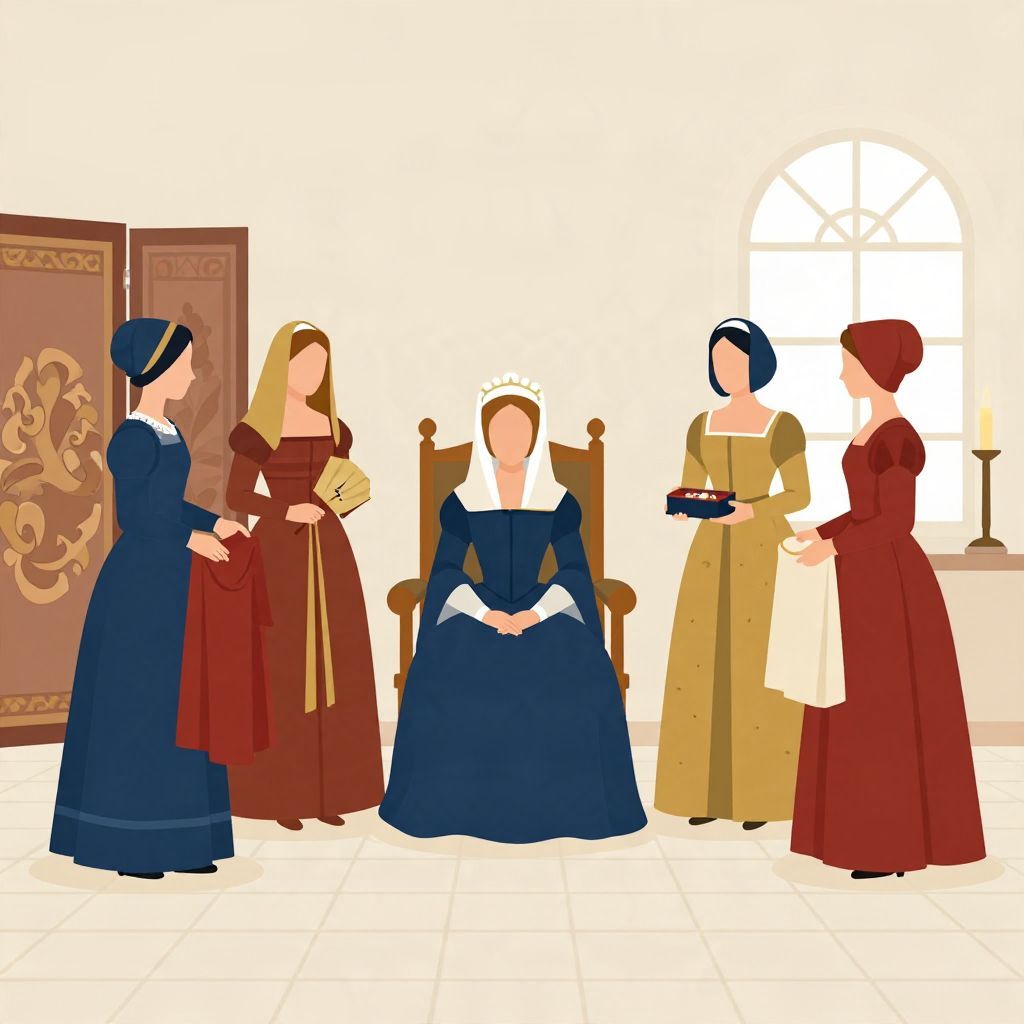
“Ladies in waiting” were women who attended a queen, princess, or other high-ranking noblewoman in a royal or aristocratic household. They were not simply servants in the modern sense. In many courts, they were companions, attendants, and political observers whose daily presence reflected both rank and power.
The role changed over time and from one kingdom to another, but it was a familiar feature of European court life for centuries. Understanding ladies in waiting helps explain how royal households worked, how women participated in politics, and how status was displayed through ceremony and personal service.
What are ladies in waiting?
Ladies in waiting were women of gentle birth who served and accompanied a queen or other elite woman at court. Their duties could include dressing their mistress, keeping her company, assisting at ceremonies, relaying messages, and helping manage the social life of the household. In some courts, they also influenced politics through access and conversation.
Where did ladies in waiting come from?
The office grew out of medieval and early modern court culture, when rulers maintained large households filled with attendants, advisors, and ceremonial officers. Women of rank were expected to have female companions and attendants of their own. By the later Middle Ages, especially in European monarchies, this arrangement had become a formal part of court life.
From household service to court office
In early medieval households, elite women were often served by women from their own kin groups or local noble families. Over time, these arrangements became more structured. Courts in England, France, Spain, Scotland, and elsewhere developed hierarchies of female attendants, with titles and duties that varied by place and period.
Why noble birth mattered
Unlike ordinary domestic servants, ladies in waiting were often chosen from noble or gentry families. Their social standing made them suitable companions for a queen or princess. Their presence also helped reinforce rank: a ruler’s household was meant to display dignity, lineage, and order, not just practical service.
What did ladies in waiting do?
Their work combined personal service, companionship, and ceremonial duty. Some tasks were intimate and routine, while others were highly visible at court. The exact role depended on the age, status, and temperament of the woman they served, as well as the customs of the court itself.
Common duties
- Assisting with clothing, jewelry, and grooming
- Accompanying their mistress in public and private
- Helping during travel, audiences, and religious ceremonies
- Reading, writing, or delivering messages when needed
- Providing companionship, conversation, and entertainment
- Serving as social intermediaries between court factions and family networks
More than servants
Because they were often close to powerful women, ladies in waiting could become trusted confidantes. Some managed access to the queen, filtered petitions, or passed along information. In politically tense courts, this proximity could make them influential, even when they held no formal governing office.
Were ladies in waiting powerful?
Sometimes, yes—but usually indirectly. Their influence came from access rather than official authority. A lady in waiting might shape who could speak to a queen, what news she heard, or how she interpreted events. In a world where personal relationships mattered deeply, that access could be politically significant.
Access as power
Courts were places where favor mattered. A woman who spent hours in the queen’s chamber might learn private concerns before anyone else. She could advocate for relatives, support a faction, or help shape patronage. At the same time, her position was dependent on trust and could be lost quickly if she fell out of favor.
Limits on their authority
Despite their visibility, ladies in waiting did not usually command armies, make policy, or hold independent office in the modern sense. Their influence was personal, social, and often fragile. It depended on the status of the woman they served and on the rules of the court.
How were ladies in waiting different from maids or servants?
The distinction was mainly one of rank and function. Maids and household servants usually performed laboring or domestic work and came from lower social backgrounds. Ladies in waiting were typically gentlewomen or noblewomen whose service was considered honorable and compatible with elite status.
Service and status together
In aristocratic society, service did not always mean low status. For a noblewoman, attendance at court could be a career path, a social opportunity, or a family strategy. Serving a queen might help maintain family connections, improve marriage prospects, or secure patronage for relatives.
How did the role vary across history?
The title “lady in waiting” is most associated with European monarchies, especially from the late medieval period through the nineteenth century. But similar female attendants existed in many royal and imperial courts around the world, even when the exact title or structure differed.
Medieval and early modern Europe
In England and France, queens commonly had households of female attendants organized by rank. Some were unmarried daughters of noble families; others were widows or married women who served part-time or in rotation. Their work was shaped by ceremony, religion, and the politics of dynastic marriage.
Courts beyond England
In Spain, the Habsburg court developed especially elaborate female household structures. In Scotland, ladies in waiting were part of the queen’s household and could play important roles in dynastic and factional politics. Similar systems existed elsewhere in Europe, though the names and ranks differed.
Non-European parallels
Many royal courts outside Europe also had female attendants, companions, and chamber women. In imperial China, for example, palace women formed complex hierarchies. In the Ottoman world, women in the imperial household also occupied structured roles. The specific institution of “ladies in waiting” is European in name, but the broader idea of elite female attendants is much wider.
Why were ladies in waiting important in royal courts?
They helped make monarchy function on a daily level. Courts were not just political centers; they were households that had to be fed, dressed, organized, and ceremonially presented to the public. Ladies in waiting helped sustain the image and routine of female royal authority.
They supported queenship
A queen’s household was a public expression of her rank. Female attendants helped create the proper atmosphere around her person, especially in contexts where gender norms limited public contact between men and women. Their presence also made it possible for a queen to move through court life with dignity and privacy.
They connected families to power
For noble families, placing a daughter at court could be a way to strengthen ties to the monarchy. A successful placement might lead to patronage, marriage opportunities, or advancement for brothers and fathers. Thus, ladies in waiting were often part of broader family strategies, not just individual careers.
Did all ladies in waiting live glamorous lives?
No. Court life could be privileged, but it was also demanding, competitive, and uncertain. A lady in waiting might enjoy fine clothing, access to elite spaces, and proximity to rank. She might also face long hours, strict etiquette, gossip, rivalry, and the risk of losing favor.
The pressures of court culture
Courts were highly political environments. Small mistakes could be noticed, and personal relationships could shift quickly. A lady in waiting needed discretion, social skill, and adaptability. Her reputation mattered, especially if marriage, inheritance, or family honor depended on her conduct.
Marriage, widowhood, and service
Some ladies in waiting served only while unmarried. Others continued after marriage, especially if their husbands were also at court or if their mistress valued them highly. Widows sometimes remained in service because court employment offered security, status, and a place within elite society.
What happened to ladies in waiting over time?
The role declined as courts changed. By the nineteenth and twentieth centuries, monarchies became less centered on large personal households, and aristocratic service became less politically significant. Some royal households still retain ladies in waiting today, but the role is often more ceremonial than it once was.
From political household to ceremonial tradition
As modern states developed bureaucracies and public institutions, the old court household lost much of its governing importance. Yet the title survived because monarchy itself remained symbolic. Ladies in waiting continued to represent continuity, tradition, and personal service to the crown.
Why does the term still matter today?
“Ladies in waiting” is more than a decorative phrase. It reveals how status, gender, and power worked in premodern societies. The term shows that women at court were not merely background figures; they were part of the machinery of monarchy, ceremony, and patronage.
In short, ladies in waiting were elite female attendants whose role combined service, companionship, and occasional influence. They were central to court culture for centuries, and their history offers a window into how monarchy operated behind the scenes. For related court and household roles, see what a eunuch was in historical courts and how historical service roles shaped trade and empire.