
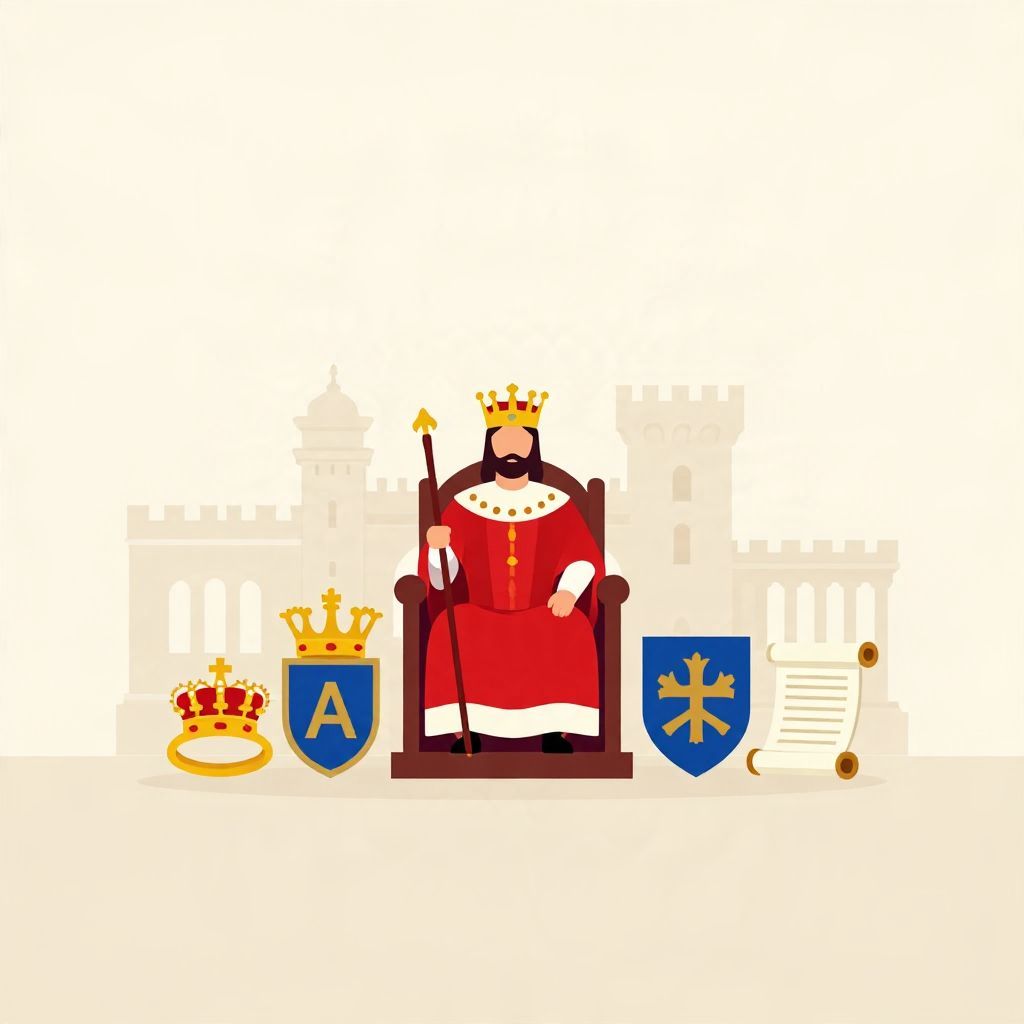
A royal title is a formal rank or style used for members of a monarchy, such as king, queen, prince, princess, duke, or duchess. It marks a person’s place within a royal family or ruling hierarchy and often signals legal authority, inherited status, or ceremonial honor.
Royal titles have changed across time and place, but they have always helped define power. In some societies, they identified the sovereign ruler; in others, they marked relatives of the ruler, nobles, or honored consorts. Their meaning depends on the history of monarchy itself.
What Is a Royal Title?
A royal title is an official designation connected to royalty and monarchy. It can indicate the reigning monarch, a close family member, or a noble rank granted by the crown. Historically, royal titles were not just honorifics; they often carried legal rights, political authority, landholding privileges, and duties tied to governance and ceremony.
Where Did Royal Titles Come From?
Royal titles emerged in the earliest states, when rulers needed recognized words for authority. In ancient Egypt, Mesopotamia, China, and later Greece and Rome, titles such as “king,” “queen,” “emperor,” and “prince” developed from words meaning ruler, lord, or first among others. These titles reflected the growth of centralized power, dynastic succession, and sacred kingship.
Ancient roots of royal language
Many royal titles began as practical descriptions of leadership. A king was often simply the chief ruler of a people or territory. Over time, titles became more formal and hereditary. In some cultures, the ruler was seen as chosen by the gods; in others, the title expressed military dominance, lineage, or control over land and tribute.
From ruler to dynasty
As monarchies became hereditary, titles helped distinguish the sovereign from relatives and officials. A royal family needed terms for heirs, spouses, younger children, and cadet branches. This is one reason why the vocabulary of royalty expanded in medieval Europe and in many non-European courts as states became more complex.
What Does a Royal Title Mean in History?
Historically, a royal title meant more than social prestige. It usually signaled a person’s place in the political order. The title could indicate who had the right to rule, who might inherit the throne, and who held ceremonial precedence. In some cases, it also granted real power over courts, armies, taxes, or territories.
Authority, inheritance, and legitimacy
The most important function of a royal title was legitimacy. A monarch’s title told subjects and rivals that this person had a recognized claim to rule. Inheritance laws, marriage alliances, religious rituals, and public ceremonies all reinforced that claim. When succession was disputed, the title itself could become the focus of war or rebellion.
Ceremonial meaning
Royal titles also shaped court culture. They determined how people were addressed, where they sat, what they wore, and how they appeared in processions. Even when a title no longer carried direct governing power, it could remain highly symbolic, preserving continuity with the past.
How Royal Titles Developed in Europe
In Europe, royal titles took shape from late antiquity through the Middle Ages as Roman institutions gave way to Germanic kingdoms, Christian monarchies, and feudal societies. Titles such as king and queen became standard for sovereigns, while prince, princess, duke, and duchess identified members of ruling houses and high nobility.
Kings and queens
The terms “king” and “queen” are among the oldest royal titles in European history. A king was the male sovereign of a kingdom, while a queen could be a reigning monarch in her own right or the wife of a king. The distinction mattered greatly in law and politics, especially where succession through women was accepted only under certain conditions.
Princes, princesses, dukes, and duchesses
“Prince” originally meant a leading person or first-ranking ruler, but in many monarchies it came to mean the child or close relative of a sovereign. “Duke” and “duchess” were noble titles associated with major territorial authority, especially in medieval Europe. In some countries, dukes were powerful regional rulers; in others, the title became largely ceremonial over time.
The role of the church and ceremony
Christian coronation rituals helped formalize royal titles in medieval Europe. Anointing, crowns, regalia, and oaths gave the monarch’s title sacred legitimacy. This did not eliminate political conflict, but it made royal rank appear divinely sanctioned and publicly recognizable.
How Did Royal Titles Work Outside Europe?
Royal titles were not exclusively European. Across Asia, Africa, the Middle East, and the Americas, rulers used titles that expressed sovereignty, sacred authority, and dynastic status. While the English words differ, the historical function was often similar: to identify legitimate rulers and their families within a political hierarchy.
Emperors, sultans, shahs, and pharaohs
Some titles denoted rulers above kings, especially in large multiethnic empires. “Emperor” became associated with supreme imperial authority in Rome, China, Japan, and elsewhere. “Sultan” and “shah” were used in Islamic and Persian political traditions, while “pharaoh” identified the ruler of ancient Egypt and carried strong religious meaning.
Local traditions and translated titles
When Europeans described non-European rulers, they often translated local titles into familiar terms like king or emperor. That practice can be misleading, because the original title may have had different religious, political, or cultural meanings. Historians therefore try to preserve the original title where possible rather than flattening it into a European equivalent.
Who Uses Royal Titles Today?
Today, royal titles remain in use in constitutional monarchies and surviving royal houses. In countries such as the United Kingdom, Spain, Sweden, Japan, Thailand, and several others, titles still identify the monarch and close members of the royal family. However, their political power is often limited compared with the past.
Modern constitutional monarchies
In modern constitutional monarchies, the sovereign usually reigns but does not rule in the old sense. The title still carries constitutional, ceremonial, and national significance, but elected governments handle day-to-day political power. Royal titles in these systems are often protected by law and tied to protocol, succession, and state symbolism.
Titles as social and diplomatic symbols
Royal titles continue to matter in diplomacy, public ceremony, and national identity. They can represent continuity, tradition, and state history. At the same time, modern societies often debate whether inherited titles still fit democratic values, which is why the role of royalty can be both admired and questioned.
How Are Royal Titles Different From Noble Titles?
Royal titles belong to the monarchy itself, while noble titles usually belong to the aristocracy below the sovereign. A king or queen is royal; a duke or duchess may be royal in some families but is often noble rather than sovereign. The exact ranking depends on the country’s traditions and laws.
A simple hierarchy
- Sovereign titles: king, queen, emperor, empress, sultan, shah, and similar ruling styles
- Dynastic titles: prince, princess, crown prince, heir apparent
- Noble titles: duke, duchess, earl, count, marquess, baron, and equivalents
This hierarchy is not universal, but it helps explain how royal and noble ranks were organized in many monarchies.
Why Did Royal Titles Matter So Much?
Royal titles mattered because they organized power in societies where personal allegiance, inheritance, and ceremony were central to government. A title could determine who inherited land, who commanded armies, who sat closest to the ruler, and who had the right to speak for the state. In times of crisis, the title itself could become the prize.
Titles and political conflict
Disputed titles often fueled civil wars, succession crises, and rival claims. If two people claimed the same throne, the question was not only who had the better army, but who had the legitimate title. This made royal language a political weapon as well as a symbol of continuity.
Titles and public memory
Even after monarchs lost direct power, their titles remained part of national memory. Royal styles appear in literature, law, architecture, and ritual. They remind us that monarchy was once a central framework for organizing states, identity, and authority.
What Is the Historical Legacy of Royal Titles?
The legacy of royal titles is the long history of monarchy itself. These titles show how societies defined power, succession, and status before modern democracy and bureaucracy. They also reveal how language can preserve political ideas long after the institutions behind them have changed.
So, what is a royal title? It is a formal rank connected to monarchy, but historically it is also a key to understanding how rulers legitimized power, how dynasties formed, and how states expressed hierarchy. If you want to explore related rank and regalia topics, see what a duchess is and what a diadem is.