
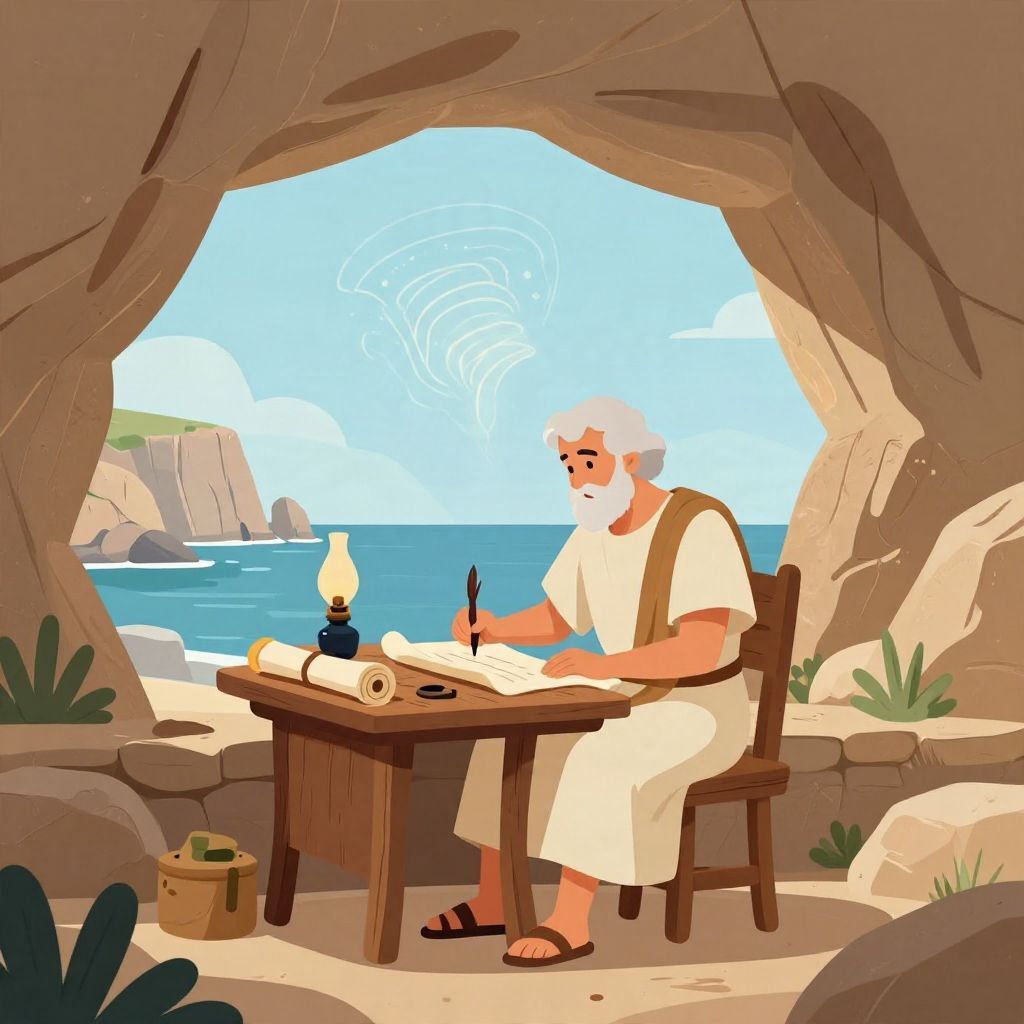
How old was John when he wrote Revelation? The honest historical answer is that we do not know his exact age. Most scholars believe the book of Revelation was written near the end of the reign of Emperor Domitian, around AD 95–96, when John was likely an older man, probably in his late 60s to 80s if he was the same John traditionally identified as the apostle.
That estimate is based on chronology, not on a surviving record of John’s birth date. Because the New Testament does not give his age, any precise number would be speculation. What historians can do is reconstruct the likely timeline of John’s life and explain why Revelation is usually dated to the final decade of the first century.
How old was John when he wrote Revelation?
John’s exact age is unknown, but if he was the apostle John, he was probably an elderly man when he wrote Revelation, most likely somewhere between his late 60s and 80s. The book is commonly dated to about AD 95–96, and John’s earlier ministry with Jesus would place him well into later life by then.
Why historians think Revelation was written late in John’s life
The traditional view places Revelation during the reign of Domitian, Roman emperor from AD 81 to 96. Early Christian writers such as Irenaeus associated the book with the end of Domitian’s reign, and that testimony strongly influenced later dating. If that chronology is correct, John would have been an old man by first-century standards.
The Domitian date in context
Roman rule in the eastern Mediterranean shaped the world of Revelation. The book speaks of persecution, imperial power, and pressure to remain loyal to Rome. Those themes fit the atmosphere of the late first century, when Christians in Asia Minor were living under a strong imperial cult and increasing social tension. That does not prove a specific age for John, but it supports the standard late date.
Could Revelation have been written earlier?
Some scholars argue for an earlier date, often during the reign of Nero in the 60s. This minority view usually depends on interpreting the book’s symbols in relation to the Jewish-Roman War and the destruction of Jerusalem in AD 70. If that dating were correct, John would have been younger—perhaps in his 50s or 60s—but the evidence remains debated rather than settled.
Who was John, and which John wrote Revelation?
The identity of the author is one of the major historical questions surrounding Revelation. The book names its writer simply as John, but it does not explicitly say “John the apostle.” Early Christian tradition often connected the text to the apostle John, one of Jesus’ twelve disciples, yet some scholars distinguish the author from the Gospel writer and from other early Christian leaders named John.
The traditional view: John the apostle
In the traditional Christian reading, the author is John the apostle, son of Zebedee. If so, he would have been a young adult during Jesus’ ministry in the 30s and an elderly church leader by the 90s. That makes an age range in the 70s or 80s plausible, though still approximate. Ancient authors rarely recorded exact birth years, especially for ordinary people.
Alternative scholarly views
Some historians believe Revelation was written by a different John, often called John of Patmos because the book says the author was on the island of Patmos when he received the vision. This view matters because it changes how we think about age: if the writer was not the apostle, his age could have been very different. The historical record does not allow a definitive answer.
What the timeline suggests about John’s age
Even without a birth date, a rough timeline helps explain why John is usually imagined as elderly when he wrote Revelation. If he was already an adult follower of Jesus in the 30s, then by the 90s he would have lived through decades of Christian mission, conflict, and Roman rule. That span strongly points to advanced age.
A simplified chronology
- c. AD 30–33: Jesus’ public ministry, death, and resurrection.
- c. AD 30s–60s: Early Christian expansion in the eastern Mediterranean.
- c. AD 64: Nero’s persecution of Christians in Rome after the Great Fire.
- c. AD 70: Destruction of Jerusalem by the Romans.
- AD 81–96: Reign of Domitian, the usual date range for Revelation.
- c. AD 95–96: Most common date for the writing of Revelation.
On that timeline, a man who had known Jesus in the 30s would almost certainly be elderly by the mid-90s. If John was in his early 20s during Jesus’ ministry, he would have been in his late 70s or early 80s when Revelation was written. If he was somewhat older at the time of Jesus, he could have been even older still.
Why John’s age is not recorded precisely
Ancient biographies often focused on public action, teaching, and religious significance rather than exact personal details. Birth records for most people in the Roman world were not preserved in a way that would let modern historians calculate someone’s age with confidence. For a figure like John, the sources preserve memory, tradition, and theology more than exact chronology.
What the sources do and do not tell us
The New Testament gives clues about John’s role, not his birthday. It places him among Jesus’ followers, later among the early church, and finally on Patmos. Early Christian writers add tradition about his later life, but they do not provide a firm age. As a result, historians speak in estimates, not certainties.
Why Revelation sounds like an older writer’s work
Some readers notice that Revelation has a stark, urgent tone and a strong sense of memory, judgment, and endurance. That does not prove the author’s age, but it fits the possibility of an experienced elder writing to struggling churches. The book’s concern with perseverance, suffering, and faithfulness reflects a mature pastoral voice.
Patmos and the setting of the book
Revelation says John was on Patmos, a small island in the Aegean Sea. Ancient tradition often understood this as a place of exile or enforced residence. Whether John was formally imprisoned there or simply living under restriction is uncertain. Either way, the setting suggests a later stage in his life, after years of ministry and travel.
How historians distinguish fact from tradition
It is important to separate what can be established from what is inferred. The book itself identifies a John on Patmos, but it does not state his age. The common belief that he was the apostle John comes from early church tradition. The estimate that he was elderly comes from combining that tradition with the likely date of the book.
What is well supported
- Revelation was written in the first century.
- The most common scholarly date is around AD 95–96.
- The author identifies himself as John.
- John was on Patmos when he received the visions.
What remains uncertain
- Whether the author was John the apostle.
- John’s exact birth year.
- His exact age when Revelation was written.
- Whether the book was written in the 60s or the 90s.
So how old was John likely to be?
If you want the shortest historically responsible answer, it is this: John was probably an elderly man, likely in his late 60s to 80s, when he wrote Revelation, assuming the traditional identification with the apostle John and the standard late-first-century date. That is an informed estimate, not a proven fact.
The larger historical significance is not John’s exact age but the setting of the book itself: an aging Christian leader writing to communities under Roman pressure, using vivid apocalyptic language to encourage endurance. For more on the dating of the text, see when Revelation was written, and for background on the text itself, what language the Bible was originally written in.