
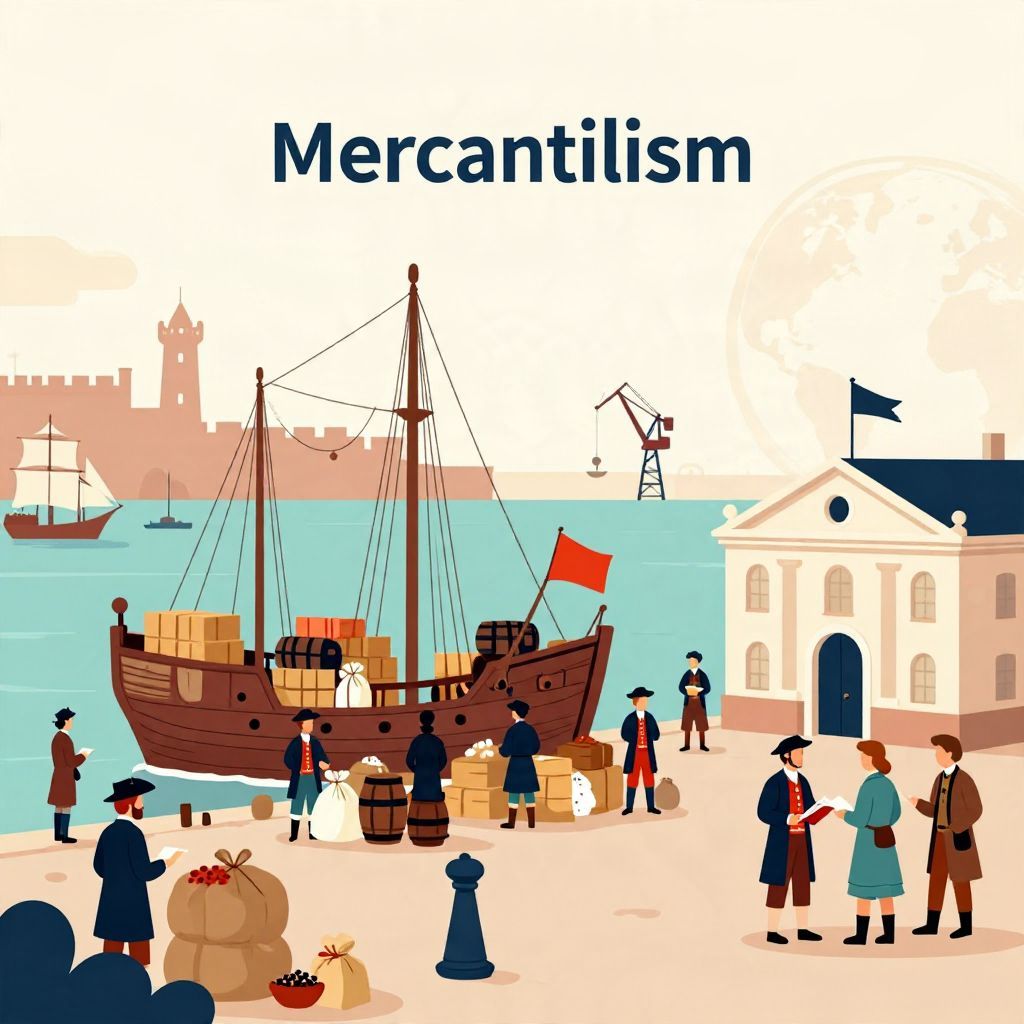
What is mercantilism, and why did it shape so much of early modern European history? In simple terms, mercantilism was a set of economic ideas and state policies that aimed to make a country stronger by increasing exports, controlling trade, and accumulating wealth, especially gold and silver.
It was not a single theory with one founder. Rather, mercantilism developed across the 16th to 18th centuries as European monarchies, merchants, and empires competed for power, colonies, and revenue.
What Is Mercantilism?
Mercantilism was an economic system and political strategy that treated national wealth as limited and believed the state should manage trade to strengthen the country. Governments encouraged exports, restricted imports, supported colonies, and sought bullion, because wealth was often measured in precious metals and trade surpluses.
Origins of Mercantilism
Mercantilism emerged gradually in Europe during the late 15th and 16th centuries, alongside the growth of centralized states, overseas exploration, and expanding long-distance trade. It was shaped by the end of medieval economic patterns, the rise of Atlantic commerce, and the intense rivalry among kingdoms such as Spain, France, England, and the Dutch Republic.
The rise of strong states
As monarchies became more centralized, rulers needed money to fund armies, navies, bureaucracies, and wars. Economic policy became a tool of state power. Instead of leaving trade entirely to local custom or guild regulation, governments increasingly tried to direct commerce in ways that would benefit the crown and the nation.
Exploration and empire
The voyages of the late 15th and 16th centuries connected Europe to the Americas, Africa, and Asia on a much larger scale. This expanded access to silver, sugar, spices, tobacco, and other commodities. It also made trade competition global. Colonies were often viewed as sources of raw materials and captive markets, fitting neatly into mercantilist thinking.
How Mercantilism Worked in Practice
Mercantilist policies varied from country to country, but they usually aimed to keep money flowing into the state and prevent rivals from gaining advantage. Governments used tariffs, navigation laws, monopolies, subsidies, and colonial restrictions to shape trade. The goal was not free exchange, but controlled exchange that served national interests.
Common mercantilist policies
- Tariffs on imported goods to discourage foreign competition
- Export incentives to encourage domestic production and sales abroad
- Navigation laws to reserve shipping for national merchants and ships
- Colonial trade restrictions requiring colonies to trade mainly with the mother country
- State-supported monopolies for companies or industries seen as strategically important
- Subsidies and regulation to promote manufacturing, especially textiles and shipbuilding
Why bullion mattered
Many mercantilists believed that gold and silver were essential signs of national strength. In an age when coin was central to taxation, military pay, and international finance, bullion seemed to represent real power. This did not mean every mercantilist thought only about hoarding treasure, but it did mean that money, trade, and political strength were closely linked in their minds.
Mercantilism and Colonial Empires
Mercantilism was closely tied to empire. European states often treated colonies as parts of a larger economic system, expected to supply raw materials and buy finished goods. This helped imperial powers enrich merchants and tax collectors, but it also constrained colonial economies and deepened exploitation, especially in plantation systems and the Atlantic slave trade.
The colonial “exclusive trade” idea
Under mercantilist logic, colonies existed to benefit the mother country. They might provide sugar, tobacco, cotton, timber, or metals, while purchasing manufactured goods from Europe. The system was designed to keep profits within the empire and reduce dependence on rival powers. In reality, smuggling and local resistance often undermined these controls.
Mercantilism and slavery
Mercantilist empires were deeply connected to coerced labor. Plantation economies in the Caribbean and the Americas relied heavily on enslaved Africans to produce sugar, coffee, tobacco, and other export crops. Although mercantilism was an economic doctrine, its historical operation cannot be separated from colonial violence, racial slavery, and forced labor.
Important Mercantilist Thinkers and Statesmen
Mercantilism was not a unified school with one doctrine, but several writers and officials articulated its principles. Some of the best-known were administrators, financiers, and advisers who tried to strengthen state revenue and trade. Their ideas differed, yet they shared the belief that economic policy should serve national power.
Notable figures
- Jean-Baptiste Colbert in France, whose policies under Louis XIV became a classic example of state-directed economic management
- Thomas Mun in England, who argued that foreign trade could enrich a nation when managed to produce a favorable balance
- Antonio Serra in the Kingdom of Naples, an early writer on the relationship between industry, trade, and state wealth
These figures did not use the word “mercantilism” the way historians do today. That label is a later term, applied retrospectively to a broad set of early modern policies and assumptions.
Mercantilism in France, England, and Other European Powers
Mercantilism took different forms depending on local political and commercial conditions. France often emphasized manufacturing and state supervision. England increasingly focused on shipping, colonial trade, and naval power. The Dutch Republic, despite its commercial success, also used state support and trade protection in selective ways. Spain, meanwhile, relied heavily on American silver and imperial regulation, though the system was often undermined by smuggling and administrative limits.
France
French mercantilism is often associated with Colbert, who promoted industries such as textiles, glass, and shipbuilding. The French state also tried to improve roads, ports, and administrative control. The aim was to reduce imports, increase exports, and make France less dependent on foreign manufactures.
England
English mercantilist policy developed through navigation laws, colonial regulation, and support for shipping. Parliament and the crown sought to strengthen the merchant marine and limit Dutch or other foreign competition. England’s growing colonial empire in North America and the Caribbean became central to this strategy.
Spain and the silver economy
Spain received vast amounts of silver from the Americas, especially from mines in Potosí and Mexico. Yet bullion alone did not guarantee broad prosperity. Heavy military spending, inflation, and dependence on imported goods created serious weaknesses. Spain’s experience showed that precious metals could support empire, but they did not automatically create balanced economic development.
What Mercantilists Believed About Wealth
Mercantilists generally assumed that the world’s wealth was finite and that one country’s gain could be another’s loss. They valued a favorable trade balance, meaning more exports than imports, because they believed this would bring money into the country. They also saw manufacturing as important because finished goods usually earned more profit than raw materials.
Core assumptions
- National power depends on economic strength.
- Trade should be regulated to serve the state.
- Exports are preferable to imports.
- Colonies should support the mother country.
- Manufacturing increases national wealth and independence.
These ideas were practical as well as ideological. In a period of frequent war, rulers believed that control over trade could help finance armies and secure strategic advantage.
Criticism and the Decline of Mercantilism
Mercantilism came under increasing criticism in the 18th century. Enlightenment thinkers and political economists argued that trade could create mutual benefit rather than a zero-sum struggle. They also questioned whether heavy regulation truly made nations richer. Over time, many states moved toward freer trade, though never in a perfectly laissez-faire way.
Adam Smith and the challenge to mercantilism
Adam Smith’s The Wealth of Nations (1776) became the most famous critique of mercantilist thinking. Smith argued that wealth came from productive labor and market exchange, not simply from accumulating gold or restricting imports. He believed competition and specialization could increase prosperity more effectively than rigid state control.
Why mercantilism faded
Several changes weakened mercantilism:
- Growing confidence in market exchange and economic analysis
- Expanding industrial production, which made some trade restrictions less useful
- Rising criticism of monopolies and colonial exclusivity
- Changing state priorities in the late 18th and 19th centuries
Even so, mercantilist habits did not disappear overnight. Tariffs, imperial preference, and state intervention continued in many places long after the classic mercantilist era.
Why Mercantilism Matters in History
Mercantilism matters because it helps explain how early modern states built power, financed war, and organized empire. It also shows that economics and politics were deeply intertwined. Trade policy was not just about profit; it was about sovereignty, military strength, and imperial rivalry. Understanding mercantilism helps explain the rise of global commerce and the unequal structures of colonial rule.
Lasting significance
Although historians debate how useful the term is, mercantilism remains a valuable shorthand for a major phase in European and Atlantic history. It captures the logic of state-directed trade, colonial extraction, and competitive empire that shaped the modern world. It also reminds us that economic ideas often reflect the political needs of their time.
In short, mercantilism was the early modern belief that a nation became stronger by controlling trade, building industry, and accumulating wealth through state power. It helped shape European empires, colonial economies, and later debates over free trade and government intervention. For related context, see what political ideology means in history and how imperialism contributed to World War I.