
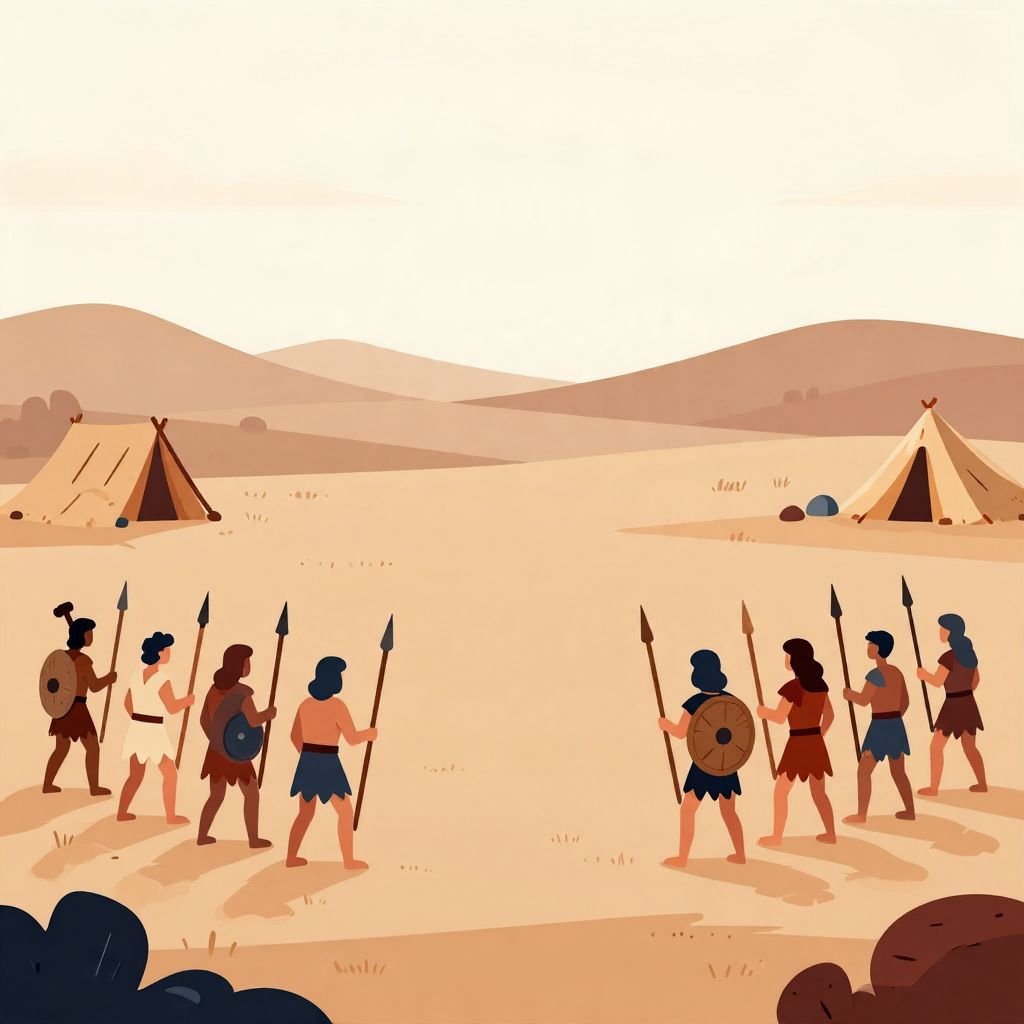
People often ask, “What was the first war?” It is a simple question with a complicated answer, because war began long before writing, and early humans left no headlines or official records. Historians can identify some of the oldest known conflicts, but there is no single universally agreed “first war” in all of human history.
The answer depends on what you mean by war: a large organized armed conflict, a battle between states, or any violent struggle between groups. The earliest evidence points to prehistoric warfare, and the oldest clearly documented wars appear in ancient Mesopotamia and Egypt around the fourth millennium BCE.
What Was the First War?
The “first war” is not known with certainty. If war means organized conflict between communities, it likely began in prehistory, thousands of years before written history. If you mean the earliest war we can identify from records, scholars often point to conflicts in ancient Mesopotamia and Egypt around 3500–3000 BCE, when states and armies first emerged.
Why There Is No Single Definite First War
War did not begin at one exact moment. Human groups likely fought long before cities, kings, or writing existed, but those conflicts left only archaeological traces such as weapons, mass graves, burned settlements, and defensive walls. Because of that, historians can identify early warfare, but not a single universally accepted first war.
War before written history
Archaeology shows that violence between groups is very old. Some prehistoric sites contain evidence of repeated attacks, and some burials suggest organized killing rather than isolated violence. Still, without written sources, it is difficult to know whether these were wars in the full sense or smaller-scale raids and feuds.
What counts as “war”?
Historians usually distinguish war from individual violence by looking for organized group conflict, repeated fighting, leadership, strategy, and a wider political purpose. Under that definition, war is usually linked to the rise of settled societies, surplus food, property, and competition over land and resources.
The Earliest Known Wars in History
The oldest wars we can describe with some confidence come from the ancient Near East and northeastern Africa. As cities and kingdoms developed, rulers began to record victories, conquests, and campaigns. These early states created the first written war narratives, even if they were often one-sided and meant to glorify kings.
Mesopotamia and the rise of city-states
In southern Mesopotamia, by the late fourth millennium BCE, cities such as Uruk, Lagash, and Umma competed for land and water. One of the earliest documented conflicts is the war between Lagash and Umma, often dated to around 2450 BCE. Inscriptions and artifacts suggest a real struggle over territory and irrigation rights.
Although details are incomplete, this conflict matters because it shows war becoming part of state formation. City-states were no longer just communities defending themselves; they were organized political units capable of mobilizing labor, soldiers, and resources for sustained fighting.
Ancient Egypt and early state warfare
In Egypt, unification itself was shaped by conflict. Around 3100 BCE, Upper and Lower Egypt were brought under one rule, though the exact process is debated. Later royal imagery and inscriptions portray kings as conquerors who subdued rivals and expanded authority. These sources are partly historical and partly political propaganda.
One famous early ruler is Narmer, often associated with the unification of Egypt. The Narmer Palette, a ceremonial object, depicts the king in a triumphal pose over enemies. Scholars use it as evidence of early state power and warfare, but it does not give a simple battlefield account in the modern sense.
Possible Candidates for the Oldest War
Because the evidence is fragmentary, several early conflicts are often discussed as candidates for the “first war.” None can be proven as the absolute first, but each helps explain how warfare emerged in human history.
- Prehistoric group conflict — likely the earliest form of war, but impossible to date precisely.
- The Lagash-Umma conflict — one of the earliest recorded wars, around 2450 BCE.
- Early Egyptian unification conflicts — state-building wars around 3100 BCE, though sources are partly symbolic.
- Other early Near Eastern campaigns — conflicts among emerging kingdoms in Sumer, Akkad, and neighboring regions.
The problem with “first” in ancient history
When people ask for the first war, they often want a single event. But ancient history rarely works that way. The earliest wars were probably repeated, overlapping conflicts among many groups. What survives in the record is not the first war itself, but the first wars that left enough evidence to be recognized.
How War Developed in Early Societies
War became more common as human societies changed. Farming created food surpluses, which supported larger populations, permanent settlements, and social hierarchies. Once land, grain, water, and labor became valuable and defendable, organized violence became a way to control them.
From raids to organized campaigns
Early conflict may have begun as raids, ambushes, or seasonal attacks. Over time, as communities grew into chiefdoms and states, warfare became more organized. Leaders could command fighters, store supplies, build fortifications, and claim divine or royal authority to justify war.
Weapons and fortifications
Archaeological evidence for early warfare includes spear points, arrowheads, helmets, shields, and fortified walls. These finds do not always prove war on their own, but together they show that many early societies expected violent conflict and prepared for it.
What the Earliest Written Sources Tell Us
The first written records of war are not neutral reports. They were usually created by rulers, priests, or scribes to celebrate victory and authority. That means historians must read them carefully, separating historical fact from royal boasting, religious symbolism, and political messaging.
Royal inscriptions and victory claims
Ancient kings often described themselves as chosen by the gods and destined to defeat enemies. Such texts can confirm that wars happened, but they often exaggerate scale and success. A ruler may claim total conquest when the reality was a temporary victory or a disputed border change.
Why archaeology matters
Because written sources are biased and incomplete, archaeology is essential. Settlement destruction layers, mass burials, and defensive structures help confirm that conflict occurred. In some cases, archaeology reveals warfare in places and periods where no written history survives at all.
Was the First War a Battle Between States?
Not necessarily. The earliest wars may not have involved fully formed states. They may have been fought by clans, villages, chiefdoms, or proto-states. The line between a raid, a feud, and a war is often blurry in early history, especially before governments and formal armies existed.
State warfare versus tribal conflict
Modern readers sometimes imagine war as something only states can wage, but human conflict is older than states. Once agriculture and settlement expanded, groups had reasons to defend territory and resources. In that sense, warfare likely evolved gradually from smaller-scale violence into larger organized campaigns.
Why the Question Still Matters
Asking about the first war is really asking how organized violence began in human society. The answer helps explain the rise of political power, borders, armies, and conquest. It also shows that war is not a timeless constant in one fixed form, but a historical process shaped by changing societies.
Understanding early warfare also helps explain why ancient civilizations invested so much in walls, weapons, and kingship. War was not just destruction; it was tied to state formation, control of resources, and the creation of historical memory. The earliest wars helped shape the first empires and political systems.
Conclusion
So, what was the first war? There is no single proven first war in all of human history. The earliest warfare probably began in prehistory, long before writing, while the oldest clearly documented wars appear in ancient Mesopotamia and Egypt around 3500–2450 BCE. If you want to explore related origins in history, you may also be interested in what was the first and what was the longest war.