
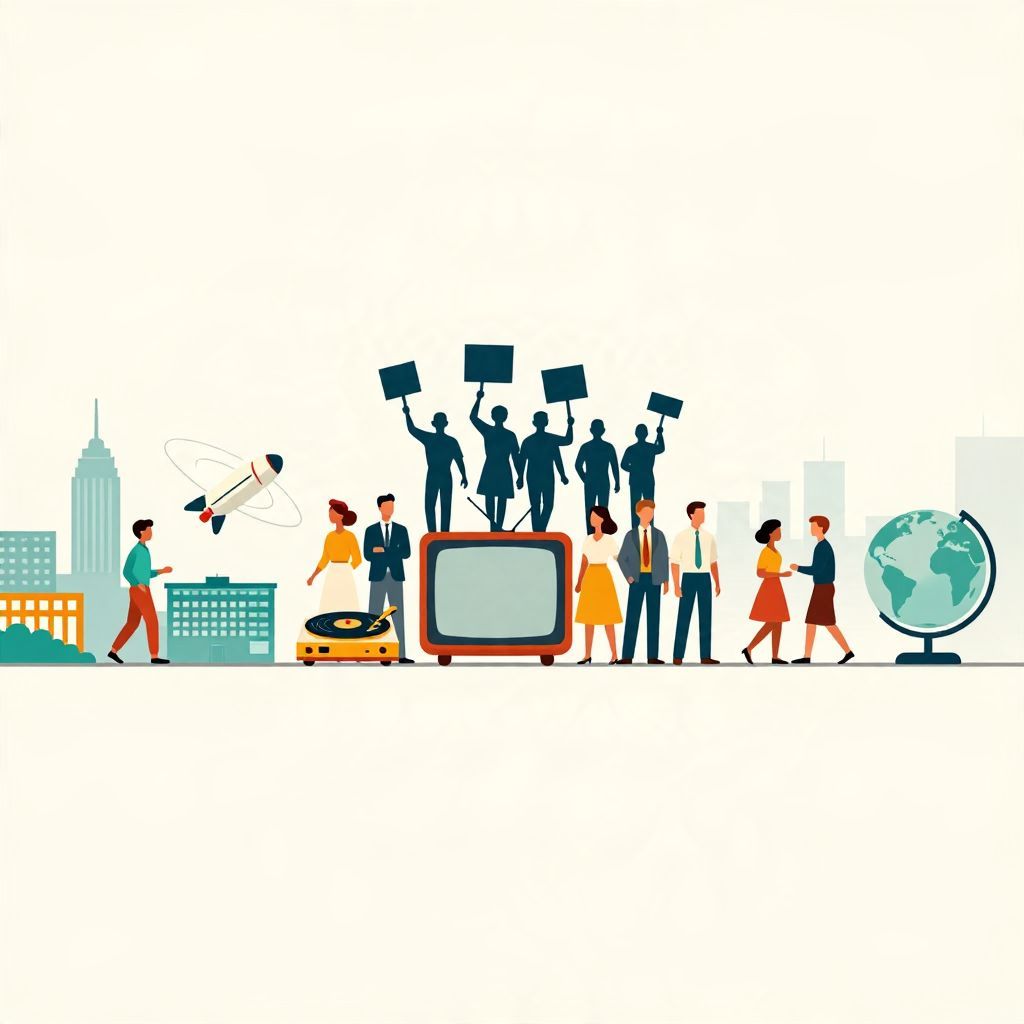
What happened in 1965? It was a year of major change across politics, civil rights, war, culture, and technology. In the United States, the civil rights movement reached a turning point, while the Vietnam War escalated sharply. Around the world, nations in Asia and Africa faced decolonization, conflict, and rapid social change.
1965 also left a lasting mark on everyday life: popular music expanded, television became more influential, and new laws reshaped citizenship and voting rights. The year did not have one single defining event, but rather a cluster of developments that helped shape the late 20th century.
What happened in 1965?
1965 was a pivotal year marked by the passage of the U.S. Voting Rights Act, the escalation of the Vietnam War, the launch of major cultural shifts in music and media, and important political changes worldwide. It was a year when long-building tensions in civil rights, decolonization, and Cold War rivalry became impossible to ignore.
1965 timeline: the major events
Several events in 1965 stand out because they changed policy, intensified conflict, or altered public life. The chronology below shows how quickly the year moved from reform to confrontation in many parts of the world.
- March 7 – “Bloody Sunday” in Selma, Alabama: peaceful civil rights marchers were violently attacked by law enforcement, shocking the United States and helping build support for voting rights legislation.
- March 8 – The first U.S. combat troops arrive in South Vietnam, signaling a major escalation of American involvement in the war.
- March 15 – President Lyndon B. Johnson addresses Congress on civil rights, urging stronger federal action.
- August 6 – The U.S. Voting Rights Act is signed into law, outlawing discriminatory voting practices that had long suppressed Black voters in the South.
- August 11–16 – The Watts uprising in Los Angeles highlights racial inequality, police-community tensions, and urban unrest in the United States.
- September 8 – The first episode of Star Trek airs, reflecting the growing importance of science fiction in television culture.
- October 1 – Indonesia’s political crisis deepens after an attempted coup and the anti-communist violence that follows, leading to a dramatic shift in power.
- Throughout the year – The war in Vietnam expands, antiwar sentiment grows, and youth culture becomes more visible in the United States and Europe.
Why 1965 mattered in U.S. history
In the United States, 1965 was one of the most consequential years of the 1960s. The civil rights movement won a landmark legislative victory, but racial inequality remained deeply rooted. At the same time, the Vietnam War became far more central to American politics, dividing public opinion and shaping the presidency of Lyndon B. Johnson.
The Voting Rights Act changed American democracy
The Voting Rights Act of 1965 was one of the most important civil rights laws in U.S. history. It targeted literacy tests, poll taxes, and other devices used to prevent Black citizens from voting, especially in the South. Federal oversight of elections in certain jurisdictions became a powerful tool for enforcing constitutional rights.
This law did not solve racial inequality, but it transformed political participation. Black voter registration and officeholding increased in many places over time, and the federal government took a much stronger role in protecting voting access. Its effects shaped American politics for decades.
Selma exposed the struggle for equal rights
The Selma campaign in Alabama showed that legal equality on paper did not guarantee fair access in practice. Activists organized marches to demand voting rights, and the violent response to the first march on the Edmund Pettus Bridge drew national attention. Images of the attack helped shift public opinion and increased pressure on Washington.
Selma is often remembered as a turning point because it connected grassroots protest with federal action. It demonstrated how nonviolent activism, media coverage, and political leadership could combine to produce change, even if that change remained incomplete.
Watts revealed deep urban tensions
The Watts uprising in Los Angeles was triggered by an arrest but rooted in deeper problems: unemployment, housing discrimination, poor schools, and strained relations between police and Black residents. The unrest lasted several days and left many people dead, injured, or arrested.
Historians generally see Watts as part of a broader pattern of urban unrest in the 1960s rather than a single isolated riot. It reflected frustration with slow progress and helped push debates about poverty, policing, and racial justice into the national spotlight.
1965 and the Vietnam War
1965 was the year the Vietnam War became a much larger American war. The United States increased troop levels, expanded bombing, and moved from limited advisory involvement toward direct combat. This escalation changed the scale of the conflict and intensified debate at home.
Why the war escalated
American leaders feared that a communist victory in South Vietnam would destabilize the region and damage U.S. credibility during the Cold War. This “domino theory” influenced policy, though historians continue to debate how persuasive or accurate it was. Johnson’s administration believed that stronger military commitment might prevent collapse.
Instead, the war deepened. More troops meant more casualties, more spending, and more public scrutiny. By the end of 1965, the conflict had become a central issue in American life, helping fuel the antiwar movement that would grow stronger in later years.
How 1965 changed public opinion
As the war escalated, many Americans began questioning official assurances that victory was near. Television brought the conflict into living rooms, making war more immediate and visible than in earlier eras. The gap between government optimism and battlefield reality widened over time.
This shift did not happen overnight, but 1965 set the stage for it. The year marked the beginning of a longer crisis of trust between the public and political leaders over foreign policy.
Global political change in 1965
Outside the United States, 1965 was also a year of upheaval. The Cold War shaped events in Asia, Africa, and Latin America, while newly independent states struggled with internal conflict, military coups, and the challenges of building stable governments.
Indonesia’s political crisis
In Indonesia, the attempted coup of late 1965 led to a violent political transformation. The aftermath included mass killings of suspected communists and a major shift in power away from President Sukarno toward General Suharto. The exact death toll remains disputed, but scholars agree that the violence was enormous and politically decisive.
This episode is one of the darkest in modern Indonesian history. It also shows how Cold War fears and local political struggles could combine with devastating consequences.
Decolonization continued
Across Africa and Asia, the postcolonial world was still taking shape. Some states were consolidating independence, while others faced border disputes, economic instability, or internal division. The mid-1960s were not simply a time of liberation; they were also a period of difficult state-building.
In this sense, 1965 belongs to the broader era of decolonization. The end of empire did not bring immediate peace or prosperity, but it did create new political possibilities and new conflicts over power, identity, and development.
Culture, music, and everyday life in 1965
1965 was not only a year of politics and war. It was also a year when popular culture changed rapidly. Music, television, fashion, and youth identity all became more visible, helping define the spirit of the decade.
Music reflected a changing generation
By 1965, rock music had become a major force in youth culture. Bands and solo artists were experimenting with new sounds, lyrics, and performance styles. The British Invasion remained influential, while American artists were also pushing popular music in new directions.
Music increasingly carried political and social meaning. Songs could now speak to civil rights, generational conflict, war, and personal freedom. This helped make the mid-1960s a transformative period in modern cultural history.
Television became more central
Television was becoming the dominant mass medium in many homes. It shaped how people experienced news, entertainment, and public events. Major political moments, protests, and war coverage reached large audiences quickly, changing public expectations about information and immediacy.
This mattered because 1965 was a year when image and broadcast coverage influenced politics more than ever before. Public opinion was increasingly shaped by what people saw, not just what they read.
Science, technology, and space in 1965
1965 also saw important advances in science and technology, especially in the space race. The Cold War competition between the United States and the Soviet Union continued to drive innovation, funding, and public fascination with exploration.
Space exploration advanced rapidly
In 1965, the U.S. Gemini program made major progress toward the later Apollo moon landings. Astronauts carried out increasingly complex missions, including spacewalks and rendezvous maneuvers. These achievements were essential steps toward landing a human on the Moon in 1969.
The space race was more than a technological contest. It was also a propaganda struggle, with each superpower trying to prove the superiority of its system. Success in space carried symbolic weight far beyond the laboratory or launch pad.
Technology was reshaping daily life
Although many modern conveniences were still limited compared with today, the mid-1960s were part of a broader era of rapid technological expansion. Consumer electronics, transportation, and communications were all changing. These shifts affected work, leisure, and family life in ways that would become even more pronounced later in the century.
How historians view 1965
Historians often treat 1965 as a turning point because it brought together several long-running trends: civil rights activism, Cold War intervention, decolonization, and cultural change. The year did not create these forces, but it concentrated them in ways that made their consequences harder to ignore.
Some developments in 1965 were clearly progressive, such as the Voting Rights Act. Others, like the escalation in Vietnam and the violence in Indonesia, reveal how the same era could produce both reform and tragedy. That mix is part of what makes the year historically significant.
Historical impact of 1965
The impact of 1965 can be seen in later decades. In the United States, voting rights became a central issue in debates over democracy and federal power. The Vietnam War reshaped politics, protest movements, and trust in government. Globally, the year fit into a larger pattern of postcolonial instability and Cold War competition.
Just as importantly, 1965 helped define the mood of the late 20th century: more media-driven, more politically polarized, and more aware of social inequality. It was a year when history moved quickly, but the consequences lasted far longer than twelve months.
In short, what happened in 1965 was not one event but a convergence of turning points. If you want to compare how later decades were shaped by similar upheavals, you may also find what happened in 1999 and what happened in 2013 useful for broader historical context.