
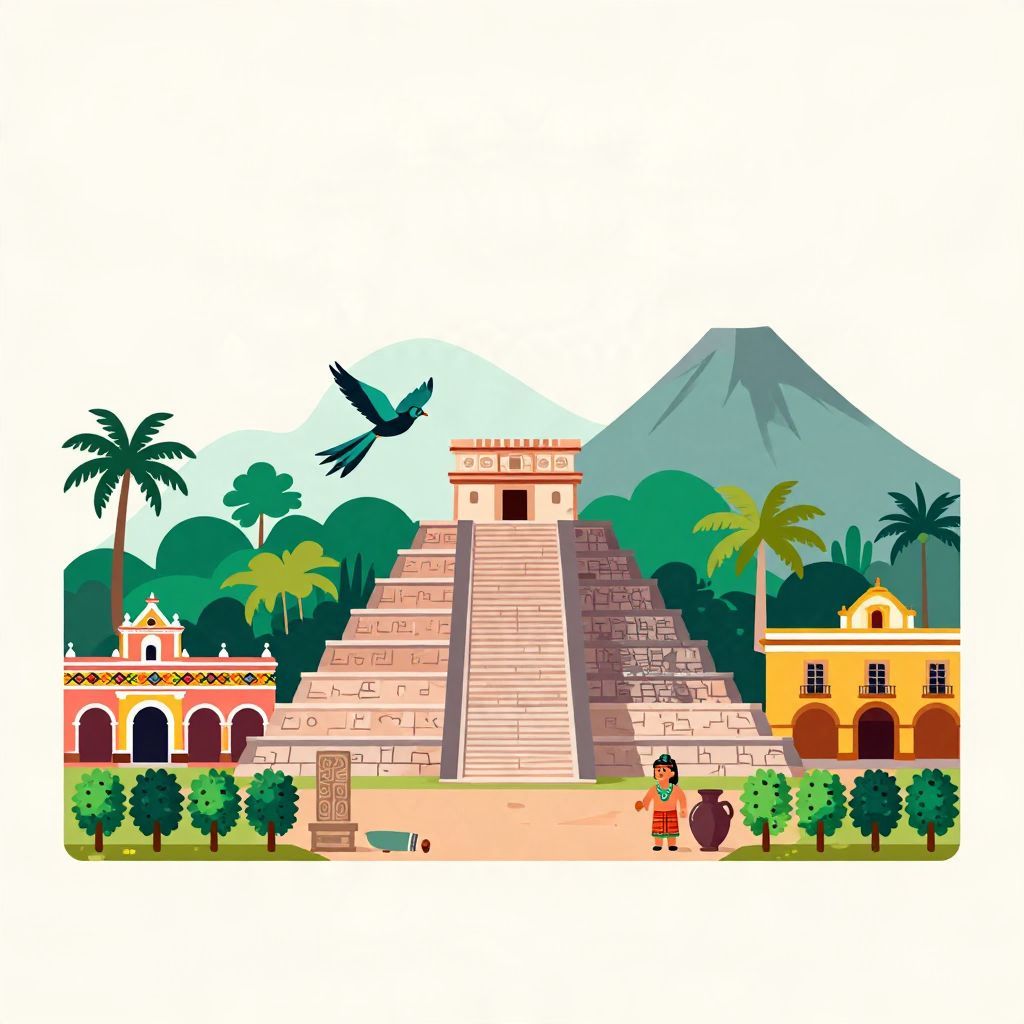
What is Guatemala known for? The answer depends on whether you mean ancient history, colonial heritage, or modern culture. Guatemala is best known as the heartland of the ancient Maya, a country of dramatic volcanoes and highland landscapes, and a place where Indigenous traditions remain deeply visible in language, dress, food, and ritual.
It is also known for its colonial cities, especially Antigua Guatemala, its coffee and bananas, and its long, often difficult modern history shaped by conquest, inequality, civil war, and resilience. Together, these layers make Guatemala one of the most historically rich countries in the Americas.
What Is Guatemala Known For?
Guatemala is known for its Maya heritage, volcanic scenery, colorful Indigenous culture, and colonial architecture. Historically, it was a major center of the ancient Maya civilization and later a key Spanish colonial region. Today, it is also recognized for its distinctive textiles, coffee production, and the survival of many Indigenous languages and traditions.
The Ancient Maya Legacy
When people ask what Guatemala is known for historically, the ancient Maya are usually the first answer. Long before Spanish conquest, much of present-day Guatemala was part of the Maya world, with powerful city-states, advanced astronomy, elaborate writing systems, and monumental architecture. This heritage remains one of the country’s defining features.
A major center of Maya civilization
Maya civilization developed over many centuries, with important cultural growth in the Preclassic period and major urban flourishing during the Classic period, roughly from about 250 to 900 CE. In what is now Guatemala, cities such as Tikal became major political and ceremonial centers. The ruins of Tikal, in the northern lowlands, are among the most famous archaeological sites in the Americas.
The Maya were not a single empire ruled from one capital. Instead, they formed a network of city-states, often competing with one another through war, alliances, marriage, and trade. That political fragmentation did not mean weakness; it produced a highly sophisticated and dynamic civilization.
Writing, mathematics, and astronomy
The Maya are known for developing one of the most complex writing systems in the pre-Columbian Americas. They also made major advances in mathematics and astronomy, including the use of a positional number system and the concept of zero. These achievements were tied to religion, politics, and calendrical calculation, helping rulers legitimize authority through sacred time.
Popular culture often simplifies Maya history into a mystery of “vanished” people. That is misleading. Maya civilization changed over time, and some cities declined for political, environmental, and economic reasons, especially in the southern lowlands after the Classic period. But Maya peoples did not disappear. Millions of Maya descendants live in Guatemala today.
Guatemala’s Indigenous Cultures Today
Another reason Guatemala is known is the strength of its Indigenous cultural life. A large share of the population identifies as Indigenous, especially Maya communities, and many people continue to speak Indigenous languages alongside Spanish. Guatemala is one of the most linguistically diverse countries in Latin America.
Languages and identity
Spanish is the official language, but Guatemala also recognizes numerous Maya languages, along with Xinka and Garifuna in specific communities. This linguistic diversity reflects historical continuity rather than a modern revival alone. In many towns, language, clothing, and local ritual still express community identity in ways shaped by centuries of adaptation.
Textiles, markets, and ritual life
Guatemalan woven textiles are widely admired for their color, symbolism, and regional variation. Traditional clothing, especially women’s huipiles, often carries local designs that can indicate community identity. Markets, religious festivals, and family ceremonies also preserve older patterns of social life, even as modern urbanization changes daily routines.
It is worth distinguishing between heritage and stereotype. Guatemala is not “frozen” in the past. Its Indigenous cultures are living traditions that have endured conquest, colonial rule, and modern political pressure while continuing to evolve.
Colonial Guatemala and Spanish Rule
Guatemala is also known for its colonial past. Spain conquered much of the region in the 16th century, and the area became part of the Captaincy General of Guatemala, a major administrative region within the Spanish Empire. This colonial era reshaped landholding, religion, labor systems, and urban life.
Conquest and settlement
Spanish conquest in the early 1500s was not a single event but a prolonged process involving military campaigns, alliances with Indigenous rivals, disease, and negotiation. Pedro de Alvarado played a major role in the conquest of the region in the 1520s, though local Indigenous resistance continued for generations. Spanish control expanded unevenly across highlands and lowlands.
Colonial rule introduced Catholic institutions, new legal structures, and an economy centered on tribute, labor extraction, and agriculture. Indigenous communities were often forced into new settlements and subjected to heavy burdens, yet they also preserved local authority and cultural practices in adapted forms.
Antigua Guatemala
One of the country’s best-known historical sites is Antigua Guatemala, founded in the 16th century and later rebuilt after repeated disasters. Earthquakes damaged the colonial capital severely, and the city was eventually abandoned as the seat of government in the late 18th century. Its preserved ruins, churches, and streets now make it a UNESCO World Heritage Site.
Antigua is known not only for beauty but for what it reveals about colonial urban life: religious power, Spanish imperial planning, and the vulnerability of cities built in an earthquake-prone region.
Geography: Volcanoes, Highlands, and Rainforests
Guatemala is also known for its striking geography. The country sits on the Pacific Ring of Fire, with many volcanoes, fertile highlands, and humid lowland forests. Geography has shaped settlement patterns, agriculture, trade, and even political history.
Volcanoes and natural landscape
Volcanoes such as Fuego, Pacaya, and Agua are among the most famous in the country. Their presence has contributed to fertile soils but also to eruptions, earthquakes, and recurring disaster. The dramatic landscape has become part of Guatemala’s international image, especially in travel writing and photography.
Lakes and biodiversity
Lake Atitlán is one of Guatemala’s most iconic natural landmarks, surrounded by volcanoes and highland towns. The country is also part of a biologically rich region with cloud forests, tropical lowlands, and diverse wildlife. This environmental variety has long influenced agriculture, transportation, and regional identity.
Geography has not merely provided scenery. It has shaped power. Mountainous terrain often made communication difficult, strengthened local identities, and complicated state control, while fertile volcanic zones supported agricultural production and dense settlement.
Coffee, Bananas, and the Export Economy
Guatemala is known internationally for coffee, and historically for export agriculture more broadly. In the 19th and 20th centuries, coffee became one of the country’s most important products, deeply influencing land ownership, labor systems, and political power.
How export agriculture changed the country
As global demand for coffee grew, Guatemalan elites expanded plantation agriculture, often at the expense of Indigenous landholding and communal rights. Labor recruitment systems and coercive practices tied many rural communities to estate work. Bananas also became important, especially in lowland export zones, linking Guatemala to foreign capital and multinational companies.
This export economy brought wealth to some sectors but also deepened inequality. The concentration of land and power became one of the central historical problems of modern Guatemala, helping shape later political conflict.
Independence, Nation-Building, and Political Change
Guatemala is known for a complicated path to independence and state formation. The region declared independence from Spain in 1821, then briefly joined the Mexican Empire before becoming part of the Federal Republic of Central America. After that federation collapsed, Guatemala emerged as a separate republic in the 1830s.
From colony to republic
Independence did not immediately transform daily life. Colonial elites, church influence, and rural inequalities remained powerful. The 19th century was marked by conflict between liberals and conservatives over church property, education, labor policy, and the role of the state. These struggles helped define modern Guatemalan politics.
One important figure was Rafael Carrera, a conservative leader who rose to power in the mid-19th century and dominated national politics for years. His rule reflected both elite interests and alliances with rural Indigenous communities, showing that Guatemalan politics could not be reduced to a simple liberal-versus-conservative story.
Revolution, Cold War Violence, and Civil War
In modern historical memory, Guatemala is also known for political upheaval and violence. The 20th century brought reform, repression, foreign intervention, and a long civil war. These events remain central to how historians understand the country today.
The 1944 Revolution and its aftermath
In 1944, a revolution ended the dictatorship of Jorge Ubico and opened a period of reform. Presidents Juan José Arévalo and Jacobo Árbenz pursued labor rights, education reform, and land redistribution. Árbenz’s land reform especially alarmed powerful domestic interests and the United States, which viewed the reforms through the lens of Cold War anti-communism.
In 1954, Árbenz was overthrown in a coup backed by external pressure and internal opposition. The coup had far-reaching consequences: reform was reversed, political polarization deepened, and military influence increased.
Long civil war
From 1960 to 1996, Guatemala endured a civil war between government forces and leftist insurgent groups. The conflict was especially devastating in Indigenous rural areas, where counterinsurgency campaigns caused widespread suffering. Human rights organizations and later truth commissions documented massacres, forced displacement, and severe abuses, particularly during the early 1980s.
This period is one of the darkest in Guatemalan history. It is essential to approach it carefully: the war was not simply a battlefield conflict, but a broader struggle shaped by inequality, racism, state violence, insurgency, and Cold War politics. The 1996 peace accords formally ended the war, but its social and political consequences remain visible.
Food, Festivals, and Everyday Culture
Guatemala is also known for its food and festivals, which reflect Indigenous, Spanish, and regional influences. Dishes such as tamales, pepián, and kak’ik are part of a culinary tradition that varies by region and community. Food often carries historical memory, especially in family and religious celebrations.
Religious festivals and syncretism
Catholic feast days, processions, and local saints’ celebrations remain important, often blending Catholic forms with older Indigenous practices. This syncretism is one of the most distinctive features of Guatemalan cultural history. It shows how conquest did not erase older traditions but transformed them through centuries of adaptation.
Music, dance, and public memory
Traditional dances, marimba music, and civic celebrations also play a role in national identity. At the same time, public memory in Guatemala is often contested. Monuments, museums, and commemorations can reflect different interpretations of conquest, revolution, and the civil war, revealing ongoing debates over history itself.
So, What Is Guatemala Known For in Historical Terms?
Historically, Guatemala is known for three major things: its deep Maya heritage, its colonial and postcolonial struggles, and its enduring cultural diversity. It is a country where ancient cities, colonial ruins, volcanic landscapes, and living Indigenous traditions all remain part of the present.
Its history is not just one of beauty or tragedy, but of continuity and change. Guatemala’s past helps explain why the country is famous for archaeological wonders, colorful textiles, coffee, and dramatic mountains, while also reminding us of conquest, inequality, reform, and resilience. For readers interested in broader historical context, related topics such as general world history and modern historical events can provide useful comparisons.