
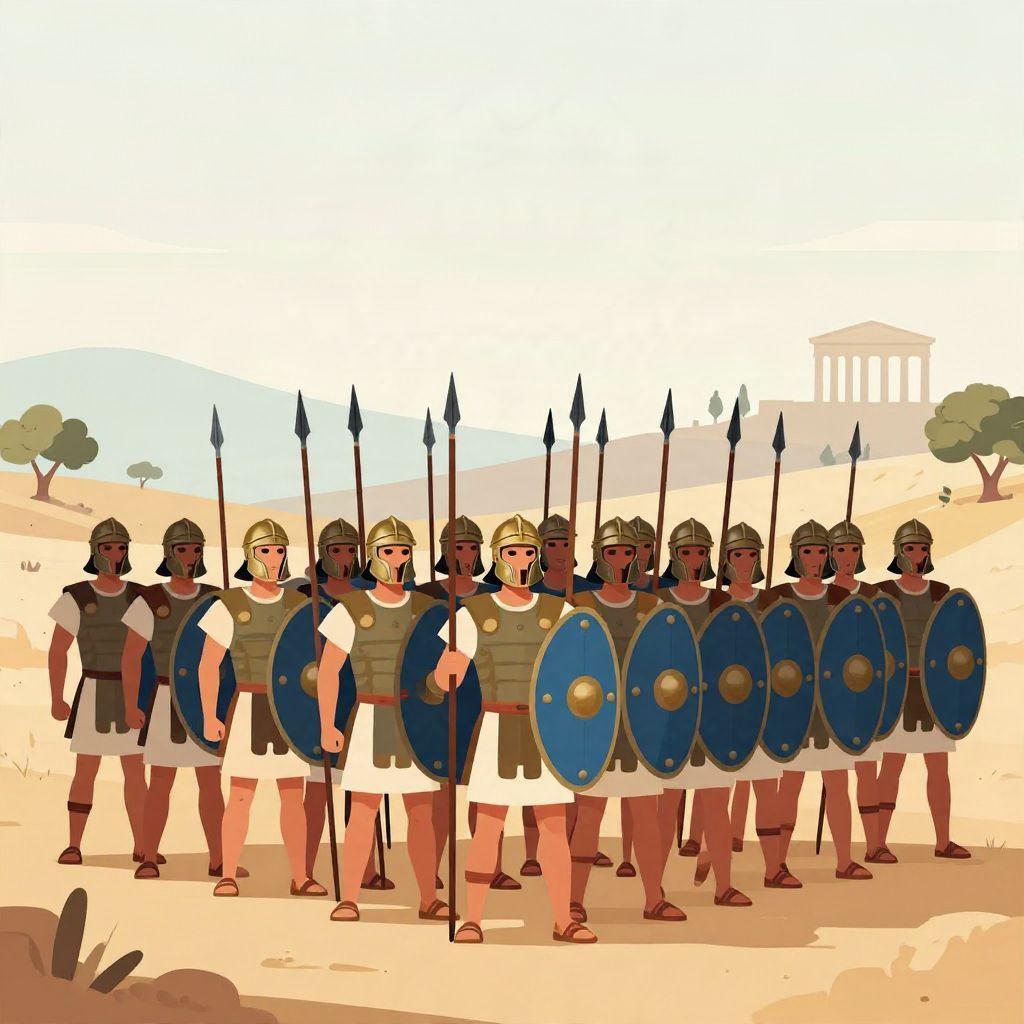
A phalanx was one of the most famous military formations in the ancient world. In its simplest form, it was a dense block of infantry standing shoulder to shoulder, usually armed with spears and shields, designed to present a nearly unbroken wall of weapons to an enemy.
The phalanx is most closely associated with ancient Greece, especially the city-states of the classical period and later the armies of Macedon. But the idea was older, broader, and changed over time. Understanding what a phalanx was means looking at how soldiers fought, why the formation worked, and why it eventually gave way to other styles of warfare.
What Is a Phalanx?
A phalanx is a tight infantry formation in which soldiers stand in close ranks, usually several lines deep, with overlapping shields and long spears or pikes projecting forward. It worked best on fairly level ground and depended on discipline, cohesion, and mutual protection. The formation was powerful head-on, but vulnerable to flanking, rough terrain, and disorder.
Where Did the Phalanx Come From?
The phalanx did not appear fully formed in one moment. Historians generally trace its development to early Greek warfare in the late 8th or 7th century BCE, when citizen-soldiers began fighting in heavier armor and tighter ranks. Over time, this style became the standard Greek way of battle, especially among hoplites, the heavily armed infantry of the city-states.
Early Greek warfare and the hoplite tradition
Before the classic phalanx, warfare in the Greek world was less standardized. As Greek communities grew richer and more organized, more men could afford bronze armor, shields, and spears. This encouraged a style of fighting in which ordinary citizens formed a collective line rather than relying only on individual heroism or aristocratic champions.
The result was the hoplite phalanx: a massed infantry formation built around the round shield, the spear, and mutual support. It became a defining feature of Greek warfare in the Archaic and Classical periods.
How Did the Classical Greek Phalanx Work?
The classical Greek phalanx usually consisted of rows of hoplites standing close together, each man helping protect the one beside him. The shield was crucial, and the line depended on discipline more than speed. In battle, the formation advanced as a compact body, often pushing against the enemy in a brutal close-range struggle.
Weapons and equipment
- Shield: A large round shield, often called an aspis or hoplon, used for both defense and formation.
- Spear: The main offensive weapon, typically long enough to strike over or around the front ranks.
- Armor: Bronze or linen armor, helmets, and greaves offered protection, though not every soldier wore the same gear.
The phalanx was not just a line of men with spears. It was a system of interdependence. Each soldier’s shield helped protect the man to his left, so the formation worked only if everyone held position. That made training, morale, and trust essential.
Why it was effective
The phalanx concentrated force at the front and reduced the chance of individual soldiers being isolated. Against a similar formation, victory often depended on discipline, timing, and endurance. Because the men were tightly packed, the formation could absorb pressure and create a sense of collective momentum.
Its strength was also its weakness. If the line broke, or if the enemy attacked from the side or rear, the phalanx could become difficult to defend. It was especially effective in open terrain, where it could maintain order, and less effective in broken ground, forests, hills, or narrow passes.
What Does the Word “Phalanx” Mean?
The word phalanx comes from Greek, where it referred to a log, beam, or something set in a row. In military usage, it came to mean a compact body of troops arranged in ranks. The term later entered other languages and became a general word for a tightly organized group, not only in military history but also in broader political or social language.
How Did the Macedonian Phalanx Differ?
The phalanx changed significantly under Philip II of Macedon in the 4th century BCE and his son Alexander the Great. Macedonian infantry used much longer spears, called sarissas, which made the front of the formation even more dangerous. This version of the phalanx was deeper, more specialized, and designed to work with cavalry and other troops.
Philip II’s military reforms
Philip II transformed Macedon into a major military power by reorganizing infantry, cavalry, and command structure. His phalanx was not simply a larger Greek hoplite line. It was a more complex battlefield instrument, with pike-armed infantry holding the center while cavalry and light troops handled movement, pursuit, and exploitation.
This Macedonian system helped defeat the city-states of mainland Greece and later supported Alexander’s conquests. It was highly effective when coordinated with other arms, but it still required order and open ground. The phalanx was strongest as part of a combined military system, not as a standalone solution.
Key differences from the hoplite phalanx
- The Macedonian version used much longer spears.
- It often relied on deeper ranks and more specialized drill.
- It worked best in combination with cavalry and missile troops.
- It was more offensive in reach, but sometimes less flexible than earlier hoplite formations.
Was the Phalanx Only Greek?
No. Although the Greek phalanx is the best-known version, similar dense infantry formations appeared in other ancient societies. Ancient Near Eastern armies, for example, used massed infantry with spears and shields, though not always in the same standardized way. The term “phalanx” is often applied broadly by historians, but the Greek and Macedonian examples remain the most influential.
It is important not to assume that every ancient shield wall was identical. Different cultures used different weapons, armor, command systems, and battlefield tactics. The phalanx is best understood as a family of related heavy-infantry formations rather than one timeless model.
How Did the Phalanx Shape Ancient Greek Society?
The phalanx was more than a battlefield tactic. It reflected and reinforced the social structure of the Greek polis, or city-state. Because hoplites were often citizen-soldiers, military service became tied to civic identity. Fighting in the phalanx encouraged ideas of shared duty, cooperation, and public responsibility.
That does not mean ancient Greek warfare was democratic in a modern sense. Many city-states remained unequal, and women, enslaved people, and non-citizens were excluded from political power. Still, the phalanx helped make the citizen body central to military life in many Greek communities.
Why Did the Phalanx Eventually Decline?
The phalanx did not disappear overnight, but it gradually lost its dominance because warfare changed. Armies became more diverse, commanders valued flexibility, and opponents found ways to exploit the phalanx’s weaknesses. As battlefields became more complex, dense infantry blocks were often too rigid on their own.
Reasons for decline
- Terrain problems: Uneven ground could break the formation.
- Flanking threats: Faster troops and cavalry could attack the sides.
- Changing weapons: Missile troops and longer-range tactics reduced the phalanx’s advantage.
- Combined-arms warfare: Armies increasingly needed more mobility and coordination.
By the Hellenistic and Roman periods, the phalanx still appeared in battle, but it was no longer unbeatable. The Roman legion, with its smaller tactical units and greater flexibility, proved especially effective against rigid formations. The famous Roman victory at Pydna in 168 BCE is often cited as an example of the phalanx’s vulnerability when terrain and battle conditions disrupted its cohesion.
What Was the Phalanx Like in Combat?
In actual battle, the phalanx was terrifying and physically exhausting. Soldiers advanced in close order, shields locked, spears angled forward. Once contact was made, the fight could become a violent press of bodies, with men trying to hold position while striking at exposed opponents. Victory often went to the side that maintained discipline longest.
Because of this, the phalanx was as much a psychological formation as a physical one. It depended on confidence, training, and the willingness of each soldier to stand firm while surrounded by comrades. Panic could be fatal; steadiness could decide the battle.
Why Does the Phalanx Still Matter in History?
The phalanx matters because it shows how military organization can shape society, politics, and state power. It also illustrates a broader historical pattern: a tactic that is highly effective in one context may become less useful as enemies adapt and conditions change. The phalanx was not primitive; it was sophisticated for its time.
Its legacy survives in military history, political language, and the study of ancient civilization. When historians discuss the phalanx, they are not only describing a formation of soldiers. They are also examining a way of organizing collective force, discipline, and civic identity in the ancient world.
In Summary: What Is a Phalanx?
A phalanx was a tightly packed infantry formation, best known from ancient Greece and Macedon, in which soldiers fought shoulder to shoulder with shields and spears. It was powerful, disciplined, and effective on open ground, but it depended on cohesion and could be defeated by mobility, terrain, and tactical adaptation. If you want to explore related military and political history, see what political ideology is and what Prussia was.