
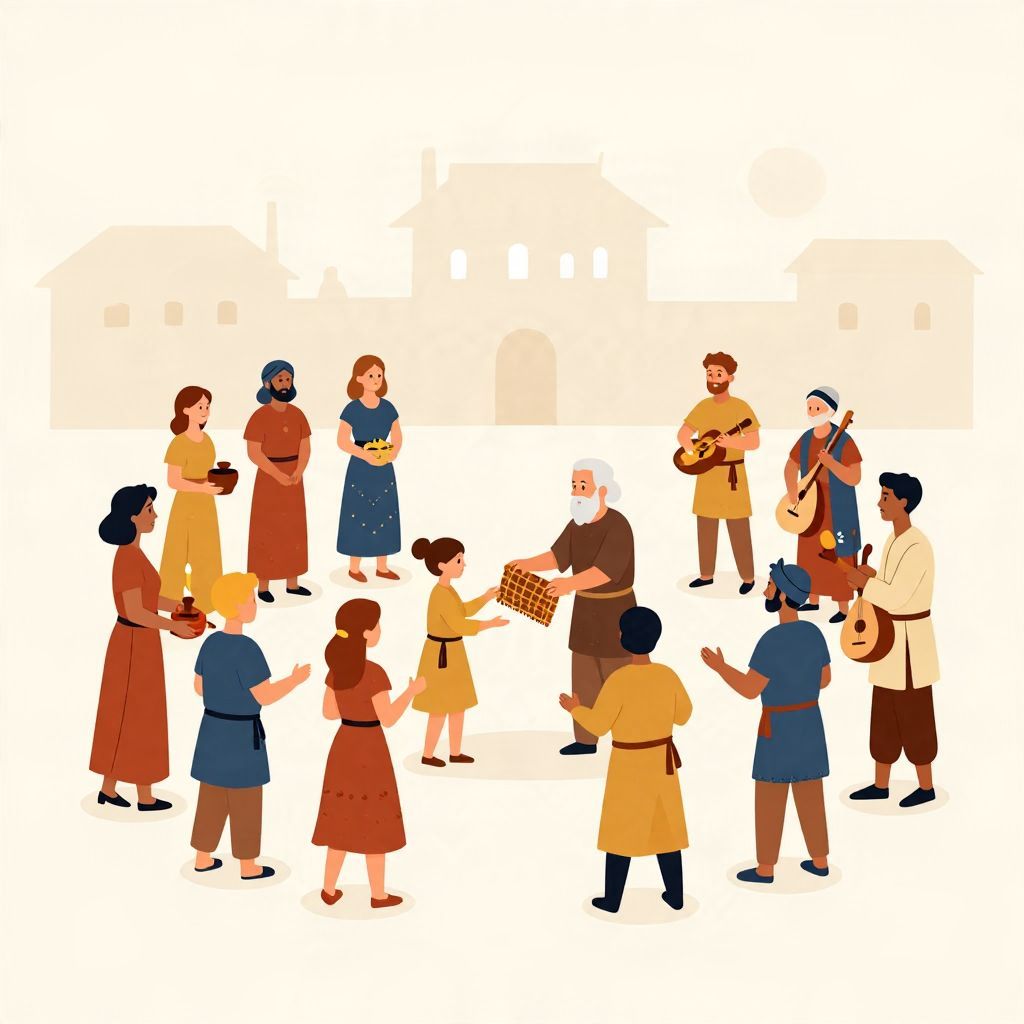
What is a tradition? In history, a tradition is a practice, belief, custom, or story passed from one generation to another. Traditions can be religious, family-based, national, or local, and they often help communities preserve identity, memory, and social order.
Traditions are not frozen in time. They change as people adapt old customs to new circumstances, which is why historians study them as living parts of culture rather than simple relics of the past.
What Is a Tradition?
A tradition is a learned pattern of behavior or belief that is transmitted across generations. It may include rituals, celebrations, oral stories, dress, food, or social rules. Historically, traditions have helped communities maintain continuity, mark important life events, and explain where they came from.
Where Did Traditions Come From?
Traditions did not begin at one single moment. They emerged gradually in early human societies when repeated actions, shared memories, and communal rituals became meaningful enough to be preserved. Long before writing, people relied on oral tradition to pass on myths, laws, genealogies, and practical knowledge.
Oral culture in early societies
In prehistoric and early historic communities, stories and customs were essential tools for survival and identity. Hunting practices, seasonal festivals, burial rites, and creation stories could all become traditions. Because these were passed by word of mouth, they often changed over time, but their core meaning remained recognizable.
Religion and ritual
Many of the oldest traditions were religious. Ancient civilizations such as Egypt, Mesopotamia, India, China, Greece, and Rome developed rituals tied to gods, kingship, agriculture, and the afterlife. Some traditions were performed to ensure fertility, protect the community, or honor ancestors. In many cases, religious tradition and civic life were closely linked.
How Historians Understand Tradition
Historians usually distinguish between tradition as a living practice and tradition as an idea about the past. A custom may be genuinely old, but it may also be a more recent invention presented as ancient. For that reason, historians ask when a practice first appeared, who preserved it, and how its meaning changed over time.
Traditional versus invented tradition
Not every tradition is truly ancient. Some customs are what scholars call “invented traditions,” meaning they were created or standardized in relatively recent times but presented as timeless. This often happened in the 18th, 19th, and 20th centuries, especially as nations, schools, and institutions sought symbols of unity and identity.
For example, national ceremonies, uniforms, anthems, and public holidays may feel old, but many were formalized in modern times. That does not make them meaningless; it simply shows that tradition can be shaped deliberately.
Why Traditions Matter in History
Traditions matter because they reveal how people understood belonging, authority, and memory. They can preserve knowledge, reinforce social hierarchy, and create a sense of continuity between past and present. At the same time, traditions can exclude outsiders or limit change, which is why they are historically powerful and sometimes contested.
Identity and community
Traditions often tell people who they are. Family customs, local festivals, and national ceremonies create shared experiences that connect individuals to a larger group. In many societies, these practices helped communities survive political upheaval, migration, or conquest by preserving a sense of common identity.
Power and legitimacy
Rulers and institutions have long used tradition to justify authority. Kings, emperors, priests, and governments often claimed that their rules were ancient and therefore legitimate. In this way, tradition could become a political tool, not just a cultural one.
Examples of Traditions Across History
Traditions appear in nearly every society, but their forms vary widely. Some are sacred, some practical, and some social. A few examples show how broad the concept can be.
- Religious rituals: prayers, pilgrimages, fasting, sacrifice, and feast days.
- Family customs: naming practices, marriage ceremonies, inheritance rules, and mourning rites.
- Seasonal festivals: harvest celebrations, New Year observances, and solstice rites.
- Oral storytelling: myths, legends, epics, and ancestral histories.
- Craft and profession: apprenticeship systems, guild customs, and inherited techniques.
Ancient and medieval traditions
In the ancient world, traditions were often tied to religion and state power. Roman public rituals, Chinese ancestor veneration, and Hindu ceremonial practices are examples of long-lived customs that shaped social life. In medieval Europe, Christian feast days, pilgrimage, and local saints’ cults became deeply rooted traditions that structured the calendar and community identity.
Modern traditions
Modernity did not eliminate tradition; it transformed it. As states became more centralized and societies more mobile, people often used tradition to preserve continuity amid rapid change. School ceremonies, military parades, holiday customs, and family celebrations became especially important in the 19th and 20th centuries.
How Traditions Change Over Time
Traditions survive because they adapt. A custom may keep its name while its meaning changes, or it may spread to new regions and take on local forms. Historians pay close attention to this process because it shows that tradition is dynamic, not static.
Adaptation and borrowing
Trade, migration, conquest, and religious conversion all helped traditions move across cultures. As practices traveled, they were often blended with existing customs. This process, sometimes called cultural diffusion, explains why many traditions have mixed origins rather than a single birthplace.
Preservation and revival
Some traditions decline and later return through revival movements. Communities may revive older songs, dress, festivals, or languages to strengthen identity or resist cultural loss. Such revivals can be historically important even when they are based on selective reconstructions of the past.
Tradition, Memory, and History
Tradition and history are related but not the same. History is the study of the past using evidence and interpretation. Tradition is a way people remember, repeat, and give meaning to the past. A tradition may preserve a real historical event, but it may also reshape that event into legend or symbol.
When tradition becomes legend
Many traditions contain stories that cannot be verified in full detail. A founding tale, a saint’s miracle, or a national origin story may reflect historical memory while also including legend. Historians do not dismiss these stories; instead, they examine what the stories meant to the people who told them.
Why evidence matters
Because traditions can change, historians use documents, archaeology, art, and oral testimony to trace their development. This helps separate older layers of practice from later additions. It also shows how communities used tradition to respond to new political or social realities.
Tradition in the Modern World
Today, traditions remain central to family life, religion, tourism, education, and national identity. Some people value them as a link to ancestors; others question whether certain customs should continue unchanged. Modern debates about tradition often involve issues of gender, class, ethnicity, and cultural preservation.
Globalization and tradition
Global communication has made traditions more visible and more vulnerable. Some customs spread widely through media and migration, while others are simplified for public display or tourism. At the same time, communities may work harder to preserve language, ritual, and heritage in response to cultural loss.
Tradition and change
A tradition endures not because it never changes, but because people keep finding it useful. It may offer comfort, identity, moral guidance, or a sense of belonging. When traditions do change, that change itself becomes part of the historical record.
So, What Is a Tradition in Historical Terms?
Historically, a tradition is a repeated cultural practice or belief passed through generations and given meaning by memory, ritual, and shared identity. Some traditions are ancient, some are newer than they seem, and many have changed repeatedly over time. Their importance lies not only in their age, but in the role they play in shaping communities and preserving the past.
To explore related ideas, see what is cultural preservation in architecture and what is cultural diffusion.