
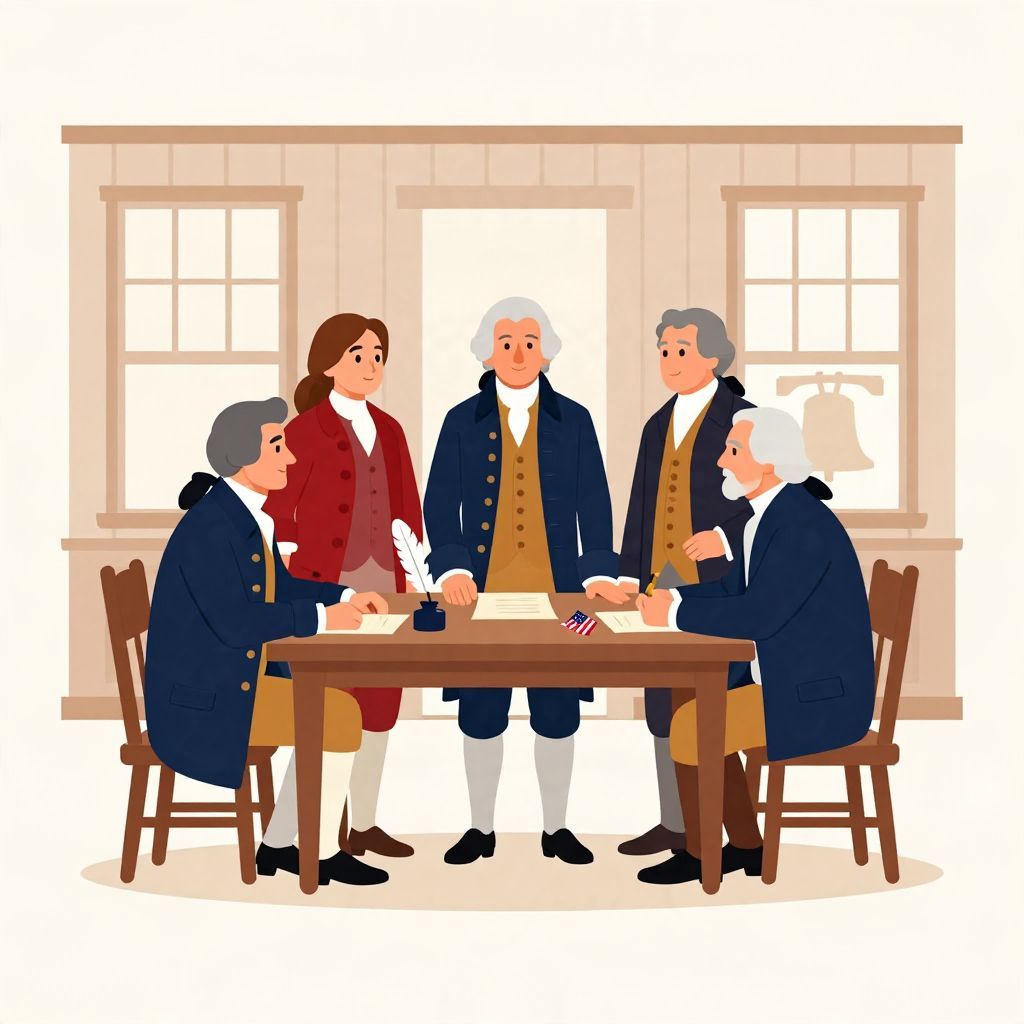
The question “How old were the Founding Fathers in 1776?” has a simple answer and a more interesting one. In the year the Declaration of Independence was adopted, the men most closely associated with the American founding ranged from their early 20s to their early 70s.
That age spread mattered. The Revolution was not led by one generation alone, but by a mix of younger radicals, middle-aged organizers, and older statesmen whose experience shaped the break with Britain.
How old were the Founding Fathers in 1776?
In 1776, the best-known Founding Fathers were mostly in their 20s, 30s, 40s, 50s, and 70s. Thomas Jefferson was 33, James Madison 25, Alexander Hamilton 21, John Adams 40, Benjamin Franklin 70, and George Washington 44. The founding generation was broad, not a single age group.
The ages of major Founding Fathers in 1776
Here is a quick snapshot of some of the most prominent figures associated with the founding era. Their ages are based on their birth dates and their ages during 1776, the year of the Declaration of Independence.
- George Washington — born 1732, age 44 in 1776
- John Adams — born 1735, age 40 in 1776
- Thomas Jefferson — born 1743, age 33 in 1776
- Benjamin Franklin — born 1706, age 70 in 1776
- James Madison — born 1751, age 25 in 1776
- Alexander Hamilton — born 1755, age 21 in 1776
- John Hancock — born 1737, age 39 in 1776
- Samuel Adams — born 1722, age 54 in 1776
- Roger Sherman — born 1721, age 55 in 1776
- Benjamin Rush — born 1746, age 30 in 1776
These ages help show that the American Revolution was a multi-generational political movement. Some leaders were seasoned public figures, while others were young men just beginning their careers in law, military service, or politics.
Why their ages mattered in the Revolution
The age of the Founding Fathers was not just a biographical detail. It affected how they approached independence, war, and government. Older leaders often brought political experience and public credibility, while younger leaders brought urgency, ambition, and new ideas. Together, they created a coalition broad enough to sustain a revolution.
Older leaders brought experience and authority
Benjamin Franklin was already a famous printer, scientist, diplomat, and writer by 1776. His long public career gave him unusual influence in both America and Europe. John Adams, though much younger than Franklin, was also a seasoned lawyer and political thinker by the time independence was declared. George Washington had military experience from the French and Indian War, which made him a natural choice to command the Continental Army.
Younger leaders brought energy and new political ideas
Thomas Jefferson, James Madison, and Alexander Hamilton belonged to a younger generation. Jefferson’s age in 1776 is especially notable because he was only in his early 30s when he drafted the Declaration of Independence. Madison and Hamilton were even younger, and both would later play major roles in shaping the Constitution and the new federal government. Their youth helped give the founding era a forward-looking character.
How old were the signers of the Declaration of Independence?
The Declaration of Independence was signed by men of very different ages. The signers were not all “Founding Fathers” in the same sense, but many became central figures in the new nation. Their ages ranged from young adulthood to old age, with most in middle age.
Examples of signer ages in 1776
- Thomas Jefferson — 33
- John Adams — 40
- Benjamin Franklin — 70
- John Hancock — 39
- Samuel Adams — 54
- Roger Sherman — 55
- Robert Morris — 42
- Button Gwinnett — 42
- Francis Lewis — 62
- George Wythe — 49
Most signers were in their 30s, 40s, or 50s, which reflects the practical reality of revolutionary politics. Men usually had to build reputations, property, and local influence before they could represent colonies in major political decisions. A few were younger, but the founding leadership was not dominated by teenagers or men in their early 20s.
Who counts as a “Founding Father”?
The phrase “Founding Fathers” is a later historical label, not an official title used in 1776. Historians and the public often use it to describe the men who helped lead the American Revolution, sign the Declaration, draft state and federal constitutions, fight the war, and establish the new government. That means the list can vary depending on the context.
Different ways historians use the term
Some people use “Founding Fathers” narrowly to mean the most famous names: Washington, Jefferson, Adams, Franklin, Madison, Hamilton, and a few others. Others use it more broadly to include signers, military leaders, state constitution writers, and diplomats. Because of that, there is no single official roster, and age comparisons can shift depending on who is included.
Still, the core point remains the same: the founding generation spanned a wide age range, and the Revolution depended on cooperation across that range.
What 1776 looked like in the lives of these men
To understand their ages, it helps to place them in context. In 1776, the United States did not yet exist as a fully formed nation. The colonies were in rebellion, the Continental Congress was trying to hold together a fragile political coalition, and British forces still posed a serious threat.
George Washington at 44
Washington was in his mid-40s and already had a public reputation as a soldier and gentleman planter. He was old enough to command respect, but young enough to endure the physical demands of leading an army through a long war. His age placed him in the middle of the founding generation rather than at its oldest edge.
Benjamin Franklin at 70
Franklin was the elder statesman of the Revolution. By 1776, he had spent decades in public life and had become one of the most recognizable Americans in the Atlantic world. His age gave him authority, but also made him a symbolic link to an earlier colonial era. He represented continuity as well as change.
Thomas Jefferson at 33
Jefferson was young for someone entrusted with writing a document of such importance. His age is a reminder that revolutionary leadership could move quickly when talent and political trust aligned. He was not yet an old political veteran, but he had already proven himself as a writer and legislator.
James Madison and Alexander Hamilton in their 20s
Madison and Hamilton were among the youngest major founders. In 1776, Madison was 25 and Hamilton only 21. They were not the most visible leaders of independence itself, but they would become crucial in the later stages of nation-building. Their youth helps explain why the founding era continued evolving long after the Declaration was signed.
Average age of the Founding Fathers: what can we say?
There is no single official average age for all Founding Fathers, because the group is not fixed and the label is broad. But if one looks at the best-known revolutionary leaders, the average falls roughly in the middle years of adulthood, with many in their 30s, 40s, and 50s. The group was not unusually young or old by the standards of 18th-century politics.
That makes sense historically. Political leadership in the 1700s usually came from men who had already built careers, property, and public standing. At the same time, the crisis of revolution opened the door for younger men to rise quickly if they had the right skills and connections.
Why the age range of the founders is important
The age spread among the Founding Fathers helps explain the nature of the American Revolution itself. It was not a sudden uprising led by one generation alone. It was a layered movement in which older and younger men contributed different strengths: experience, rhetoric, military leadership, legal skill, and institutional design.
It shows the Revolution was both conservative and radical
Many founders were not young rebels in the modern sense. They were established men defending rights they believed had been violated. Yet younger leaders pushed the movement further toward independence and nationhood. The result was a revolution that combined continuity with change.
It helps explain the Constitution, too
The age of the founders matters beyond 1776 because many of the same men later shaped the Constitution in 1787 and the early republic in the 1790s. By then, some were older and more experienced, while others were still relatively young. The founding era was therefore a long process, not a single year.
Timeline: ages of key founders during the founding era
These milestones show how the same men moved through the revolutionary period at different stages of life.
- 1776 — Declaration of Independence adopted; Jefferson is 33, Adams 40, Washington 44, Franklin 70
- 1781 — British surrender at Yorktown; the war’s outcome begins to turn in America’s favor
- 1787 — Constitutional Convention; Madison is 36, Hamilton 32, Washington 55
- 1789 — Washington becomes first president at 57; Franklin dies at 84
This timeline shows that the founding generation was active across decades. Some men were central in 1776 but less so later, while others rose to prominence after independence had already been declared.
So, how old were the Founding Fathers in 1776?
In short, the Founding Fathers in 1776 were a surprisingly mixed-age group. The most famous names ranged from Alexander Hamilton at 21 to Benjamin Franklin at 70, with many key figures clustered in middle age. That range reflects the real character of the American founding: a coalition of generations, not a single age cohort.
If you want to explore the broader context of the Revolution, you may also find it useful to read about when the USA was founded and the historical background behind major dates and turning points such as the Ides of March.