
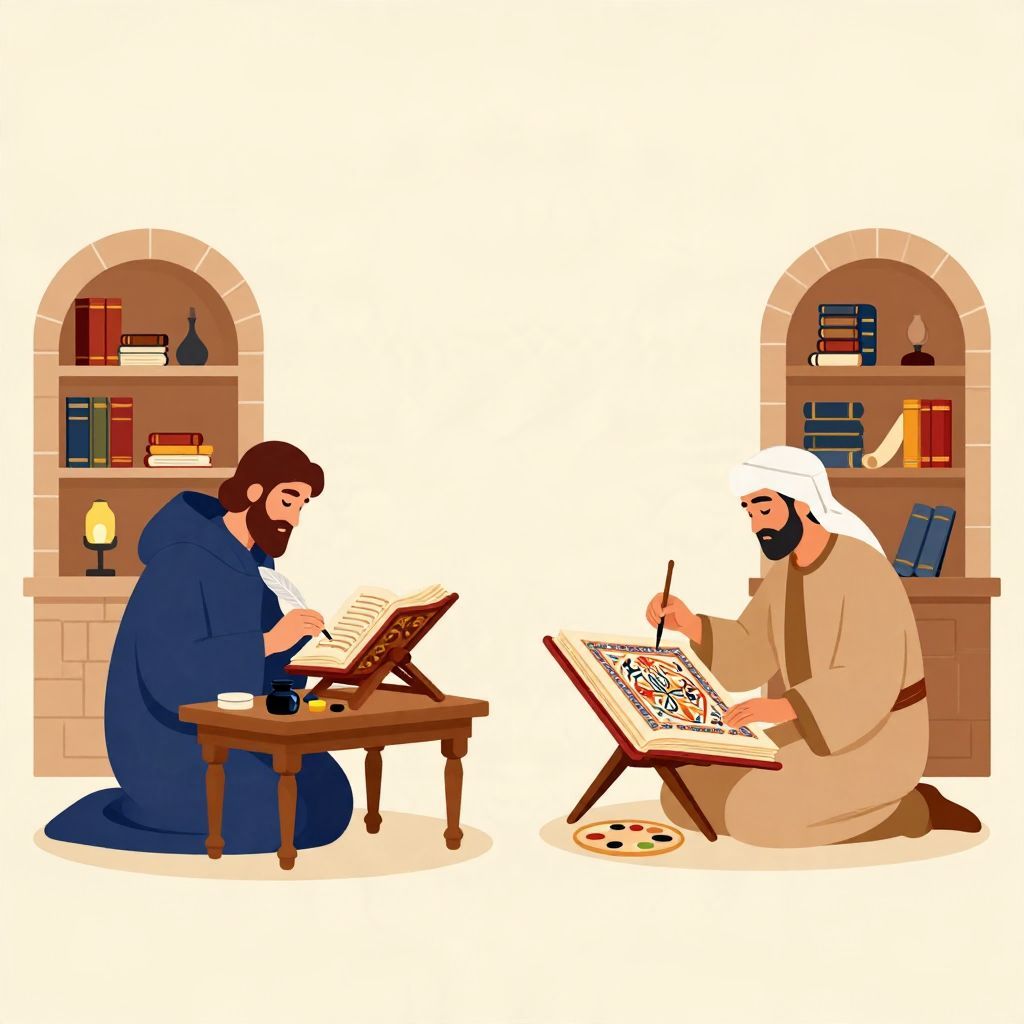
Illuminated manuscripts were historically created and used primarily by Christianity and Islam. In both traditions, sacred texts, devotional works, and elite books were decorated with gold, color, and intricate ornament to honor the written word and display learning, piety, and authority.
Although the styles and purposes differed, manuscript illumination became one of the most important forms of religious art in the medieval world. Its history reveals how faith, scholarship, and craftsmanship shaped book culture across Europe, the Middle East, and beyond.
Illuminated manuscripts have historically been created and used by which two religious faiths?
The two religious faiths most closely associated with illuminated manuscripts are Christianity and Islam. Christian communities produced illuminated Bibles, psalters, gospel books, and prayer books, while Islamic societies produced illuminated Qur’ans, scientific texts, poetry, and courtly manuscripts. Both traditions valued beautiful writing and ornament, though for different theological and cultural reasons.
What is an illuminated manuscript?
An illuminated manuscript is a handwritten book decorated with gold, silver, vivid pigments, or elaborate ornament. The term “illumination” originally referred to the way gold leaf and bright colors seemed to make the page glow. These books were usually made before printing spread in Europe and the Islamic world, especially between late antiquity and the early modern period.
Illumination was more than decoration
Illumination could frame a sacred text, mark important passages, guide readers through a book, or display the wealth and status of a patron. In religious settings, decoration also reinforced reverence: the page itself became an object of devotion, not just a vehicle for words.
Christianity and the rise of illuminated books
Christianity was one of the earliest and most influential traditions to develop illuminated manuscripts on a large scale. From the late Roman Empire onward, Christian scribes and artists produced lavish Gospel books, Bibles, liturgical texts, and devotional manuscripts for churches, monasteries, and rulers.
Early Christian and late antique beginnings
By the 4th and 5th centuries, as Christianity became more established in the Roman world, manuscript production expanded. Some of the earliest surviving Christian illuminated books include gospel codices and biblical manuscripts with decorated initials, portraits of evangelists, and elaborate canon tables. The book form itself—the codex, or bound pages—became central to Christian textual culture.
Monastic scriptoria and medieval Europe
During the early Middle Ages, monasteries became major centers of manuscript production. Monks copied and decorated texts for worship, study, and preservation. Famous traditions such as Insular art in Ireland and Britain, Carolingian illumination under Charlemagne, and later Romanesque and Gothic styles all contributed to a rich visual language for Christian books.
Christian illuminated manuscripts were not limited to the Bible. They included psalters, missals, breviaries, books of hours, saints’ lives, and theological works. In many cases, these manuscripts were used daily in worship or private devotion, so their beauty served both spiritual and practical purposes.
Why Christians illuminated manuscripts
- To honor sacred scripture and liturgy
- To make important texts easier to navigate
- To express devotion through beauty and craft
- To display the prestige of patrons, churches, or rulers
- To teach biblical stories visually to readers and worshippers
Islam and the manuscript tradition
Islam also developed a strong and enduring manuscript culture, especially from the 7th century onward. The most revered Islamic manuscript was the Qur’an, which was copied with exceptional care and often richly decorated. Over time, Muslim societies also produced illuminated books of poetry, history, medicine, astronomy, and administration.
The Qur’an and reverence for the written word
Because the Qur’an is regarded as the revealed word of God, its written form carried profound religious importance. Scribes developed highly refined calligraphic styles, and illuminators used geometric, vegetal, and abstract ornament to frame the text. Early Qur’ans often featured decorated chapter markers, illuminated headings, and gold embellishment rather than figurative imagery.
This emphasis on calligraphy and ornament reflected both artistic taste and religious sensibility. In many Islamic contexts, the beauty of the script itself was a form of devotion, and illumination supported the dignity of the sacred text.
Beyond scripture: courts, scholarship, and literature
Islamic manuscript illumination was not confined to religious books. Persian, Arabic, and later Ottoman, Mughal, and other manuscript traditions produced richly decorated copies of epic poetry, scientific treatises, histories, and albums. Some manuscripts included figurative miniatures, especially in Persian and later South Asian courtly settings, while Qur’ans generally remained non-figurative.
These books circulated among scholars, rulers, and elites. They were used for study, recitation, administration, and display. In many Islamic societies, manuscript culture linked religious learning with court patronage and intellectual life.
How Christian and Islamic manuscript traditions differed
Christian and Islamic illuminated manuscripts shared a devotion to the beauty of the written word, but they developed different visual emphases. Christian manuscripts often included figurative scenes from the Bible, portraits of saints, and narrative imagery. Islamic manuscripts, especially Qur’ans, usually emphasized calligraphy, geometry, and abstract ornament, though some non-religious books included illustrations.
Shared features
- Hand-copied texts produced before mass printing
- Use of gold, color, and fine materials
- Religious reverence for sacred or authoritative writing
- Patronage by rulers, clergy, scholars, and wealthy elites
- Combination of artistic, educational, and devotional functions
Important differences
- Christian manuscripts more often used narrative figural imagery
- Islamic Qur’ans typically favored calligraphy and ornament over images
- Christian manuscript production was deeply tied to monasteries and churches
- Islamic manuscript production was closely linked to mosques, madrasas, courts, and urban scholarly networks
Timeline of illuminated manuscripts in Christian and Islamic history
The history of illuminated manuscripts spans many centuries, but a simplified timeline helps show how both faiths shaped the tradition.
- 4th–6th centuries: Christian illuminated books emerge in late antiquity as Christianity becomes a major religion in the Roman world.
- 7th century onward: Islamic manuscript culture develops after the rise of Islam, with the Qur’an at its center.
- 8th–12th centuries: Christian monasteries and Islamic courts both expand manuscript production and decoration.
- 12th–15th centuries: Gothic Christian books and major Islamic manuscript traditions flourish, including Persian and Mamluk examples.
- 15th–16th centuries: Printing gradually changes book production in Europe, while manuscript illumination continues in some Islamic regions and in luxury Christian books.
- After the 16th century: Printed books dominate, but illuminated manuscripts remain important in ceremonial, devotional, and artistic contexts.
Why illuminated manuscripts mattered historically
Illuminated manuscripts were not simply beautiful objects. They were tools of religious practice, learning, and power. In Christian Europe, they helped preserve scripture and liturgy through centuries of political change. In Islamic societies, they sustained a culture of reverence for the Qur’an and supported broad traditions of scholarship and patronage.
They preserved knowledge before print
Before the printing press, manuscripts were the main way to transmit sacred texts, legal works, medicine, philosophy, and literature. Because each manuscript was copied by hand, every surviving example also reflects the labor of scribes, artists, and binders who invested time and skill in its creation.
They expressed authority and identity
For rulers and religious institutions, a lavish manuscript could signal legitimacy, learning, and divine favor. A beautifully decorated gospel book or Qur’an was both an object of worship and a statement of cultural identity. The manuscript page became a place where faith and power met.
Common misconceptions about illuminated manuscripts
One common misconception is that illuminated manuscripts were only made for kings or only for monks. In reality, they served many audiences, from churches and monasteries to courts, scholars, and private devotees. Another misconception is that all illuminated manuscripts were religious. While many were, especially in Christianity and Islam, some were secular works of poetry, science, or history.
It is also important not to overstate a single artistic rule for Islam or Christianity. Both traditions were diverse across regions and centuries. Local customs, theological views, available materials, and patron preferences all shaped how books were decorated.
Historical significance today
Illuminated manuscripts remain vital sources for historians, art historians, and scholars of religion. They reveal how texts were read, revered, and used in daily life. They also preserve evidence of language, trade, artistic exchange, and the movement of ideas across continents.
Today, manuscripts are studied in libraries, museums, and archives around the world. Their survival reminds us that religious history is not only about doctrine and institutions, but also about material culture: paper, parchment, ink, gold, and the hands that transformed them into works of art.
So, the direct answer is clear: illuminated manuscripts were historically created and used chiefly by Christianity and Islam. Their long and varied traditions show how two major world religions turned books into sacred and artistic objects, shaping the history of reading, devotion, and visual culture. For more on related topics, see medieval Christian art and the history of Islamic calligraphy.