
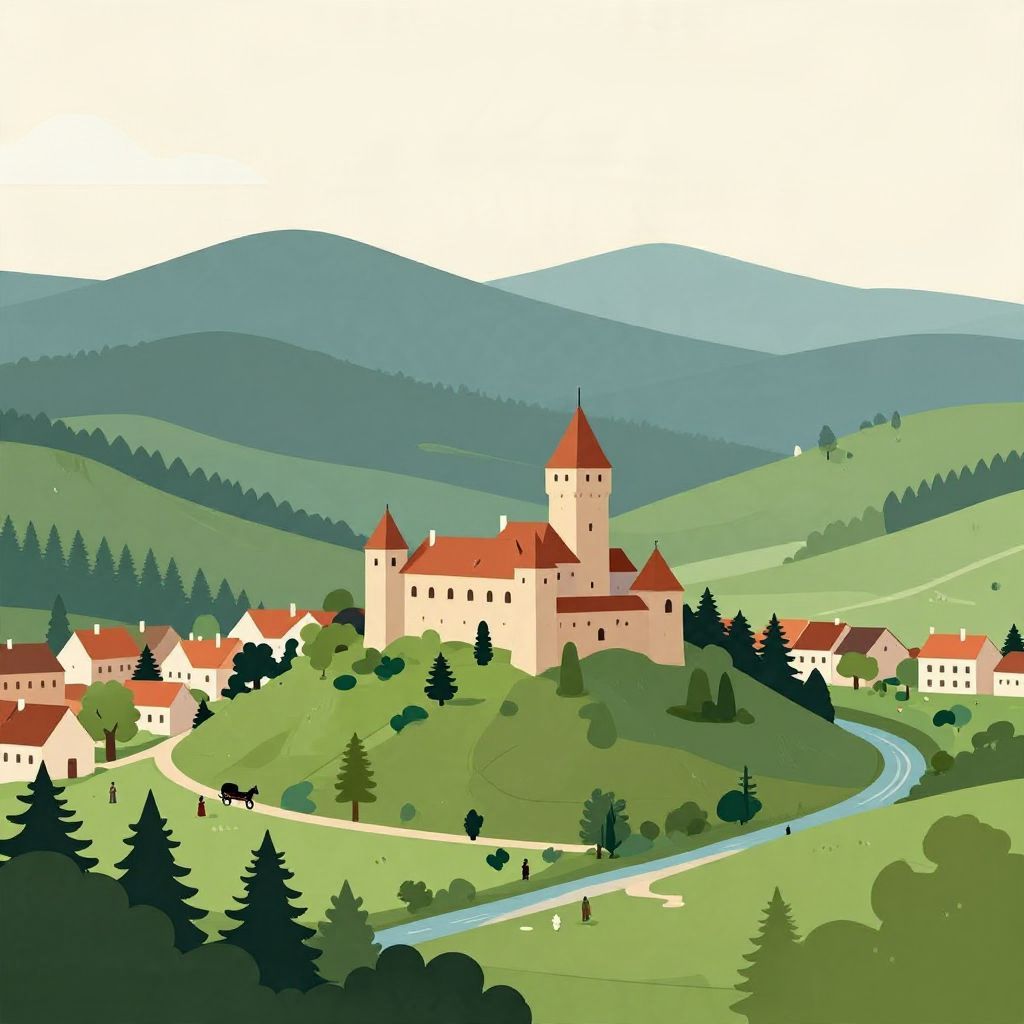
Is Transylvania a real place? Yes—Transylvania is a real historical and geographic region in central Romania, not just a setting from vampire stories. It has a long documented past, a distinct landscape, and a name that appears in medieval records centuries before Dracula entered popular culture.
The confusion comes from the region’s dramatic reputation. In folklore and fiction, Transylvania became associated with castles, mountains, and the supernatural, but the place itself is entirely real and has played an important role in Central European history.
Is Transylvania a real place?
Yes. Transylvania is a real region in central Romania, bordered by the Carpathian Mountains. It has been inhabited for thousands of years and appears in historical sources under various names. The region was part of the Kingdom of Hungary, later the Habsburg Empire, and eventually modern Romania.
Where is Transylvania located?
Transylvania lies in the interior of modern-day Romania, surrounded on several sides by the Carpathians. Its name is usually associated with a broad plateau and mountain basin rather than a single city or province. Major historic centers include Cluj-Napoca, Sibiu, Brașov, and Alba Iulia.
Because it is enclosed by mountains and has a strong regional identity, Transylvania has often been imagined as remote or mysterious. In reality, it has long been connected to trade routes, migration, and political change across Central and Eastern Europe.
The historical origins of Transylvania
Human settlement in the region goes back to prehistoric times. In antiquity, the area was inhabited by the Dacians, who built fortified settlements and developed a complex society before Roman conquest. The Roman Empire annexed much of Dacia under Emperor Trajan in the early 2nd century CE, though Roman control did not last permanently.
After the Roman withdrawal in the 3rd century, the region saw successive movements of peoples and political formations over many centuries. By the early medieval period, Transylvania became part of the sphere of the Kingdom of Hungary, which shaped its political and demographic history for centuries.
Why the name matters
The word “Transylvania” is generally understood to mean “beyond the forest” from Latin roots, reflecting how medieval outsiders described the region. This does not mean it was invented as a fantasy name; it was a geographic label used in real administrative and historical contexts.
Transylvania in medieval and early modern history
During the Middle Ages, Transylvania was a frontier region of the Hungarian kingdom, with a diverse population that included Hungarians, Romanians, Saxons, Szeklers, and others. Its towns developed under a mix of royal, ecclesiastical, and local authority, and many communities had special privileges and legal arrangements.
After the Battle of Mohács in 1526 and the collapse of central Hungarian power, Transylvania became the center of the Principality of Transylvania, a semi-independent state that navigated between the Ottoman Empire and the Habsburgs. This period gave the region a distinct political identity that historians still study closely.
A region of many communities
Transylvania’s history is not the story of one ethnic group alone. Its population changed over time through settlement, war, trade, and state policy. That diversity is one reason the region has such a complex historical memory in Romania, Hungary, and beyond.
- Dacians shaped the pre-Roman era.
- Romans left roads, forts, and administrative influence.
- Medieval Hungarians integrated the region into a larger kingdom.
- Saxon settlers contributed to urban and commercial life.
- Romanians formed a major part of the population and cultural landscape.
How Transylvania became linked to Dracula
Transylvania’s modern fame owes much to Vampire literature, especially Bram Stoker’s 1897 novel Dracula. Stoker never visited the region, but he used its name because it sounded exotic to English readers and fit the novel’s atmosphere of danger and superstition.
The fictional Count Dracula is not a historical ruler of Transylvania. He is a literary character inspired in part by the reputation of Vlad III, also known as Vlad the Impaler, a 15th-century ruler of Wallachia, a neighboring principality. Vlad was real; Dracula as a vampire is not.
Fact and fiction are not the same
This is where confusion often begins. The real Transylvania has castles, mountain passes, medieval towns, and a turbulent borderland history. Those features made it easy for later writers and filmmakers to turn the region into a setting for horror fiction. But the gothic image is cultural, not proof that the place itself is imaginary.
What historical evidence proves Transylvania is real?
There is abundant evidence for Transylvania as a real region: medieval charters, royal administration, church records, town privileges, maps, travel accounts, archaeological remains, and modern political boundaries. Historians can trace its development across centuries through these sources.
The region also appears in the records of neighboring states and empires, including Hungary, the Ottoman Empire, and the Habsburg Monarchy. Its cities, fortresses, and monasteries still stand as physical evidence of its past.
Examples of historical evidence
- Written records from medieval Hungarian and later Habsburg administration.
- Archaeology showing settlement from prehistoric, Roman, and medieval periods.
- Surviving architecture such as fortified churches, castles, and city walls.
- Maps and chronicles that identify the region by name.
- Modern state records defining Transylvania within Romania.
Transylvania in modern history
In the 19th and 20th centuries, Transylvania became especially important in debates over nationalism, ethnicity, and borders. After the Austro-Hungarian Empire collapsed in 1918, Transylvania was united with Romania. The Treaty of Trianon in 1920 confirmed most of this transfer internationally.
That change did not erase the region’s multicultural past. Instead, it added another layer to a long history of shifting sovereignty. Today, Transylvania remains a major historical and cultural region within Romania, with strong local traditions and a complex memory shared by multiple communities.
Why people still ask if Transylvania is real
The question persists because popular culture often overwhelms historical knowledge. Movies, novels, and tourism marketing have made Transylvania feel mythic. For many people, the name first appears in connection with Dracula, not with medieval towns, imperial politics, or real geography.
There is also a broader historical reason: borderlands are often misunderstood. Regions like Transylvania change rulers, languages, and identities over time, which can make them seem less “real” to outsiders. But complexity is not the same as unreality.
Real place, real history, real myths
Transylvania is a real place with a real and well-documented past. What is fictional is the idea that its identity is defined mainly by vampires. The stronger historical truth is that it was a crossroads of peoples, empires, and religions for many centuries.
Conclusion
So, is Transylvania a real place? Absolutely. It is a real region in central Romania with ancient roots, medieval records, and a rich historical legacy. Its reputation as a land of castles and vampires belongs to folklore and fiction, but the geography, people, and history behind the name are genuine. If you want to explore more regional history, you may also enjoy articles on the Kingdom of Hungary and Vlad the Impaler.