
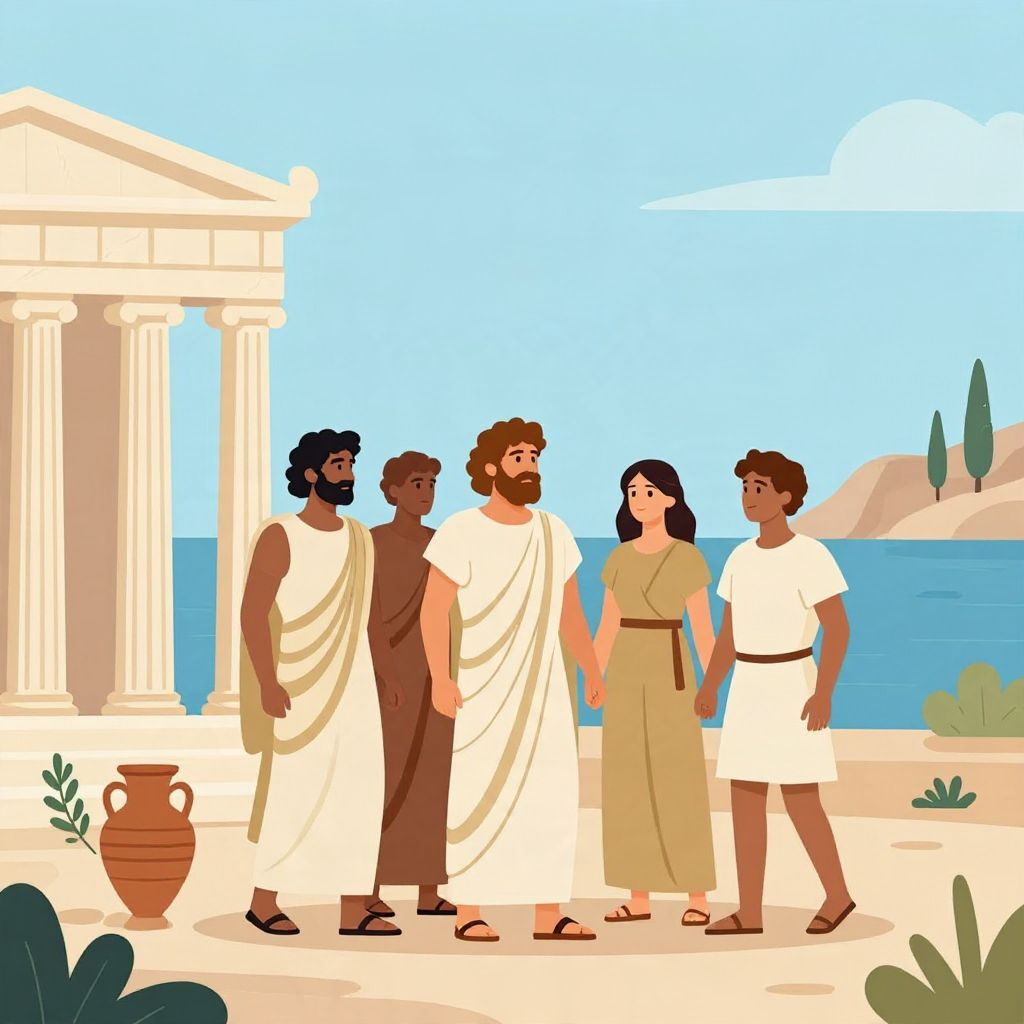
What did ancient Greeks look like? It is a simple question with a complicated answer, because “ancient Greeks” were not one uniform people. Across the Greek world, from mainland city-states to islands and colonies around the Mediterranean, appearance varied by region, diet, social class, age, and era.
What we can say with confidence is that ancient Greeks were generally Mediterranean populations of the Bronze Age and Iron Age, with physical traits similar to other peoples of southern Europe and the Aegean. Their art, skeletons, and written descriptions help us reconstruct their appearance, but no single “Greek look” existed.
What Did Ancient Greeks Look Like?
Ancient Greeks were typically depicted and, in many cases, likely appeared as people with dark hair, brown eyes, and skin tones ranging from light olive to medium tan, though there was wide variation. Their look was shaped by geography, ancestry, diet, and daily life, and ancient art often idealized their features rather than recording them exactly.
Ancient Greek appearance: what the evidence actually shows
1. Art gives clues, but not perfect realism
Greek sculpture, vase painting, and mosaics are among the best-known sources for ancient Greek appearance. These works often show men and women with straight or wavy hair, strong noses, and athletic bodies. But Greek artists were not trying to create modern-style portraits in most cases. They aimed for beauty, status, divine ideals, or civic identity.
That means a marble statue of a god or athlete should not be read as a photograph. Even so, repeated artistic patterns suggest that many Greeks imagined themselves as dark-haired and generally medium-complexioned, especially compared with the pale marble surfaces that survive today.
2. Skeletons and teeth reveal health more than “race”
Archaeology can tell us about nutrition, workload, disease, and average height, but not exact eye color or hairstyle. Skeletal remains from ancient Greece and Greek colonies show that many people lived physically demanding lives. Average height was often lower than modern standards, partly because of childhood nutrition and illness.
Teeth and bones also show that some Greeks suffered from stress, hard labor, and periodic food shortages. In other words, the typical ancient Greek body was not the polished, idealized body of a temple statue. Many people were lean, weathered, and shaped by manual work.
3. Ancient writers noticed variety among Greeks and neighbors
Greek and later Roman authors sometimes described physical traits, but these accounts are uneven and often tied to stereotypes. Some writers associated northern peoples with lighter hair and colder climates, while southern peoples were often described as darker or more sun-tanned. Such descriptions reflect ancient ideas about geography and character as much as actual observation.
Importantly, the ancient Greek world included many communities: Athenians, Spartans, islanders, Macedonians, Ionians, Dorians, Aeolians, and Greek-speaking settlers in Asia Minor, southern Italy, North Africa, and the Black Sea region. Over centuries, intermarriage and migration made appearance even more diverse.
How ancient Greeks probably looked in daily life
Hair, eyes, and skin tone
Most evidence suggests that many ancient Greeks had dark brown or black hair, with brown eyes being common. Lighter hair and eyes certainly existed, but they were probably less common than in some northern European populations. Skin tone would have varied naturally, but many Greeks likely had olive to medium complexions, especially in sunny Mediterranean climates where outdoor life produced tanning.
It is also worth remembering that ancient people did not divide human appearance using modern racial categories. They noticed difference, but their classifications were based on language, customs, geography, and political identity more than on the rigid racial systems used later in history.
Facial features and body type
There was no single Greek face. Some people had narrow faces, others broader ones; some had straight noses, others more curved profiles. The famous “Greek nose” is a later artistic stereotype, not a universal ancient feature. Greek sculpture often favored balanced proportions and symmetrical faces because those qualities were linked to beauty and harmony.
As for body type, many Greeks were likely lean and muscular rather than heavily built, especially men who trained for war, athletics, or labor. Yet body shape varied widely. Wealthy people, who had more access to food and less physical labor, may have looked different from farmers, sailors, artisans, and enslaved people.
Clothing and grooming mattered a great deal
If you want to picture an ancient Greek, clothing is as important as anatomy. Men commonly wore a chiton or a himation, while women wore longer tunics and draped garments. Fabrics were usually wool or linen, and colors ranged from plain natural shades to dyed garments for the wealthy. Clothing signaled age, gender, occupation, and status.
Hair and grooming also shaped appearance. Greek men often wore beards in some periods, especially in the Archaic and Classical eras, though fashions changed over time. Women arranged their hair in braids, buns, nets, or ribbons, depending on local custom and social class. Cosmetics, oils, and perfumes were known in the Greek world, especially among the elite.
Ancient Greek appearance across different periods
Bronze Age Greeks: Minoans and Mycenaeans
The earliest Greek-speaking cultures, including the Mycenaeans of the Late Bronze Age, are known from palace art, frescoes, and burial evidence. Their appearance was likely similar to other eastern Mediterranean populations of the time. Frescoes from sites such as Knossos and Mycenae show men and women with dark hair, narrow waists, and elaborate dress, though these images are stylized and sometimes ceremonial.
Because the Bronze Age was long before the classical city-state period, it is best to think of these peoples as ancestors of later Greeks rather than identical to them in every respect. Their appearance was part of a broader Aegean world connected to Anatolia, the Levant, and Egypt.
Archaic and Classical Greeks
By the Archaic period, roughly the 8th to 6th centuries BCE, Greek communities had developed distinctive artistic styles. Vase paintings from this era often show men with athletic builds and women with flowing garments and carefully arranged hair. In the Classical period, roughly the 5th and 4th centuries BCE, sculpture became more naturalistic and idealized the human form even more strongly.
This is the period that shaped the modern image of ancient Greece: marble bodies, balanced faces, and heroic nudity in art. But the ideal body in sculpture was not the same as the average body in the street. Most people would have looked less polished, more weathered, and more practical in everyday life.
Hellenistic Greeks
After the conquests of Alexander the Great in the late 4th century BCE, Greek culture spread across a vast area from Egypt to Central Asia. In the Hellenistic era, Greek identity became more cosmopolitan. Greeks lived among Egyptians, Persians, Syrians, Jews, and many other peoples, and local populations adopted Greek language and customs to varying degrees.
As a result, appearance in the Greek-speaking world became even more diverse. In cities such as Alexandria, Antioch, and Pergamon, “Greek” could describe language and culture as much as ancestry.
What ancient Greeks did not look like
They were not a single “race” with one fixed appearance
Modern people sometimes ask whether ancient Greeks looked “white,” “Mediterranean,” or “European” in today’s racial terms. Those categories are too blunt for ancient history. Greeks were a historical population with regional diversity, not a biologically uniform group. Their appearance overlapped with many neighboring peoples around the Aegean and eastern Mediterranean.
It is also misleading to imagine all ancient Greeks as matching later European beauty standards. Ancient art created a selective image, and centuries of later copying, restoration, and classical revival have reinforced a simplified look that was never universal.
They were not all pale marble figures
One of the most persistent myths is that ancient Greek statues prove Greeks were pale-skinned. In reality, marble statues were often painted, and much of that color has been lost. The white marble we see in museums is not the original appearance of most Greek sculpture. Ancient viewers saw a more colorful world of painted hair, skin details, jewelry, and clothing.
So the familiar white statue is a poor guide to actual ancient Greek appearance. It tells us more about survival, restoration, and later taste than about living bodies.
How ancient Greeks compared with neighboring peoples
Ancient Greeks lived in a crossroads region. To the north were Macedonians and Thracians; to the east were Anatolian and Near Eastern populations; to the south were Egyptians and Libyans; to the west were Italic and Sicilian communities. Trade, war, colonization, and intermarriage meant that appearance could vary significantly from one Greek city or colony to another.
Greek identity was therefore cultural and linguistic as much as physical. A person could be Greek by language, religion, education, and civic membership even if their ancestry was mixed. This is one reason why trying to define a single “ancient Greek look” can be historically misleading.
Why the question still matters today
People ask what ancient Greeks looked like because Greece has had an enormous influence on later ideas about beauty, democracy, philosophy, and art. But the question also reveals how modern societies use the ancient world to support myths about identity. The real history is more interesting than the myth: ancient Greeks were diverse, practical, and deeply human.
They worked, fought, prayed, traded, and traveled. Their appearance reflected climate, labor, diet, and local tradition, while their art reflected ideals of order and proportion. The result is a civilization that is visually familiar in sculpture yet far more varied in life than popular images suggest.
Timeline: how Greek appearance changed over time
- c. 1600–1100 BCE: Mycenaean and other Bronze Age Aegean populations form the earliest Greek-speaking cultural background.
- 8th–6th centuries BCE: Archaic Greek art begins to show stylized but recognizable human figures with regional variation.
- 5th–4th centuries BCE: Classical sculpture idealizes the Greek body and becomes the main source for the modern image of ancient Greeks.
- Late 4th century BCE onward: Hellenistic expansion spreads Greek culture across a much wider, more diverse world.
- Roman period and later: Greek identity continues, but appearance becomes even more mixed across the eastern Mediterranean.
So, what did ancient Greeks look like?
Ancient Greeks were not a single type of person, but a range of Mediterranean populations sharing language and culture. Many likely had dark hair, brown eyes, and olive-to-medium complexions, with lean bodies shaped by active lives. Yet their true appearance varied by place, class, era, and ancestry, and ancient art often idealized them.
If you want to explore how historians reconstruct the look of past peoples, you may also find what Vikings looked like useful for comparison. The broader lesson is the same: the past rarely fits one neat image, and ancient people were more diverse than later myths suggest.