
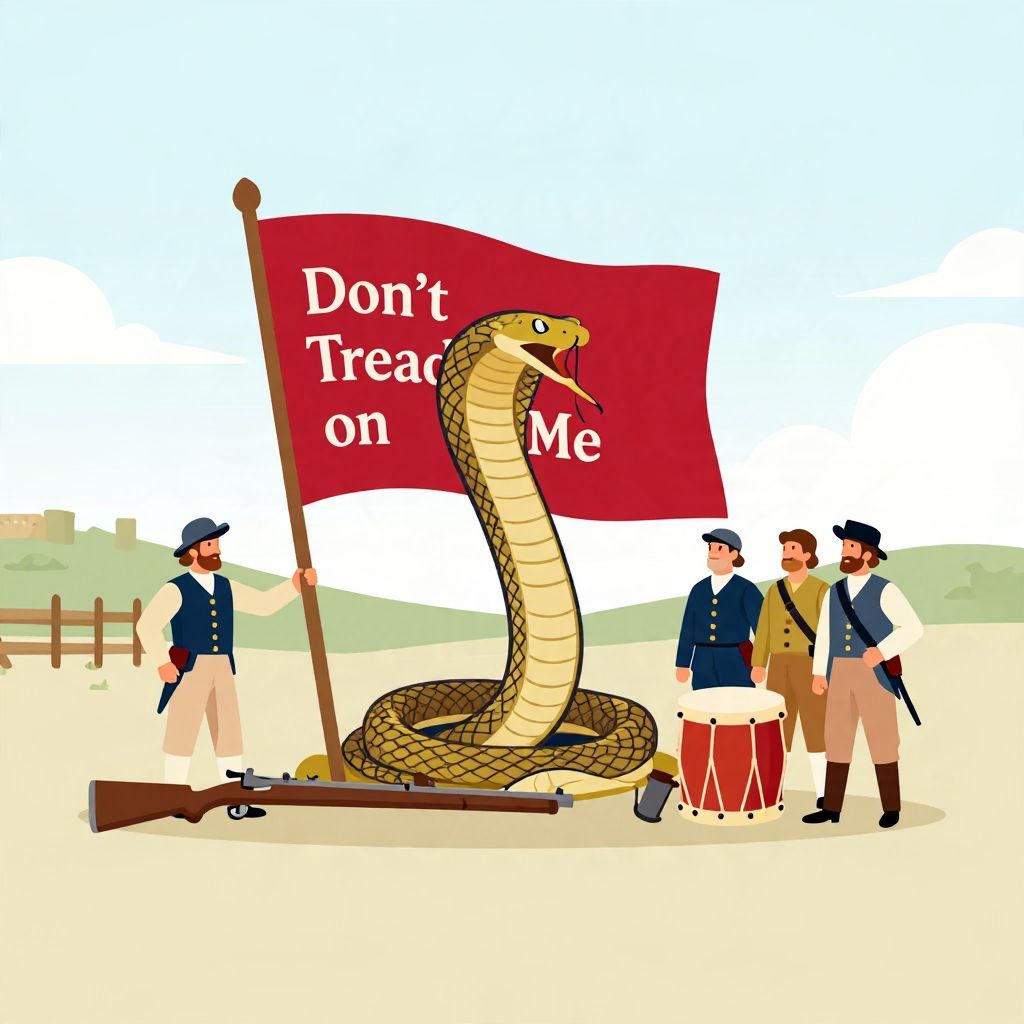
“Don’t Tread On Me” is a warning and a declaration of resistance. In American history, it most often refers to the Gadsden flag, a Revolutionary-era symbol that told political authorities—especially the British Crown—not to violate colonial rights or provoke retaliation.
Its meaning has changed over time. What began as a military and political emblem in the 1770s later became a broader symbol of liberty, defiance, and, in some modern uses, American individualism or anti-government sentiment.
What does “Don’t Tread On Me” mean?
“Don’t Tread On Me” means “do not violate my rights” or “do not provoke me.” Historically, it was a Revolutionary War-era warning that Americans should not be oppressed or ignored. The phrase became famous through the Gadsden flag, which paired the words with a coiled rattlesnake, a symbol of readiness to strike if threatened.
Where did the phrase come from?
The phrase emerged in the political world of the American Revolution, when colonists increasingly saw British policies as unjust. It was not a casual slogan but a forceful expression of resistance. The most famous version appeared on a flag designed in 1775 for the Continental Marines under Christopher Gadsden of South Carolina.
The Revolutionary context
By the mid-1770s, tensions between Britain and the American colonies had escalated over taxation, imperial authority, and military enforcement. After events such as the Stamp Act crisis, the Boston Massacre, and the battles of Lexington and Concord in 1775, many colonists believed that their liberties were under direct threat. “Don’t Tread On Me” captured that mood in a short, memorable warning.
Why a rattlesnake?
The rattlesnake was a popular American Revolutionary symbol. Writers and political cartoonists used it to represent vigilance, territorial defense, and danger when provoked. Benjamin Franklin had earlier praised the rattlesnake in political commentary, helping make it a recognizable colonial emblem. On the Gadsden flag, the snake reinforced the message: leave us alone, or face resistance.
The Gadsden flag and its timeline
The best-known historical association of “Don’t Tread On Me” is the Gadsden flag, created in 1775. It was intended as a military banner for the Continental Marines and became one of the earliest flags associated with the American Revolution. Its meaning was tied to the struggle for independence, not to a single modern political ideology.
Key moments in the flag’s history
- 1760s–1770s: Colonial protests against British taxation and imperial control grow.
- 1775: Christopher Gadsden presents the flag to the Continental Marines.
- American Revolution: The snake-and-motto symbol becomes associated with resistance and liberty.
- 19th century: The phrase appears less prominently, but the rattlesnake remains a patriotic symbol in American visual culture.
- 20th century: The Gadsden flag is revived in political movements and popular culture.
- 21st century: It is used by a wide range of groups, sometimes with conflicting meanings.
What did it mean in the 18th century?
In the 18th century, “Don’t Tread On Me” meant that political power had limits. Colonists who used or supported the slogan were saying that they would not accept arbitrary rule, military coercion, or loss of traditional rights. The phrase was less about abstract nationalism and more about immediate political grievance and self-defense.
Liberty, rights, and warning
The slogan combined two ideas common in Revolutionary thought: liberty and deterrence. It asserted a right to self-government, but it also implied that resistance would follow if that right was violated. That is why the phrase has always carried a sharp edge. It is not a gentle appeal; it is a boundary marker.
How the meaning changed over time
Over the centuries, “Don’t Tread On Me” moved beyond its original Revolutionary setting. Later Americans used it to express different ideas about freedom, from national pride to suspicion of centralized authority. Because the phrase is so compact, it has been easy for different groups to adopt it for their own causes.
From revolution to broader American symbolism
In the 19th century, the phrase was not as universally visible as the Stars and Stripes, but the rattlesnake remained a recurring patriotic image. In the 20th century, especially during periods of political tension, the Gadsden flag and its motto reappeared as symbols of personal liberty and resistance to government overreach. That revival was not a return to the exact meaning of 1775, but a reinterpretation shaped by later politics.
Modern uses and controversies
Today, the phrase can signal several different things depending on who is using it. Some people see it as a general statement of freedom and constitutional rights. Others associate it with libertarian politics or anti-federal sentiment. In some contexts, the flag has also been used by extremist groups, which has complicated its public meaning. Because of that, the symbol can be read very differently depending on time, place, and audience.
Why the phrase became so durable
“Don’t Tread On Me” has lasted because it is vivid, short, and emotionally direct. It uses a simple animal image to communicate a political warning. The phrase also fits a recurring American theme: the tension between individual liberty and governmental authority. That tension has remained relevant long after the Revolution ended.
What makes it historically powerful
- It is rooted in a real revolutionary conflict, not a later myth.
- It uses a memorable symbol, the rattlesnake, to reinforce its message.
- It can be adapted to different political movements, which has helped it survive.
- It expresses both defiance and self-protection, two ideas that resonate across eras.
Common misunderstandings about “Don’t Tread On Me”
One common mistake is assuming the phrase has always meant the same thing. In fact, its meaning has shifted with history. Another misunderstanding is treating it as a simple patriotic slogan detached from conflict. Originally, it was a warning born from war, imperial crisis, and revolutionary politics.
Not just a generic “freedom” slogan
Although many people use “Don’t Tread On Me” as a broad expression of freedom, its historical roots are sharper and more specific. It was tied to the American colonists’ claim that they should not be oppressed by a distant government. That makes it a political statement first and a general motto second.
Historical significance
The historical significance of “Don’t Tread On Me” lies in how clearly it captures the Revolutionary era’s language of resistance. It reflects the colonists’ belief that rights were worth defending and that symbolic warnings could carry political force. The motto also shows how American symbols can outlive the events that created them and take on new meanings in later generations.
In short, “Don’t Tread On Me” began as a Revolutionary warning against oppression, became tied to the Gadsden flag in 1775, and later evolved into a broader symbol of American defiance and liberty. If you want to explore related symbols and ideas, you may also find what a black American flag means and what political ideology is useful for understanding how symbols gain political meaning over time.