
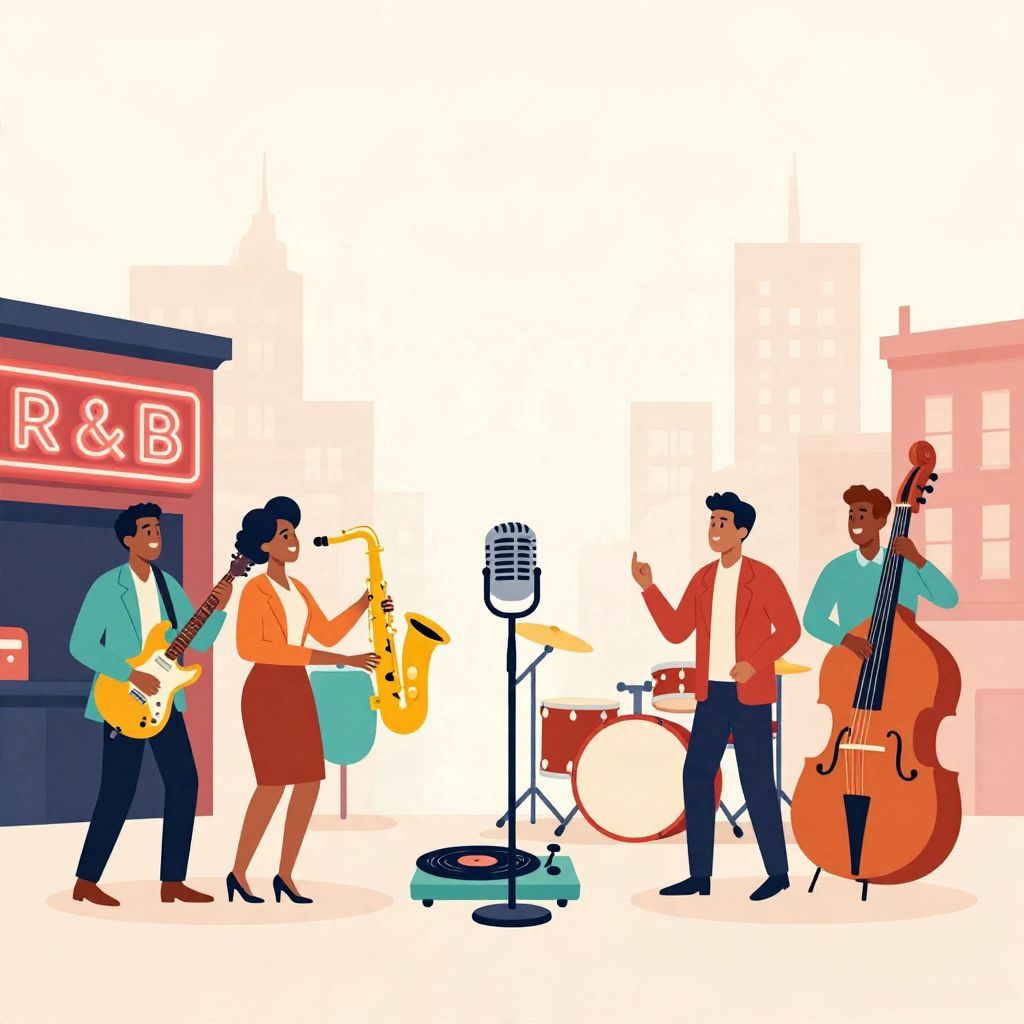
What does R&B stand for? In its most common historical sense, R&B stands for rhythm and blues. The term emerged in the United States in the mid-20th century as a label for Black popular music that blended blues, jazz, gospel, and dance rhythms. Over time, the phrase came to describe a broad and evolving musical tradition.
Its meaning has changed with the music itself. What began as an industry category in the 1940s later became associated with soul, funk, contemporary pop, and modern Black popular music, making R&B both a historical term and a living genre.
What does R&B stand for?
R&B stands for rhythm and blues. The phrase first gained wide use in the United States in the late 1940s as a replacement for the older record-industry label “race records.” It referred to Black popular music that emphasized strong backbeats, vocal expression, and blues-based harmony, while also drawing on jazz, gospel, and dance music traditions.
Where did the term R&B come from?
The term was popularized by music industry writers and record executives in the 1940s, especially in trade publications. It was not originally a self-chosen artistic movement name in the way later genre labels sometimes are. Instead, it was a commercial category used to market music to Black audiences and to organize records in a changing postwar music industry.
The shift from “race records” to rhythm and blues
Before “rhythm and blues” became standard, record companies often used the term “race records” for Black music. By the 1940s, that label had become increasingly outdated and offensive. “Rhythm and blues” sounded more modern and less openly racialized, even though the market it described remained closely tied to Black performers, Black audiences, and segregated distribution systems.
A label shaped by the music business
The phrase also reflected a practical need. As electric instruments, urban blues, jump bands, gospel-inflected vocals, and danceable beats grew more popular, record companies wanted a category broad enough to include these sounds. R&B became a flexible umbrella term for music that was rooted in African American musical culture but not limited to one style.
How did R&B develop over time?
R&B did not remain frozen in its 1940s meaning. The genre evolved through several major phases, each shaped by migration, technology, changing audiences, and crossover into mainstream popular music. Its history is best understood as a timeline of expansion rather than a single fixed style.
1. The 1940s: the original rhythm and blues era
In the late 1940s, rhythm and blues described a lively mix of urban blues, boogie-woogie, jump blues, and vocal group music. Artists such as Louis Jordan helped define the sound with upbeat arrangements and witty lyrics. The music was rooted in Black performance traditions and was often designed for dancing, jukeboxes, and radio play.
2. The 1950s: crossover and the rise of rock and roll
By the 1950s, rhythm and blues had a major influence on the emergence of rock and roll. Many early rock artists borrowed directly from R&B rhythms, vocal styles, and song structures. The boundary between genres was often blurry, and the music industry increasingly used “R&B” to describe Black artists even as some of their sounds crossed into broader pop markets.
3. The 1960s: soul music and civil rights-era expression
In the 1960s, R&B overlapped strongly with soul music. Artists such as Ray Charles, Sam Cooke, Aretha Franklin, Otis Redding, and James Brown helped shape a more emotionally direct and musically powerful style. Gospel influences became especially important, and the music carried deep cultural meaning during the civil rights era.
4. The 1970s: funk, disco, and expansion
During the 1970s, the R&B family of styles widened further. Funk emphasized tight grooves, bass lines, and rhythmic complexity, while disco brought polished dance-floor production. Labels and radio formats still used R&B, but the term now covered a broader musical landscape than it had in the 1940s.
5. The 1980s and 1990s: contemporary R&B
By the 1980s and 1990s, “contemporary R&B” became a common industry phrase. It often referred to music blending soul, pop, funk, hip-hop, and electronic production. Artists such as Whitney Houston, Janet Jackson, Boyz II Men, and Mary J. Blige helped define this era, in which R&B became a major force in mainstream radio and chart culture.
6. The 21st century: genre blending and new definitions
In the modern era, R&B has continued to evolve through neo-soul, alternative R&B, and pop crossover styles. Artists may draw from hip-hop, electronic music, jazz, and indie traditions while still being identified as R&B performers. The term now functions less as a narrow sound description and more as a broad cultural category.
Why does the history of R&B matter?
The history of R&B matters because it shows how music categories are created, renamed, and reshaped by social change. R&B is not just a genre label; it is a record of African American cultural innovation, commercial segregation, and the gradual transformation of popular music in the United States and beyond.
A Black musical tradition at the center of popular music
R&B has been one of the most influential forces in modern music history. Its rhythms, vocal styles, and performance practices helped shape rock and roll, soul, funk, hip-hop, and contemporary pop. Even when the term itself changed meaning, the musical traditions behind it continued to influence the broader sound of popular culture.
From segregated markets to global influence
Originally, R&B existed within a segregated American music market. Over time, however, it became a global reference point for style and sound. British, Caribbean, African, and other international musicians adapted R&B influences, while American artists continued to redefine the genre for new audiences.
Common misunderstandings about R&B
Because the term has changed so much, it is easy to misunderstand what R&B means. A few clarifications help place it in historical context.
- R&B does not mean one fixed sound. It has covered multiple styles across decades.
- It began as an industry label. The term was first used to classify records, not to define a timeless artistic movement.
- It is closely tied to Black musical history. The genre’s roots are deeply connected to African American cultural traditions.
- Its meaning has shifted over time. What counted as R&B in 1948 is not identical to what counts as R&B today.
Timeline of R&B history
Here is a simplified chronology of how the term and genre developed:
- Pre-1940s: Black popular music is often marketed under labels such as “race records.”
- Late 1940s: “Rhythm and blues” becomes the preferred industry term.
- 1950s: R&B strongly influences rock and roll and expands in popularity.
- 1960s: Soul music and civil rights-era expression reshape the genre.
- 1970s: Funk and disco broaden the R&B landscape.
- 1980s–1990s: Contemporary R&B becomes a major mainstream category.
- 2000s to today: R&B continues to evolve through genre fusion and new digital production styles.
What is the historical significance of R&B?
Historically, R&B is significant because it captures a major transformation in American music and American society. The term began as a commercial label, but the music it described became one of the most important artistic languages of the 20th and 21st centuries. It reflects both creative innovation and the social realities of race, marketing, and cultural exchange.
So, what does R&B stand for? It stands for rhythm and blues, a phrase that began as a mid-20th-century industry category and grew into one of the most enduring labels in popular music history. If you want to explore related music history topics, you might next look into the history of soul music or the origins of rock and roll.