
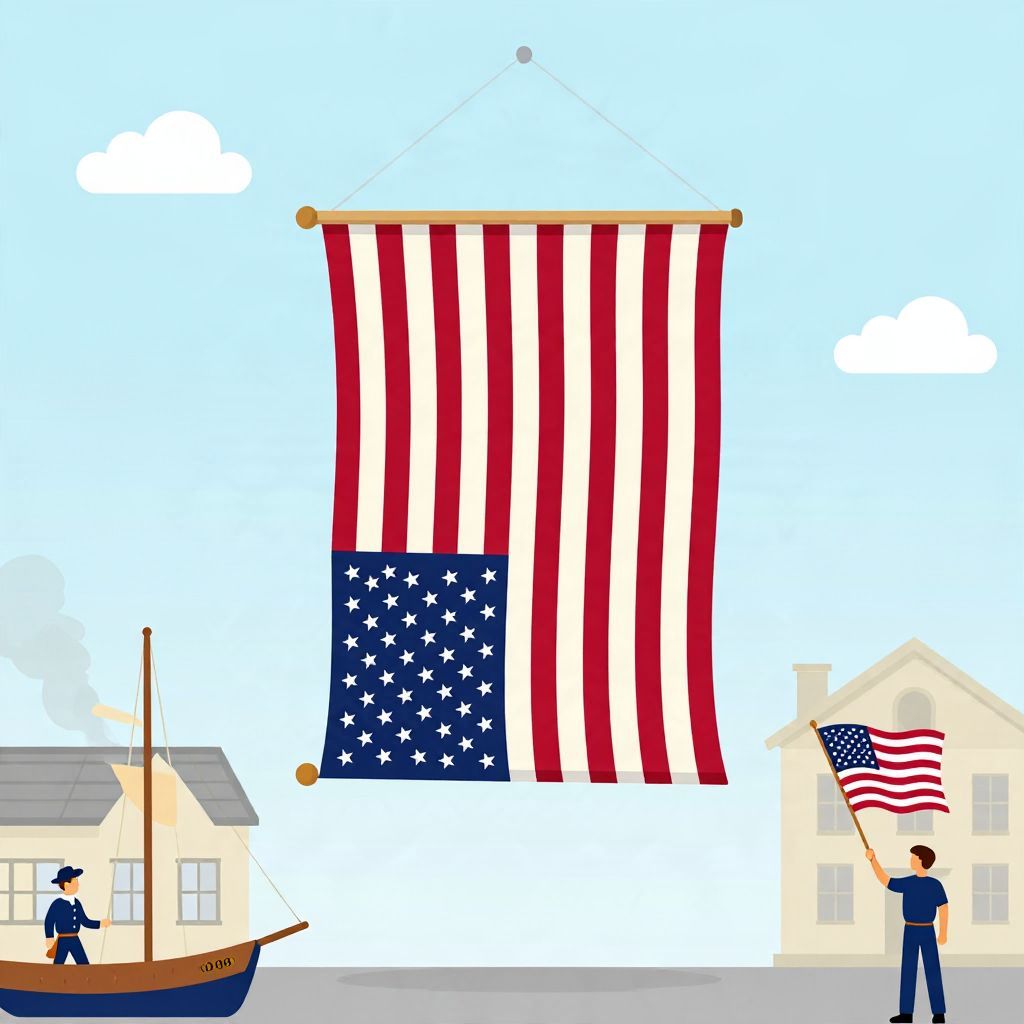
What does the upside down American flag mean? In U.S. history, it is most commonly a signal of distress—a call for urgent help. Over time, however, it has also been used as a political protest symbol, which has made its meaning more complicated and sometimes controversial.
Its significance depends on context: at sea, in law, and in public life, the inverted flag can carry different implications. Understanding its origins and historical development helps explain why the same image can be seen as both a recognized distress signal and a powerful form of dissent.
What does the upside down American flag mean?
The upside down American flag traditionally means distress or extreme emergency. In U.S. flag practice, it is an authorized signal used only in dire situations. In modern political culture, though, people also display it to express protest, anger, or opposition, even when no emergency is intended.
Origins of the upside down flag as a distress signal
The distress meaning comes from long-standing maritime custom, where flags were used to communicate quickly at a distance. An inverted flag was a visible way to show that a ship, crew, or station was in serious trouble and needed immediate assistance. This practical use shaped later American flag etiquette.
Maritime signaling before modern communications
Before radios and telephones, ships relied on visual signals. Flags, lanterns, and other markers helped crews communicate danger, identity, and requests for aid. The upside down flag fit this system because it was easy to recognize and could be shown instantly in an emergency.
How the U.S. adopted the custom
American flag usage absorbed this older nautical practice rather than inventing it from scratch. By the 19th century, the inverted flag was associated with distress in military and civilian settings. The U.S. government later formalized this meaning in flag etiquette, reinforcing the idea that the flag should be inverted only as a signal of grave danger.
Historical timeline of the upside down American flag
The meaning of the upside down flag developed gradually. It began as a practical distress signal, became part of formal flag etiquette, and later entered political protest culture. The timeline below shows how its significance changed over time.
- Pre-19th century: In maritime culture, inverted flags and other visual signals are used to indicate distress.
- 19th century: The practice becomes familiar in American naval and civilian contexts as a recognized emergency signal.
- Early 20th century: U.S. flag etiquette increasingly treats the inverted flag as a sign of distress rather than casual display.
- 1942: The U.S. Flag Code is established during World War II era standardization, helping formalize proper flag use.
- Late 20th century: Protest movements begin using the upside down flag more openly as a symbol of political crisis or national alarm.
- 21st century: The symbol becomes widely recognized in both emergency and protest contexts, sometimes causing public debate over intent and respect.
How the U.S. Flag Code treats an upside down flag
Under the U.S. Flag Code, the American flag should generally be displayed upright. It may be flown upside down only as a signal of “dire distress in instances of extreme danger to life or property.” That wording is important: the code does not define the inverted flag as a general protest symbol.
What the law means in practice
The Flag Code is a set of guidelines for proper display, not a criminal statute in most everyday cases. That means people may use the upside down flag in protest without automatically facing legal punishment, though the act can still be controversial or misunderstood. The code’s language, however, preserves its original emergency meaning.
Why the upside down flag became a protest symbol
As the American flag became a central national symbol, activists and dissidents began using it in inverted form to suggest that the nation itself was in crisis. This was especially common during periods of war, political scandal, civil unrest, or deep social conflict. The message was usually symbolic, not literal.
Protest and symbolism in the modern era
In the 20th century, Americans increasingly used national symbols to make political statements. The upside down flag could imply that the country was “upside down,” morally or politically. Because the image already carried a distress association, it worked well as a visual shorthand for alarm, frustration, or emergency-level concern.
Why the meaning can be disputed
Not every upside down flag means the same thing. Some people display it to signal a true emergency, while others use it to protest government policy, election results, social change, or court decisions. Since intent matters, the symbol can be interpreted differently by different audiences, which is why it often sparks debate.
Historical significance of the upside down American flag
The upside down American flag matters because it shows how symbols change over time. What began as a practical distress signal became a broader political expression. Its history reflects the tension between national reverence and the right to criticize the nation when citizens believe something is seriously wrong.
A symbol of urgency, not casual disrespect
Historically, the inverted flag was not meant as a joke or random reversal. Its original purpose was serious and urgent. Even when used in protest, the symbol usually draws power from that older meaning. It suggests that the situation has become so severe that normal expression is no longer enough.
Connection to American political culture
The symbol also illustrates a recurring feature of U.S. history: national emblems are often used both to unite and to challenge. The American flag has represented loyalty, sacrifice, and identity, but it has also been used in dissent. The upside down version sits at the intersection of those traditions.
Common misunderstandings about the upside down flag
Because the image is so visible, it is often misunderstood. Some people assume it always means anti-American sentiment, while others assume it is always a legal emergency signal. In reality, its meaning depends on setting, purpose, and audience.
- It does not always mean hatred of the country. In many cases, it is used to express alarm or protest.
- It does not automatically indicate a real emergency. In public life, it is often symbolic rather than literal.
- It is not a new invention. Its roots lie in older maritime distress customs.
- It can be controversial. Some view it as protected political speech; others see it as disrespectful.
How historians should understand the symbol
From a historical perspective, the upside down American flag is best understood as a layered symbol. Its oldest meaning is distress, rooted in practical communication. Its later meaning is protest, shaped by modern politics and public symbolism. Both meanings are historically real, and both can appear at the same time.
That complexity is what gives the symbol its force. It can warn, accuse, or challenge without using words. In American history, few images have carried such a strong combination of emergency, dissent, and national meaning.
In short, the upside down American flag means distress in its traditional and official sense, but it has also become a powerful protest symbol in modern U.S. history. For related background, see what an upside down American flag means and what a black American flag means.