
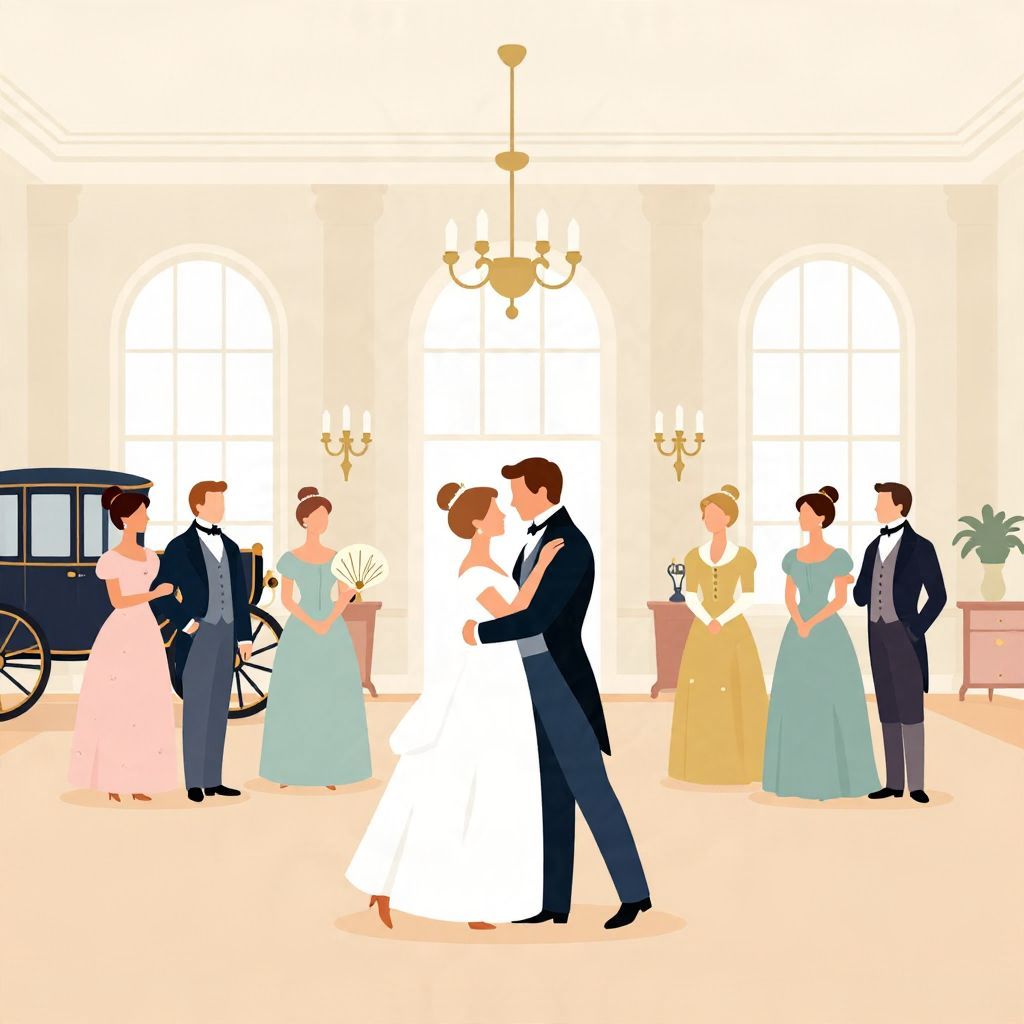
What era is Bridgerton? The Netflix series Bridgerton is set in the Regency era, specifically a stylized version of early 19th-century Britain. Its world draws most directly on the years around 1811 to 1820, when the Prince of Wales ruled as Prince Regent, though the show blends that period with broader Georgian and romanticized historical elements.
That means Bridgerton is not medieval, Victorian, or Georgian in the broadest sense alone. It sits at the transition between the late Georgian world and the coming Victorian age, using real Regency social customs, fashion, and courtship rituals as a backdrop for a fictionalized story.
What era is Bridgerton set in?
Bridgerton is set in the Regency era of Britain, roughly the years 1811 to 1820, though its atmosphere reflects the wider early 19th century. The series takes place in London high society during the period when the Prince of Wales acted as regent for his father, King George III, and before Queen Victoria’s reign began in 1837.
The historical core: the Regency period
The Regency era began when George III’s mental illness made him unable to rule effectively, leading Parliament to appoint his son as Prince Regent in 1811. In practice, the term “Regency” is often used more broadly to describe the fashion, manners, and elite culture of the early 1800s, even extending slightly before and after those exact years.
Bridgerton captures this world through debutante balls, marriage markets, estate inheritance, social rank, and the intense importance of reputation. Those were all real features of elite British society, even if the show heightens them for drama.
The historical timeline behind Bridgerton
The series is best understood as part of the transition from the Georgian age to the Victorian age. Here is the historical sequence that frames the setting:
- Georgian Britain — the long reigns of George I, George II, George III, and George IV, spanning much of the 18th and early 19th centuries.
- 1811 — the official start of the Regency, when the Prince of Wales became Prince Regent.
- 1815 — the Battle of Waterloo ended the Napoleonic Wars, reshaping British politics and society.
- 1820 — George III died and the Prince Regent became King George IV.
- 1837 — Queen Victoria’s accession marked the beginning of the Victorian era.
This timeline matters because Bridgerton borrows the look and social code of a very specific moment: a society still shaped by aristocratic power, but also moving toward industrial, political, and cultural change.
Why the Regency era fits the world of Bridgerton
The show’s central concerns—marriage, inheritance, class, and public reputation—were especially important in Regency Britain. Elite women were often expected to secure advantageous marriages, while family status and property laws shaped nearly every aspect of life. The season of “coming out” into society, with its balls and presentations, was a real feature of upper-class culture.
At the same time, the period was marked by strict social hierarchy. Aristocratic families, landed gentry, and wealthy urban elites occupied the top levels of society, while servants, laborers, and the poor lived very differently. The show turns this hierarchy into a glamorous stage, but the underlying social structure is historically grounded.
Fashion and appearance
One reason viewers quickly recognize the setting as Regency is the clothing. Women’s dresses in the early 1800s often had high waistlines, lighter fabrics, and simpler silhouettes than the heavily structured styles of the 18th century. Men’s tailoring also became slimmer and more refined. The show exaggerates color and elegance, but the overall silhouette belongs to the period.
Social rituals and courtship
Balls, dinner parties, visits, and formal introductions were not just entertainment; they were part of how elite society functioned. Courtship was highly regulated, and marriage could determine a family’s future wealth and standing. Bridgerton dramatizes this system, but the basic idea of a marriage market is historically accurate.
How accurate is Bridgerton historically?
Bridgerton is inspired by the Regency era, but it is not a strict historical reconstruction. It uses real historical frameworks while freely adapting them for modern storytelling. The result is best described as historical romance rather than documentary history.
What the show gets right
- The importance of debutante season and elite social presentation
- The centrality of marriage, inheritance, and family alliances
- The visual language of Regency fashion and interiors
- The atmosphere of London high society in the early 1800s
- The presence of rigid class distinctions and social surveillance
What the show changes
- It compresses or simplifies historical timelines for drama
- It modernizes dialogue, music, and emotional expression
- It presents a more inclusive and idealized social world than most of Regency Britain actually was
- It emphasizes romantic fantasy over the harsher realities of illness, poverty, war, and political unrest
These changes do not make the setting meaningless; they simply mean the series uses history as a framework rather than as a strict rulebook.
Where does the Regency era sit in British history?
The Regency era is part of the Georgian period, but it is often treated as its own cultural moment because it has a distinct style and social mood. It comes after the high 18th-century world of Enlightenment politics and before the more industrialized, morally formal Victorian age.
This makes it a period of transition. Britain was becoming a global imperial power, fighting major wars with Napoleonic France, and undergoing economic and social change. Yet elite life still revolved around country estates, London seasons, and aristocratic status. That tension gives the era its distinctive character.
Why historians and audiences separate “Regency” from “Georgian”
Strictly speaking, the Regency is a short constitutional period. Culturally, however, the term has come to mean a broader style and sensibility: elegant, restrained, witty, and socially coded. That broader meaning is what most viewers associate with Bridgerton.
So if someone asks what era the show is set in, the most precise answer is: Regency Britain, in the early 19th century.
The historical significance of the era behind Bridgerton
The Regency era matters because it sits at a crossroads in British history. It was shaped by war, political reform pressures, empire, urban growth, and changing cultural tastes. Even though the series focuses on elite romance, the real period was one of major transformation.
Politics and war
Britain spent much of the early 1800s fighting Revolutionary and Napoleonic France. These wars influenced taxation, government power, trade, and public anxiety. The elite social world shown in Bridgerton existed alongside military conflict and political uncertainty, even if the series keeps those pressures mostly offstage.
Gender and inheritance
Women’s limited legal and economic options are central to the period’s social history. Marriage often functioned as a financial strategy because property and titles typically passed through male lines. This reality helps explain why matchmaking was so intense and why family reputation carried such weight.
Race and representation
The show’s diverse cast has prompted discussion about historical accuracy. Real Regency Britain was not as socially integrated as the series suggests, especially at the highest levels of aristocratic society. At the same time, Britain was already an imperial and Atlantic world power, and people of African, Asian, and mixed heritage did live in Britain in various social positions. The series takes creative liberties by imagining a more inclusive elite society than the historical record supports.
That choice is artistic rather than documentary, and viewers should recognize the difference between the show’s alternate social vision and the more unequal reality of the period.
Why the setting continues to fascinate viewers
The Regency era remains popular because it combines elegance with tension. It offers grand houses, formal dances, and refined manners, but also strict rules, hidden pressures, and limited personal freedom. That mix makes it ideal for romance and conflict alike.
Bridgerton succeeds because it turns those historical ingredients into a vivid emotional world. The setting feels luxurious, yet every gesture matters. A glance, a dance, or a rumor can change a person’s future. That is not just good drama; it also reflects how reputation worked in elite society.
So, what era is Bridgerton?
Bridgerton is set in the Regency era, in early 19th-century Britain, around the years 1811 to 1820. More broadly, it belongs to the late Georgian world and sits just before the Victorian age. The series is historically inspired rather than strictly historical, but its core social setting is unmistakably Regency.
If you want to place it in a larger historical context, it belongs to the age of the Napoleonic Wars, aristocratic London society, and the final years before Victorian Britain transformed social life. For more background on the broader historical landscape, you may also find When Were the Dark Ages? and What Was Prussia? useful for comparison with other major historical periods and powers.