
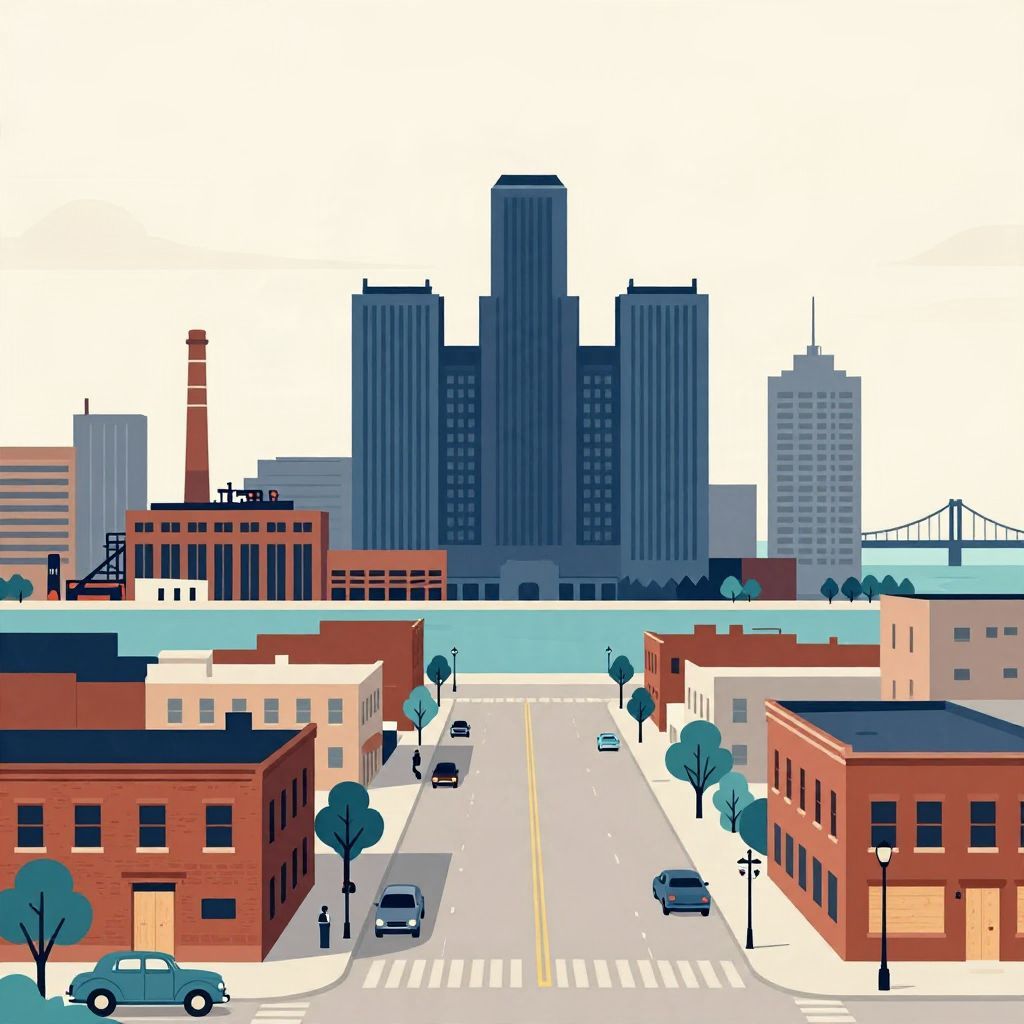
Detroit’s story is one of rise, reinvention, decline, and partial recovery. Founded as a French trading post in 1701, it grew into a major industrial city, became the center of the American auto industry, and then suffered decades of population loss, deindustrialization, segregation, and fiscal crisis.
What happened to Detroit is not a single event but a long historical process. The city’s fortunes changed as manufacturing boomed, suburbs expanded, jobs moved away, and local government struggled with shrinking tax revenue and rising costs. Detroit remains an important American city, but its history is a powerful example of how industrial success can give way to urban decline and renewal.
What Happened to Detroit?
Detroit rose from a colonial outpost to an industrial powerhouse, then declined sharply after World War II as auto jobs left, residents moved to the suburbs, and racial inequality deepened. By the early 21st century, decades of population loss and financial strain culminated in the city’s 2013 bankruptcy, though recovery efforts have continued since then.
Detroit’s Rise: From Frontier Post to Industrial Giant
The French founding and strategic location
Detroit began in 1701 when French officer Antoine de la Mothe Cadillac established Fort Pontchartrain du Détroit along the river connecting Lake Erie and Lake Huron. Its location made it a valuable fur-trading and military site. Later, under British and then American control, Detroit remained important because of its waterways, transportation links, and access to the Great Lakes region.
Growth in the 19th century
After the United States took control in the early 19th century, Detroit developed from a regional center into a growing city. Railroads, shipping, and regional commerce helped it expand. By the late 1800s, Detroit was already building a manufacturing base, but its most dramatic transformation came in the early 20th century with the automobile.
The auto industry changes everything
Detroit became known as the “Motor City” because major automakers and suppliers concentrated there. Henry Ford, General Motors, and Chrysler helped make the city a global center of industrial production. The moving assembly line, introduced by Ford in 1913, revolutionized manufacturing and drew workers from across the United States and abroad. During the first half of the 20th century, Detroit’s population surged, and the city became a symbol of American industrial power.
The Turning Point: Why Did Detroit Decline?
Detroit declined because the economic system that made it rich also made it vulnerable. When auto production spread to suburbs, other states, and eventually overseas, the city lost jobs and tax revenue. At the same time, racial segregation, housing discrimination, white flight, and political conflict weakened the city’s social and fiscal stability.
Deindustrialization and job loss
After World War II, American manufacturing changed. Companies sought cheaper land, lower taxes, automation, and new production sites outside the urban core. Many factories closed or relocated, and the number of well-paid industrial jobs fell. This was not unique to Detroit, but the city depended more heavily on autos than many others, so the impact was especially severe.
Suburbanization and the tax base problem
As middle-class residents moved to suburbs, Detroit lost property tax revenue while still needing to maintain roads, schools, water systems, and public services for a large urban infrastructure. The city’s boundaries remained fixed, but the region’s population and wealth increasingly spread outward. That mismatch made it harder for Detroit to finance services even before the worst economic shocks arrived.
Racial inequality and urban unrest
Detroit’s decline cannot be understood without race. Black migrants from the South came to Detroit in the Great Migration seeking industrial jobs and better opportunities, but they often faced discrimination in housing, employment, and policing. Tensions exploded in the 1967 Detroit uprising, one of the most destructive urban rebellions in U.S. history. The event reflected long-standing frustration over segregation, police violence, and economic exclusion. It also accelerated white flight and deepened mistrust between communities and government.
Long-term fiscal strain
By the late 20th century, Detroit faced a cycle of shrinking revenue and rising obligations. Fewer residents meant fewer taxpayers, but the city still had to support a large physical footprint. Corruption scandals, weak regional cooperation, and repeated management problems worsened the situation. Public schools, transit, housing, and city services all suffered from underinvestment and instability.
A Brief Timeline of Detroit’s Major Turning Points
- 1701 — French founder Antoine de la Mothe Cadillac establishes Detroit.
- 1760 — Britain takes control after the French and Indian War.
- 1805 — A major fire destroys much of the city; Detroit is later rebuilt.
- Late 1800s — Industrial growth accelerates.
- Early 1900s — The automobile industry turns Detroit into a manufacturing giant.
- 1913 — Ford introduces the moving assembly line.
- Post-1945 — Suburbanization and industrial restructuring begin to erode the city’s base.
- 1967 — The Detroit uprising marks a major social and political crisis.
- 1970s–2000s — Continued population loss, factory closures, and fiscal stress.
- 2013 — Detroit files for bankruptcy, the largest municipal bankruptcy in U.S. history at the time.
- 2014 onward — Debt restructuring and redevelopment efforts begin, with uneven results.
The 2013 Bankruptcy: What It Meant
Detroit’s bankruptcy in 2013 was the clearest sign that its long decline had become a financial emergency. The city could no longer meet its obligations while maintaining basic services. Bankruptcy allowed Detroit to restructure debt, reduce some liabilities, and reorganize city finances. It did not erase the underlying causes of decline, but it created a path for partial stabilization.
Why bankruptcy happened
The bankruptcy reflected decades of accumulated problems: a reduced tax base, high legacy costs, deteriorating infrastructure, and weak economic growth. The city also faced large pension and retiree health obligations. When revenues could not cover expenses, bankruptcy became the legal mechanism for renegotiating debts with creditors, pensioners, and insurers.
What changed afterward
After bankruptcy, Detroit made progress in some areas. Downtown and several neighborhoods saw new investment, and civic leaders worked to improve city services and public safety. Yet recovery has been uneven. Some districts have benefited from redevelopment, while others still struggle with poverty, abandoned property, and limited access to opportunity. The city’s revival has been real, but it has not erased the deeper structural challenges.
How Detroit’s History Shaped the City Today
A symbol of industrial America
Detroit remains closely associated with the history of mass production, labor, and the rise of the modern automobile. Its factories helped define 20th-century America, and its labor struggles shaped national debates over wages, unions, and industrial policy. Even in decline, Detroit has remained historically important because it represents both the achievements and vulnerabilities of industrial capitalism.
Lessons about urban change
Detroit’s history shows that cities can prosper for generations and still face collapse if their economies become too dependent on one industry. It also shows how policy decisions about housing, transportation, race, and regional planning can shape long-term outcomes. The city’s problems were not inevitable, but they were deeply rooted in structural changes that unfolded over many decades.
Culture, resilience, and reinvention
Detroit’s legacy is not only one of loss. The city has produced influential music, art, labor activism, and community organizing. Motown, for example, became one of the most important cultural exports in American history. In that sense, Detroit’s historical impact goes far beyond its economic decline. It remains a place of creativity, resilience, and ongoing reinvention.
So, What Happened to Detroit?
Detroit became one of America’s great industrial cities, then suffered a long decline driven by deindustrialization, suburbanization, racial inequality, and fiscal collapse. Its 2013 bankruptcy marked the lowest point in that process, but it did not end the city’s story. Detroit today is a city shaped by both dramatic loss and determined recovery.
For readers interested in broader historical turning points, you may also like what happened in 2013 and what happened in 2010.