
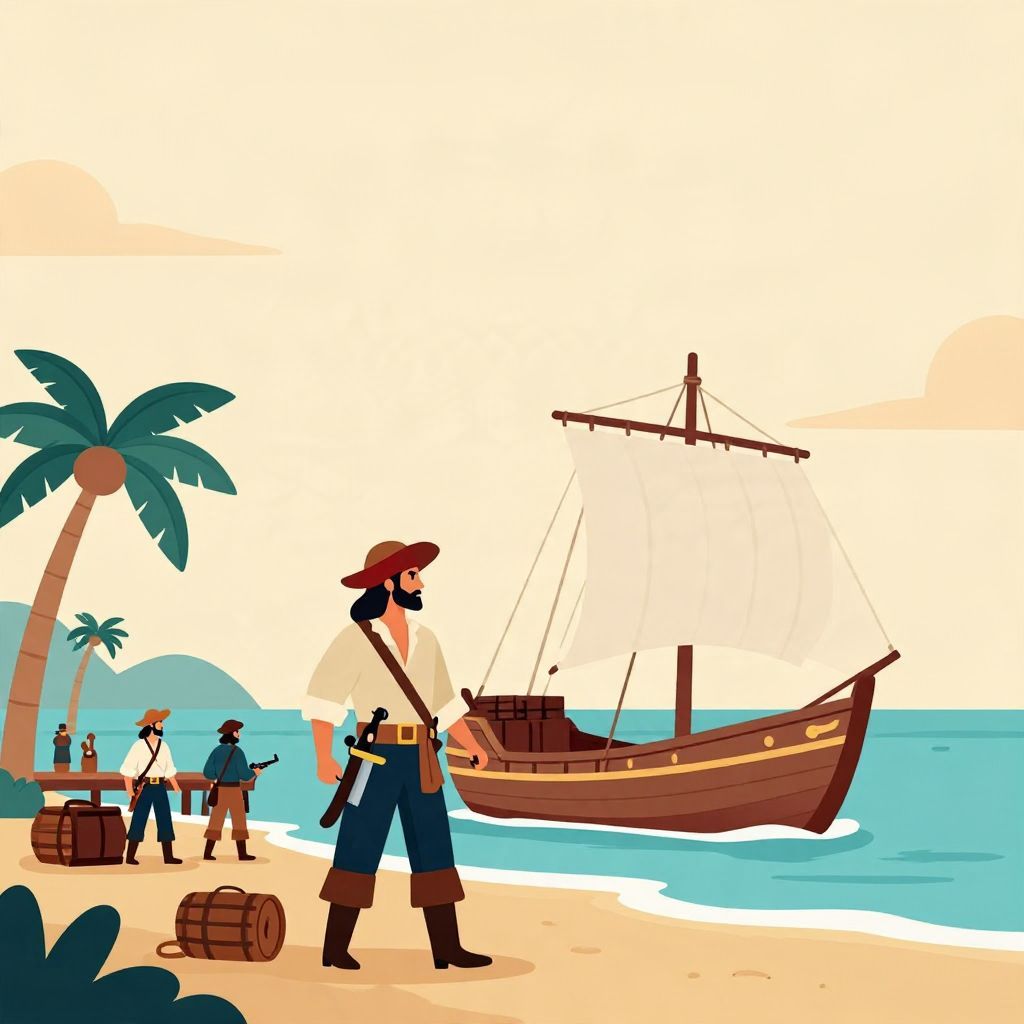
What is a buccaneer? The word usually brings to mind a pirate with a cutlass and a ship full of stolen treasure, but the historical meaning is more specific. Buccaneers were seaborne raiders active mainly in the Caribbean during the 17th century, especially on the fringes of the Spanish Empire.
They were not simply fictional adventurers or all-purpose pirates. Buccaneers emerged from a particular colonial world shaped by war, trade rivalry, and weak imperial control. Their history helps explain how piracy, privateering, and empire overlapped in the early modern Atlantic.
What Is a Buccaneer?
A buccaneer was a pirate or privateer who raided Spanish shipping and settlements in the Caribbean during the 1600s. The term originally referred to hunters on Hispaniola who smoked meat on a boucan, but it came to describe armed raiders who attacked Spanish targets with varying degrees of official approval.
Where Did Buccaneers Come From?
Buccaneers did not appear out of nowhere. They developed in the Caribbean after Spain’s early dominance of the region began to weaken in practice, even if it remained powerful on paper. European rivalries, the growth of colonial settlements, and the lure of Spanish wealth created ideal conditions for raiding.
From hunters to raiders
The earliest buccaneers were not pirates at sea. Many were French and English hunters and runaway settlers on Hispaniola, especially on the island’s western side. They used wooden racks called boucans to smoke meat, selling provisions to passing ships. Over time, as Spanish pressure increased and conflict spread, some of these men turned to raiding Spanish vessels and coastal towns.
The Caribbean frontier
The Caribbean in the 1600s was a contested frontier. Spain claimed much of the region, but other European powers—especially England, France, and the Dutch Republic—challenged that claim. Small islands, hidden coves, and poorly defended ports made the area ideal for irregular warfare. Buccaneers flourished in this unstable environment.
Why Did Buccaneers Become Important in the 17th Century?
Buccaneers became important because they served as unofficial weapons in imperial competition. European governments often tolerated or encouraged attacks on Spanish commerce when war made such violence useful. In practice, the line between pirate and patriot could be very thin, depending on who was paying, protecting, or condemning the raider.
Privateering and piracy were not the same
Strictly speaking, a privateer operated under a government-issued commission authorizing attacks on enemy shipping during wartime. A pirate acted without legal authority. Buccaneers moved between these categories. Some held commissions; others did not. Many switched roles as political circumstances changed, which is why historians treat the term as both legal and cultural rather than purely criminal.
Spanish wealth made the Caribbean a target
Spain’s American empire generated enormous wealth through silver, trade, and colonial transport routes. That wealth was vulnerable at sea and along the coast. Buccaneers targeted merchant ships, ports, and supply lines because these offered the richest rewards with relatively small crews. Their raids were often brutal, but they were also practical acts of wartime predation.
The Golden Age of Buccaneers
The classic age of buccaneering lasted roughly from the 1640s to the 1680s. This was the period when Caribbean raiders became famous in European accounts and later popular culture. Their activities peaked during times of war, especially when England and France were fighting Spain.
Key names associated with buccaneering
Several figures became famous in buccaneer history, though their reputations were often exaggerated later. Henry Morgan is the best known. Operating from Jamaica, he attacked Spanish targets in the 1660s and 1670s, including the famous raid on Panama in 1671. Morgan later received royal favor, showing how easily a buccaneer could be transformed into a respectable imperial agent.
Other well-known buccaneers included François l’Olonnais, remembered for extreme violence, and Michel le Basque, among others. Their exploits were reported in sensationalized accounts that mixed fact, rumor, and moral warning. These stories helped create the enduring image of the buccaneer as a daring and lawless sea rover.
How they operated
Buccaneers usually worked in small, flexible groups. They relied on speed, surprise, local knowledge, and cooperation among crews from different backgrounds. Their ships were often modest compared with the large treasure fleets they targeted. Success depended less on naval discipline than on opportunism and the ability to exploit weak defenses.
- They attacked merchant ships and coastal settlements.
- They used hidden anchorages and island bases.
- They often relied on intelligence from local informants and traders.
- They divided spoils according to agreed shares, though disputes were common.
What Did the Word “Buccaneer” Originally Mean?
The word comes from the Caribbean and has a practical origin. It is linked to boucan, a term used for a wooden frame or grill for smoking meat. French hunters in the region were called boucaniers, and English speakers adapted the term into “buccaneer.” Over time, the meaning shifted from hunter to raider.
Language changed with the history
This linguistic shift reflects the changing reality of Caribbean life. A word that first described food preparation and frontier survival came to describe armed men who preyed on Spain’s empire. That evolution is a reminder that historical terms often change as people’s roles change. The buccaneer was both a product of the environment and a symbol of imperial conflict.
Were Buccaneers Just Pirates?
Not exactly. In everyday speech, “pirate” is often used as a catch-all term, but historians make distinctions. Buccaneers were a specific kind of pirate-adjacent raider tied to the Caribbean and to the politics of empire. Some were legally sanctioned privateers; others were outright pirates. Many moved between the two.
Why the distinction matters
The difference matters because it shows how states used irregular violence. European empires frequently outsourced warfare to men who were not part of a regular navy. When those men attacked enemy ships, they could be celebrated. When peace returned, they could suddenly become criminals. Buccaneers lived in that unstable space between legality and outlawry.
How Did Buccaneers Affect Caribbean History?
Buccaneers helped weaken Spanish control in the Caribbean, but they also contributed to the violent making of empire. Their attacks disrupted trade, exposed the limits of Spanish defense, and encouraged rival European powers to build stronger colonial footholds. At the same time, they intensified insecurity for settlers, merchants, and enslaved people across the region.
Impact on empire
Their raids forced Spain and its rivals to think more seriously about naval defense, fortifications, and colonial administration. Ports were strengthened, convoys became more important, and imperial competition hardened. Buccaneering was not the only cause of these changes, but it was one visible expression of the struggle for Atlantic power.
Impact on local societies
Buccaneers were part of a broader world of violence that included colonial warfare, forced labor, and slavery. They did not operate in a vacuum. Caribbean societies were already shaped by conquest and exploitation, and buccaneering added another layer of instability. Their raids could devastate towns and commerce, even as some colonial authorities quietly benefited from the pressure they placed on Spain.
Why Did Buccaneering Decline?
Buccaneering declined as European states became stronger and more centralized in the late 17th century. Governments increasingly preferred controlled naval warfare to semi-independent raiders. As peace treaties, colonial administration, and anti-piracy campaigns expanded, the space in which buccaneers could operate narrowed.
From tolerated raiders to unwanted outlaws
Once imperial governments needed stable trade and diplomacy, buccaneers became inconvenient. Men who had once been useful in war were now liabilities in peace. Bases were closed, commissions were withdrawn, and naval patrols increased. Some former buccaneers settled down, while others drifted into piracy elsewhere or were absorbed into colonial society.
Buccaneers in Popular Memory
Modern culture often blurs buccaneers, pirates, and privateers into one romantic figure: the swashbuckling rebel at sea. That image is powerful, but it simplifies a much messier history. Real buccaneers were shaped by colonial rivalry, opportunism, and violence, not just adventure.
Myth versus history
Popular stories often portray buccaneers as glamorous rogues with little connection to politics. In reality, they were deeply tied to the imperial contests of their age. Their world was one of shifting loyalties, legal ambiguity, and harsh survival. The legend survives because it captures the drama, but the history is more revealing.
So, What Is a Buccaneer?
A buccaneer was a 17th-century Caribbean raider whose history sits at the intersection of piracy, privateering, and empire. The term began with hunters and smoked meat, but it came to describe men who attacked Spanish interests in a turbulent Atlantic world. Their story shows how law, war, and profit could overlap in early modern history.
In short, buccaneers were not just colorful pirates; they were part of the violent machinery of colonial competition. If you want to explore related maritime history, you may also like reading about whether pirates still exist and the wider imperial background in what Prussia was.