
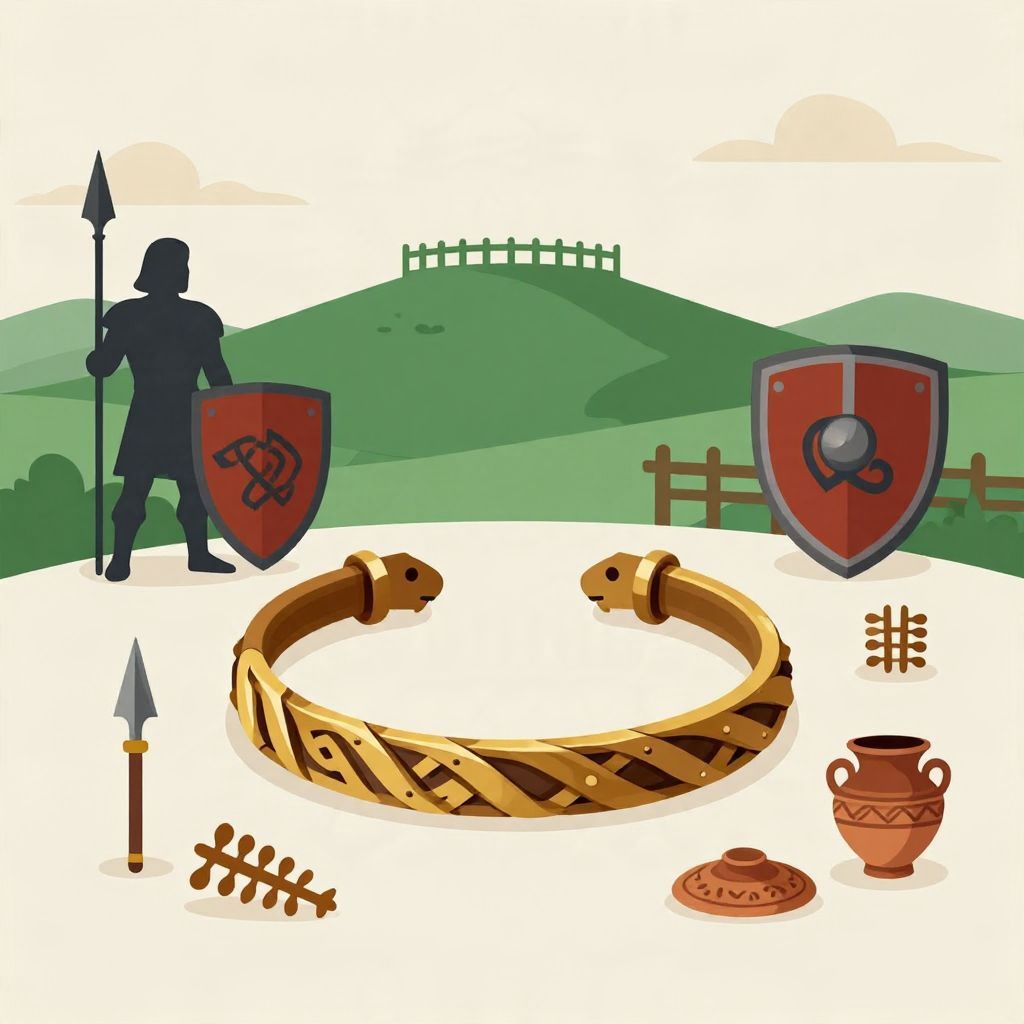
What is a torc? In history, a torc is a rigid neck ring, usually made of metal, that was worn as jewelry, a mark of status, or a symbol of power in ancient societies. It is most strongly associated with Iron Age Europe, especially Celtic cultures, but similar forms also appear in other ancient regions.
Torcs were not just ornaments. Their size, material, and craftsmanship could signal wealth, rank, religious meaning, or military prestige. Archaeology shows that they were prized objects placed in graves, offered in hoards, and sometimes depicted in art as badges of elite identity.
What Is a Torc?
A torc is a stiff, usually open-ended neck ornament made from metal such as gold, silver, bronze, or iron. Unlike a flexible necklace, it is designed to hold a fixed circular or crescent shape around the neck. In the ancient world, torcs often functioned as visible signs of status, authority, and cultural identity.
The Origins of the Torc
The torc has deep prehistoric roots, with examples appearing in Europe by the Bronze Age and becoming especially prominent during the Iron Age, roughly from the first millennium BCE onward. While the torc is most famously linked to Celtic peoples, the form was not exclusive to them. Similar neck rings existed in other ancient cultures, showing that the idea developed independently in several places.
Early metalworking and prestige objects
The rise of the torc was closely tied to advances in metalworking. As ancient craftspeople learned to cast, twist, hammer, and decorate metals more skillfully, they produced objects that were both durable and visually striking. A torc required specialized labor and valuable materials, which made it an ideal object for elites who wanted to display power through personal adornment.
Why the torc mattered
Archaeologists generally interpret torcs as prestige goods. They were expensive to make and difficult to imitate with ordinary materials. In societies without large-scale coinage or mass-produced luxury items, a torc could serve as a portable display of rank. It may also have carried symbolic meanings connected to protection, divine favor, or warrior identity.
The Torc in Celtic and Iron Age Europe
The torc is most strongly associated with the Celtic world of Iron Age Europe, especially from about the 5th century BCE through the Roman period. Classical writers noticed that many peoples in Gaul and Britain wore distinctive ornaments, and archaeology confirms that torcs were among the most important elite objects in these societies.
Materials and craftsmanship
Celtic torcs were made in a range of materials, from bronze and iron to highly prized gold. Some were simple twisted rods; others were elaborate masterpieces with terminals shaped like animal heads, spirals, or abstract designs. The ends, or terminals, often carried the most decoration, making the torc a showcase for artistic skill.
Who wore torcs?
Torcs were likely worn by high-status men and women, though the evidence varies by region and period. In some cases they appear in burials of elite individuals; in others they are found in hoards or votive deposits. Artistic depictions suggest that torcs could be associated with nobility, warriors, or even deities, rather than with one single social group.
Symbol of Power, Not Just Jewelry
In the ancient world, the torc often carried meanings beyond decoration. It could mark a person as socially elevated, spiritually significant, or politically important. Because it was worn around the neck, a highly visible and vulnerable part of the body, the torc drew attention immediately and could communicate authority at a glance.
Warrior identity and honor
Some torcs are linked to warrior culture. Ancient authors and later traditions sometimes associated them with bravery, elite rank, and gifts of honor. In this sense, a torc could function much like a medal or regalia in later societies: it was a material sign that the wearer had earned or inherited distinction.
Religious and ritual uses
Not all torcs were worn in daily life. Some were deposited in sacred places, buried as offerings, or placed with the dead. These finds suggest that torcs could also have ritual significance. In a religious context, they may have been offered to gods, ancestors, or supernatural powers as part of vows, funerary customs, or acts of devotion.
Famous Torcs in Archaeology
Some of the best-known torcs come from spectacular archaeological discoveries. These finds have helped historians understand both the artistry and the social meaning of the object. Because many torcs were made of precious metal, they were often preserved in treasure hoards or grave goods rather than in ordinary settlements.
The Snettisham Hoard
One of the most famous groups of torcs was found at Snettisham in Norfolk, England. This large deposit of Iron Age metalwork included multiple gold torcs and has become central to the study of late Iron Age Britain. The hoard suggests both great wealth and the possibility that torcs were intentionally buried for ritual reasons.
The Broighter Torc
The Broighter Torc, discovered in Ireland, is another celebrated example of Iron Age craftsmanship. Made of gold and highly refined in design, it demonstrates the technical sophistication of ancient metalworkers and the prestige attached to such objects. Finds like this show that torcs were not merely local curiosities but part of a wider elite culture across Atlantic and northwestern Europe.
The Torrs Pony-cap and horned imagery
Although not a torc itself, the famous Torrs Pony-cap is often discussed alongside torc imagery because it reflects the same artistic world. Horned and twisted forms were common in Iron Age art, and torcs often appear in depictions of deities and elite figures. This overlap suggests that the torc belonged to a broader symbolic language of power and transformation.
How the Torc Was Worn and Made
Most torcs were designed to rest around the neck, though some may have been worn higher on the chest or presented as ceremonial objects. They were usually open at the front or side, with terminals that could be twisted apart or fitted carefully around the wearer. The design balanced rigidity with enough flexibility to be put on and removed.
Common forms
- Twisted rod torcs made from braided or spiraled metal strands
- Hollow torcs formed from sheet metal or cast sections
- Gold torcs associated with high status and elite burials
- Decorated terminal torcs featuring animal heads, knobs, or geometric motifs
Craft and labor
Making a torc required both material resources and expert skill. Gold torcs, in particular, demanded access to rare metal and a workshop capable of shaping it precisely. The finished object could take many hours of labor, which increased its value. In that sense, the torc embodied both wealth and the social power to command skilled work.
The Torc in Myth and Classical Accounts
Ancient literary sources sometimes describe northern European peoples as wearing neck ornaments, and later writers helped turn the torc into a symbol of “Celtic” identity. However, these accounts should be read carefully. Classical authors often wrote from outside the cultures they described, and their observations could be selective, exaggerated, or shaped by stereotypes.
Legends versus evidence
Modern interest in torcs has sometimes been influenced by romantic images of ancient warriors and kings. While such images are powerful, the archaeological record is more reliable than legend. The evidence shows that torcs were real and important objects, but their exact meanings varied by time, place, and social context. There was no single universal “torc culture.”
Did Other Civilizations Use Torcs?
Yes, or at least similar neck rings appeared in several ancient societies. The torc is especially well documented in Europe, but related forms are known in the ancient Near East, Central Asia, and parts of Asia. This does not mean all such objects had the same meaning. In each region, neck rings could represent wealth, rank, protection, or ritual significance in different ways.
Shared shape, different meanings
One reason the torc is historically interesting is that it shows how a basic form can travel across cultures or emerge independently in different places. A rigid neck ring is visually striking and practical as a prestige object. Yet its meaning depends on who wears it, who makes it, and the social world around it.
Why the Torc Still Matters to Historians
The torc matters because it helps historians and archaeologists understand status, identity, and craftsmanship in ancient societies. It reveals how elites displayed power before modern state symbols, uniforms, or mass-produced luxury goods existed. It also shows how material culture can carry social meaning far beyond its practical function.
Today, the torc is often used in museums and popular histories as a shorthand for Iron Age Europe, especially the Celtic world. That association is useful, but it should be handled carefully. The torc was not a single ethnic emblem; it was a long-lived and flexible object whose meaning changed over time. What remains constant is its role as a powerful marker of ancient prestige.
So, what is a torc? It is an ancient rigid neck ring, usually made of metal, that served as jewelry, status symbol, and sometimes ritual object. Its history stretches across prehistoric and Iron Age Europe and beyond, offering a vivid window into the social worlds of the ancient past.