
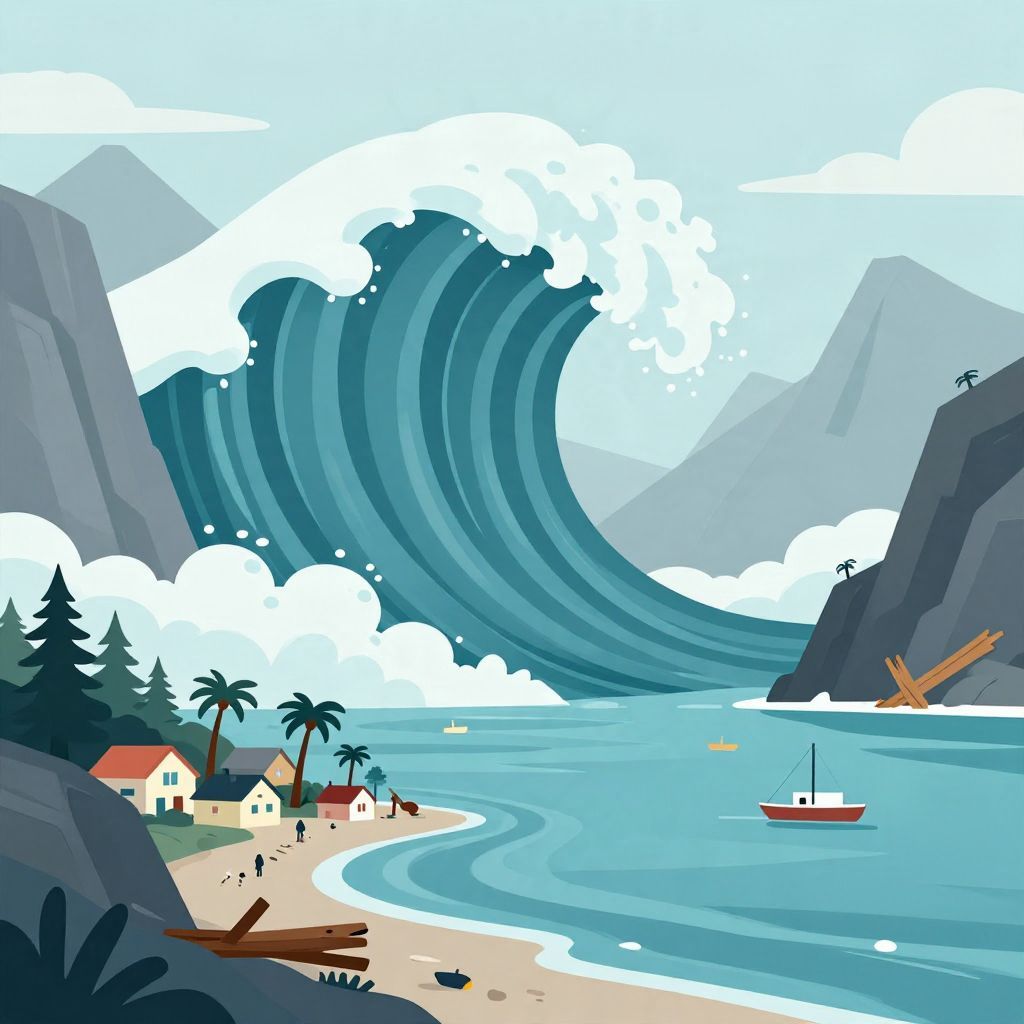
When people ask, “What was the biggest tsunami in history?” the answer depends on what “biggest” means. By wave height alone, the largest known tsunami was not a coastal disaster but a megatsunami in remote Alaska in 1958. By global human impact, however, the deadliest and most destructive tsunami in recorded history was the Indian Ocean tsunami of 2004.
Both events matter because they show how tsunamis differ from ordinary ocean waves: they are caused by sudden displacement of water, usually by earthquakes, landslides, volcanic eruptions, or impacts. The historical record of tsunamis is therefore a record of geology as much as human tragedy.
What Was the Biggest Tsunami in History?
The biggest tsunami ever documented by wave height was the 1958 Lituya Bay megatsunami in Alaska, which produced a run-up of about 524 meters (1,720 feet) on the surrounding slopes. If “biggest” means the greatest loss of life and widest impact, the answer is the 2004 Indian Ocean tsunami, triggered by a massive undersea earthquake off Sumatra.
Why “Biggest” Is Not a Simple Question
Historians and geologists use different measures for tsunamis: wave height, run-up, area affected, death toll, and economic damage. A tsunami can be record-breaking in one category and comparatively small in another. That is why the “biggest tsunami in history” is not a single fixed answer, but a question that depends on the criterion being used.
Different ways to measure a tsunami
- Wave height: the height of the water wave itself.
- Run-up: how high the water reaches above sea level on land.
- Inundation: how far inland the water travels.
- Casualties: the number of people killed or missing.
- Damage: destruction to settlements, infrastructure, and economies.
Because these measures do not always align, one tsunami may be the tallest while another is the deadliest. The history of tsunamis is therefore best understood through both physical science and human consequences.
The Largest Known Tsunami by Wave Height: Lituya Bay, 1958
The largest tsunami ever measured by run-up occurred on July 9, 1958, in Lituya Bay, a narrow fjord on the coast of Alaska. A powerful earthquake triggered a massive landslide into the bay, displacing an enormous volume of water. The surge stripped trees from hillsides and left a scar high above the shoreline, with evidence of water reaching about 524 meters up the slope.
What caused the Lituya Bay megatsunami?
This was not a typical ocean-crossing tsunami caused by seafloor movement. It was a megatsunami, driven mainly by a landslide that fell into a confined body of water. The shape of the bay amplified the wave dramatically. In open ocean, such a wave would not have behaved the same way.
Why it was so extreme
Lituya Bay’s geography made it unusually vulnerable. Steep mountains rise directly from the water, so when rock and ice crashed into the bay, the displaced water had nowhere to spread out. Instead, it surged upward and across the opposite slope with extraordinary force.
Despite its record-setting height, the Lituya Bay event killed only a small number of people compared with later tsunamis. That is one reason historians and disaster researchers are careful about using “biggest” without explanation.
The Deadliest Tsunami in History: The Indian Ocean Tsunami of 2004
The Indian Ocean tsunami of December 26, 2004 was the most devastating tsunami in modern history by human impact. It followed a magnitude 9-plus earthquake off the west coast of Sumatra, Indonesia, one of the largest earthquakes ever recorded. The tsunami spread across the Indian Ocean, striking Indonesia, Sri Lanka, India, Thailand, the Maldives, and several other countries.
How the disaster unfolded
The earthquake ruptured a huge section of the seabed, lifting and dropping the ocean floor and sending waves outward at high speed. In some places, the sea first withdrew from the coast, exposing the seabed before the waves returned. Many coastal communities had little warning and no established evacuation system, which greatly increased the death toll.
Why the 2004 tsunami was so deadly
- It struck multiple countries around the Indian Ocean.
- It hit densely populated coastlines and fishing communities.
- There was no Indian Ocean-wide tsunami warning system at the time.
- Many people did not recognize the warning signs of a tsunami.
Estimates of the death toll vary, but the disaster killed more than 200,000 people across the region. It also displaced millions and reshaped disaster policy worldwide. In historical terms, it became a turning point in tsunami preparedness.
Other Major Tsunamis in History
Several other tsunamis stand out for their scale, destruction, or historical importance. These events help show that tsunamis have shaped human history across centuries and continents, not just in the modern era.
The 1755 Lisbon tsunami
The 1755 Lisbon earthquake and tsunami devastated Portugal and sent waves across parts of the Atlantic. The disaster became famous not only for its destruction but also for its influence on European thought. It challenged older ideas about providence and disaster, and it helped inspire more systematic thinking about earthquakes and natural hazards.
The 1883 Krakatoa tsunami
When the volcano Krakatoa erupted in 1883, it generated enormous tsunamis that killed tens of thousands of people in the Sunda Strait region. This was one of the most catastrophic volcanic tsunamis in history. The event showed that tsunamis are not caused only by earthquakes; volcanic collapse and explosive eruptions can also displace enough water to create deadly waves.
The 2011 Tōhoku tsunami
On March 11, 2011, a massive earthquake off northeastern Japan produced a tsunami that devastated coastal communities and caused the Fukushima nuclear disaster. Japan’s warning systems and preparedness saved many lives, but the event still caused enormous loss. It remains one of the most important modern examples of how even highly prepared societies can be overwhelmed by extreme natural events.
How Tsunamis Became Part of History
Tsunamis have affected human societies for as long as people have lived near coasts, but the historical record is uneven. Ancient and medieval accounts often describe “great waves,” sea withdrawal, or coastal flooding without using the modern word tsunami. Some reports are reliable; others are mixed with myth, religious interpretation, or exaggeration.
Ancient and early historical records
One of the earliest well-known tsunami-related events is associated with the Thera eruption in the Aegean, often dated to the mid-second millennium BCE, though the exact chronology remains debated. In the classical world, earthquakes and sea surges were observed and recorded, but the scientific explanation for tsunamis did not exist yet.
As historical writing became more detailed, especially in coastal trading societies, tsunamis appeared more clearly in chronicles, port records, and eyewitness accounts. Still, many older descriptions must be read cautiously because the sources may not distinguish between storm surge, tidal flooding, and tsunami.
What the Biggest Tsunami Tells Us About Nature and History
The record-setting Lituya Bay megatsunami and the globally devastating Indian Ocean tsunami reveal two different truths. One shows the extreme power of local geography to magnify a landslide into a towering wave. The other shows how a large undersea earthquake can create a disaster across entire oceans when warning systems are absent or inadequate.
Historically, tsunamis have influenced settlement patterns, trade routes, religious interpretations, engineering, and emergency planning. They are not just natural events; they are historical events that reshape societies, sometimes in minutes.
So, if you mean the tallest tsunami ever measured, the answer is Lituya Bay in 1958. If you mean the most devastating in human history, the answer is the 2004 Indian Ocean tsunami. Both belong in the story of the biggest tsunami in history, because “biggest” can mean height, reach, or human cost.
For more on major disasters and their historical impact, you may also be interested in what was the biggest tsunami and how the Titanic sank.