
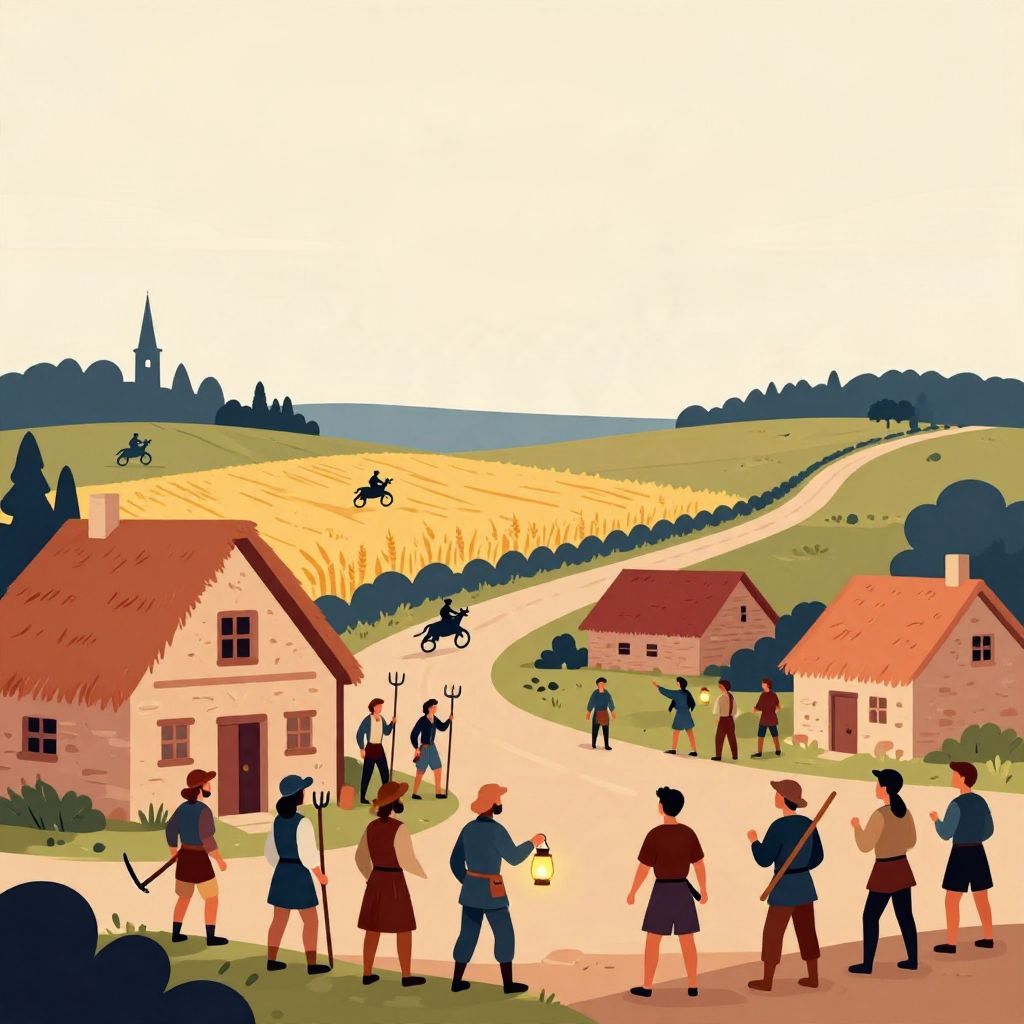
The Great Fear was a wave of panic that swept through the French countryside in the summer of 1789, during the opening months of the French Revolution. Rumors of aristocratic plots, invading brigands, and attacks on villages spread rapidly from place to place, triggering peasant unrest and violence.
It mattered because the panic helped destroy the old rural order. In many regions, frightened peasants armed themselves, attacked manor houses, and demanded an end to feudal dues. The Great Fear was not a single event but a chain reaction of fear, rumor, and revolutionary change.
What Was The Great Fear?
The Great Fear was a mass panic in rural France from late July to early August 1789, when rumors of conspiracy and invasion caused peasants to arm themselves and revolt. Historians use the term for this sudden spread of alarm, which intensified unrest and pushed the National Assembly to abolish feudal privileges on 4 August 1789.
Origins of the Great Fear
The Great Fear emerged from the unstable conditions of revolutionary France. In 1789, the kingdom faced a financial crisis, political upheaval, food shortages, and deep resentment over seigneurial rights. When the Estates-General met in May and the Third Estate declared itself the National Assembly in June, authority in France became uncertain, and fear spread quickly.
Why did rumors spread so fast?
Communication in the late eighteenth century depended on word of mouth, local messengers, and travelers. In a society already tense from high bread prices and poor harvest conditions, people were ready to believe alarming stories. A rumor in one village could become “proof” of danger in the next, especially when no central authority seemed able to restore order.
The most common rumors claimed that nobles had hired bands of brigands to destroy crops, punish peasants, or crush the Revolution. In some places people also feared foreign troops or imagined a wider aristocratic conspiracy. These claims were often false or exaggerated, but they fit the anxieties of the moment.
How Did the Great Fear Unfold?
Beginning in late July 1789, panic spread through large parts of the French countryside, especially in regions such as the Dauphiné, Franche-Comté, Burgundy, the Mâconnais, and parts of western and southern France. Villagers rang bells, gathered militias, and prepared to defend themselves against imagined attackers. In many areas, the fear turned into direct action against local elites.
A simple chronology of events
- June 1789: Political crisis deepens after the National Assembly forms.
- 14 July 1789: The storming of the Bastille in Paris signals revolutionary unrest.
- Late July 1789: Rumors of brigands and aristocratic plots spread through the countryside.
- Late July to early August 1789: Peasants arm themselves, raid manor houses, and destroy records of feudal dues.
- 4 August 1789: The National Assembly abolishes many feudal privileges in response to the crisis.
Not every village reacted in the same way. Some communities simply organized watches and defensive patrols. Others attacked châteaux, burned title deeds, or forced local lords to surrender documents that recorded dues and obligations. The violence was often aimed less at killing nobles than at destroying the legal basis of seigneurial power.
Why Did Peasants React So Strongly?
Peasants had long resented feudal dues, taxes, hunting rights, and other burdens associated with the old regime. Many rural households paid rents or services to local lords and were vulnerable to bad harvests and rising prices. When rumors suggested that nobles were preparing to retaliate against the Revolution, these long-standing grievances turned into collective action.
Fear and resentment worked together
The Great Fear was not caused by fear alone. It combined panic with social anger. Villagers did not simply imagine danger; they interpreted rumors through real experiences of inequality and hardship. That is why the same rumor could lead one community to fortify itself and another to attack a manor house.
In this sense, the Great Fear was both psychological and political. It revealed how fragile authority had become in 1789 and how quickly ordinary people could reshape events when they no longer trusted the state to protect them.
The Great Fear and the French Revolution
The Great Fear played a major role in pushing the Revolution beyond Paris and into the countryside. It showed the National Assembly that social order was collapsing and that rural France could not be governed simply by decrees from above. The panic helped accelerate one of the Revolution’s most important early decisions: the abolition of feudalism.
The Night of 4 August 1789
During the famous session of 4 August, deputies in the National Assembly announced the end of many feudal privileges. This was not a complete and immediate end to every form of rural inequality, but it was a dramatic symbolic break with the old regime. The decision was partly a response to the unrest spreading through the countryside.
In practice, the abolition of feudal rights was complicated. Some dues were ended quickly, while others were transformed into payments that peasants still had to redeem. Even so, the political meaning was enormous: the Revolution had begun to dismantle the legal structure of aristocratic privilege.
What Did the Great Fear Mean in Historical Terms?
Historians see the Great Fear as a key example of how rumor, insecurity, and political revolution can reinforce one another. It was not a single coordinated uprising, and it was not simply irrational mass hysteria. Rather, it was a real historical crisis in which fear spread through networks of communication and produced concrete political consequences.
Different ways historians interpret it
- As a rumor panic: The Great Fear spread because people believed reports of danger that were often false or distorted.
- As a social revolt: It reflected deep peasant hostility toward feudal privilege and local oppression.
- As a revolutionary turning point: It forced the National Assembly to act more decisively against the old regime.
These interpretations are not mutually exclusive. The Great Fear was at once a rumor-driven panic, a rural protest movement, and a catalyst for revolutionary reform. Its significance lies in how these elements came together in a short but decisive period.
How Widespread Was It?
The Great Fear affected much of France, but not every region in the same way. Some areas experienced intense unrest, while others were less affected. The pattern of panic varied according to local conditions such as harvest stress, existing tensions with landlords, and the speed at which rumors traveled.
Because records differ from place to place, historians do not give a single exact count of all affected villages. What is clear is that the panic was broad enough to alarm national leaders and to influence revolutionary policy at the highest level.
What Happened After the Great Fear?
The immediate aftermath of the Great Fear was a stronger revolutionary state and a more radical attack on feudalism. The countryside did not instantly become peaceful, and rural conflict continued in various forms. But the summer of 1789 marked a turning point in the relationship between peasants, nobles, and the new revolutionary government.
Lasting consequences
- The old seigneurial order was seriously weakened.
- Peasant action became a recognized force in the Revolution.
- The National Assembly moved faster toward legal and social reform.
- Fear and rumor became part of the broader revolutionary experience in France.
The Great Fear also left a lasting historical lesson: revolutions do not unfold only in capitals and assemblies. They are shaped by events in villages, fields, and local communities, where ordinary people interpret uncertainty and act on it.
Why the Great Fear Still Matters
The Great Fear remains important because it helps explain how the French Revolution spread beyond political elites. It shows that revolutionary change was driven not only by ideas about liberty and citizenship, but also by rural grievances, insecurity, and collective fear. The panic of 1789 helped transform rumor into action and action into law.
In short, the Great Fear was the countryside’s revolutionary crisis: a wave of panic and resistance that helped end feudal privilege and pushed France toward a new political order. For readers interested in the wider dynamics of upheaval and state power, related topics include what a revolution is and how governments respond to fear and unrest, including in later periods such as the rise of the Gestapo.