
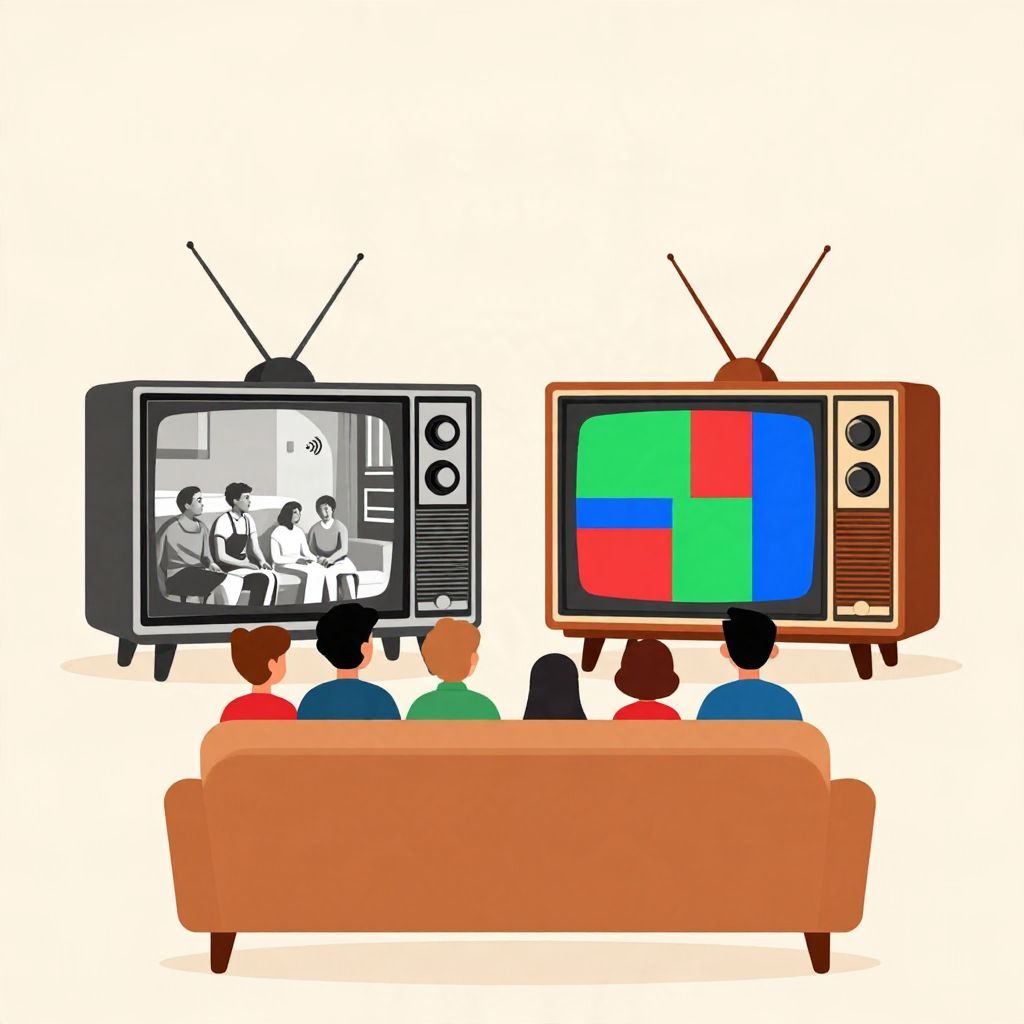
When did TV get color? The short answer is that color television was demonstrated and tested in the 1940s, introduced to the public in the early 1950s, and became common in many homes during the 1960s and 1970s. The exact date depends on whether you mean the first technical system, the first broadcast, or the moment color sets became widely affordable.
In other words, color TV did not arrive all at once. It emerged through decades of engineering, standards battles, and consumer adoption, with different countries moving at different speeds.
When Did TV Get Color?
Television got color in stages: experimental color systems appeared in the 1940s, the first commercial color broadcast in the United States aired on June 25, 1951, and color television became broadly common in American homes during the 1960s. In Britain and much of Europe, regular color broadcasting began later, mostly in the late 1960s and 1970s.
The Road to Color Television
Early television was black and white
Before color TV, broadcasts were designed for monochrome screens. Early television systems in the 1920s and 1930s focused on making moving images visible at all, not on reproducing realistic color. Engineers had to solve basic problems such as signal stability, image resolution, and synchronization before color could be added reliably.
That is why the history of color television is tied closely to the history of television itself. Once black-and-white broadcasting became practical, inventors began searching for ways to transmit red, green, and blue information in a format that existing systems could handle.
Mechanical experiments came first
Some of the earliest color television experiments used mechanical scanning devices. These systems were ingenious but limited. They could produce color images in controlled demonstrations, yet they were too awkward, fragile, or low-quality for mass broadcasting. Mechanical approaches mattered historically because they showed that color television was possible, even if they were not the final solution.
By the 1930s and 1940s, electronic television had become the dominant direction. That shift made it possible to build color systems that were more practical, though still expensive and technically complicated.
Key Dates in the History of Color TV
1940s: experimental breakthroughs
During the 1940s, engineers in the United States and elsewhere developed several competing color television systems. These were important laboratory and field tests, but not yet the familiar color broadcasting most people remember. The challenge was to create a system that could work with existing black-and-white sets or, at minimum, not make the entire broadcast system obsolete overnight.
1951: the first commercial color broadcast in the U.S.
The first commercial color television broadcast in the United States took place on June 25, 1951, on CBS. This is one of the most important dates in color TV history. However, very few viewers could actually watch it in color because color sets were rare and expensive, and the broadcast standard used by CBS was not compatible with the black-and-white sets already in most homes.
That incompatibility was a major reason early color TV adoption moved slowly. A technology can exist before it becomes socially widespread, and color television is a classic example.
1953: the NTSC color standard
A crucial turning point came in 1953, when the United States adopted the NTSC color standard. This system was designed to be compatible with existing black-and-white televisions, which made it far more practical for mass adoption. Once color broadcasts could be received on older sets, broadcasters and consumers had a stronger reason to embrace the new technology.
This compatibility issue was not a minor technical detail. It helped determine which color system succeeded and shaped the future of television in the United States and beyond.
Late 1950s to 1960s: color becomes a consumer product
Even after the standard was set, color television remained expensive. In the late 1950s and early 1960s, color sets were luxury items for many households. Broadcasters also had to invest in color cameras, studio equipment, and transmission infrastructure. As production costs gradually fell and more programming was made in color, the market expanded.
By the mid-1960s, color TV was no longer a novelty in the United States. Major networks increasingly aired prime-time shows in color, and by the end of the decade, color broadcasting had become a normal part of American television culture.
Britain and Europe: later adoption
In the United Kingdom, regular color broadcasting began in 1967 on BBC2, with other channels following later. Many European countries adopted color in the late 1960s and 1970s, though exact dates varied by nation and broadcasting system. In some places, the transition was slower because of cost, infrastructure, and differences in technical standards.
So if the question is asked globally, there is no single universal year when TV “got color.” The answer depends on region and on what counts as adoption: invention, first broadcast, standardization, or mass ownership.
Why Color TV Took So Long
Technical complexity
Color television required more than simply adding color to a picture. Engineers had to encode color information efficiently, keep the image stable, and ensure compatibility with older sets. The signal had to carry brightness and color data in a way that could be separated by the receiver. That was a difficult engineering problem for the era.
Cost and manufacturing
Early color sets were expensive to build and buy. They used more complex components than black-and-white televisions, and they needed precise adjustment. Manufacturers had to scale up production before prices could fall enough for ordinary families to purchase them.
Broadcasting investment
Television stations also had to convert studios, cameras, and transmission equipment. A broadcaster could not simply flip a switch and become a color network. The entire production chain had to change, which slowed the transition even after the technology itself was ready.
Consumer demand
Many viewers were satisfied with black-and-white television for years. Color was attractive, but not always necessary, especially when the price difference was large. Widespread adoption came only when color programming became common enough that black-and-white sets seemed outdated.
Important People and Institutions
Inventors and engineers
Color television was not the work of a single inventor. It was the product of many engineers, companies, and standards committees. Figures such as Peter Goldmark are often associated with early CBS color systems, while other teams developed competing electronic approaches. The eventual success of color TV depended less on one genius than on a long process of refinement and standard-setting.
Networks and regulators
Television networks helped test and promote color broadcasting, but government regulators also played a major role by approving standards. In the United States, the Federal Communications Commission’s decisions influenced which technology would be used nationwide. Similar regulatory choices shaped adoption in other countries.
How Color TV Changed Everyday Life
Broadcast entertainment became more vivid
Color transformed television from a primarily informational medium into a more immersive visual experience. Sports, nature programs, dramas, and variety shows all benefited from color. Viewers could see costumes, scenery, and advertising in ways that black-and-white television could not match.
Advertising and popular culture shifted
Color also changed advertising. Products could be presented more attractively, and broadcasters increasingly designed programs with visual impact in mind. As more households bought color sets, color imagery became part of everyday consumer culture.
Black-and-white did not disappear immediately
Even after color television became standard, black-and-white sets remained in use for years. Some homes kept older televisions in secondary rooms, and some broadcasts or local stations still used monochrome equipment for a time. The transition was gradual rather than sudden.
Timeline of Color Television
- 1920s–1930s: early experiments in television and color transmission
- 1940s: major electronic color TV development and testing
- June 25, 1951: first commercial color television broadcast in the U.S.
- 1953: NTSC color standard adopted in the United States
- Mid-1960s: color TV becomes common in American homes
- 1967: regular color broadcasting begins in the U.K. on BBC2
- Late 1960s–1970s: color broadcasting spreads widely across Europe and other regions
So, What Is the Best Answer to “When Did TV Get Color?”
If you want one concise answer, say this: television began getting color in the 1940s, first reached commercial broadcast audiences in 1951, and became widely available in the 1960s. The most historically accurate response is not a single year but a timeline of invention, standardization, and mass adoption.
That timeline shows how a modern technology often develops: first as an experiment, then as a broadcast innovation, and finally as an everyday household item. If you want to place color TV in the broader history of media technology, you may also enjoy reading about when color photos came out and when television was invented.