
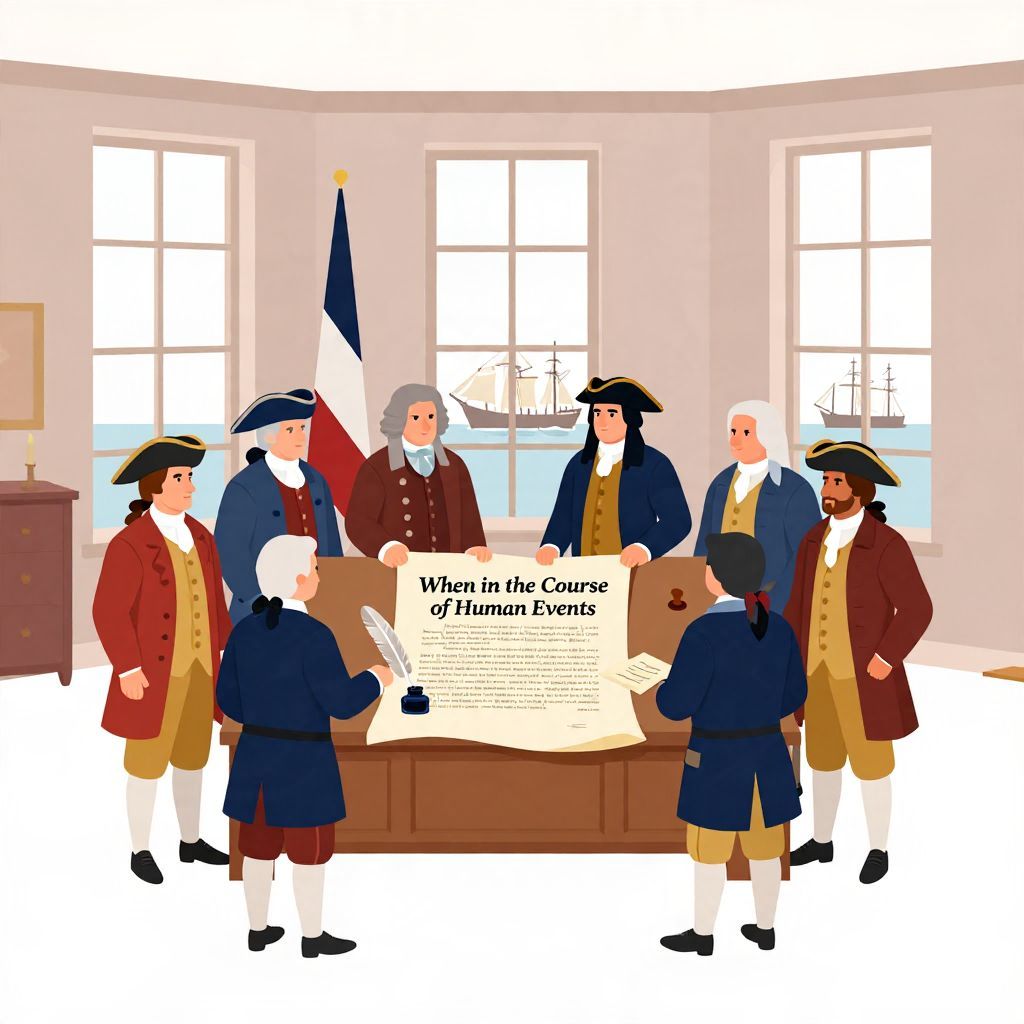
“When in the course of human events” is the opening phrase of the Declaration of Independence, the document adopted by the Second Continental Congress on July 4, 1776. The phrase is best known as the beginning of one of the most important political statements in American history, but it is also a window into the language, ideas, and revolutionary circumstances of the late eighteenth century.
To understand it, you have to look at both the document itself and the crisis that produced it. The phrase introduced a justification for breaking away from Great Britain, and it helped frame independence as a serious, reasoned response to political abuse rather than a sudden act of rebellion.
What does “When in the course of human events” mean?
The phrase means “when, in the normal flow of history, certain events occur.” In the Declaration, it introduces the idea that when one people is forced to separate from another, they should explain their reasons clearly and appeal to the judgment of humanity. It is formal, legal, and philosophical language, not a casual opening line.
Where did the phrase come from?
The wording was written in 1776 as part of the Declaration of Independence, mainly drafted by Thomas Jefferson with revisions by John Adams, Benjamin Franklin, and the rest of the drafting committee. The phrase was not borrowed from a single famous source in a simple way, but it reflects the style of Enlightenment political writing, British legal tradition, and eighteenth-century public prose.
Why the language sounds so formal
In the eighteenth century, political documents often began with broad statements about duty, law, and reason. The Declaration was meant to persuade multiple audiences: the colonies, foreign governments, and future readers. Its language was designed to sound measured and universal, not emotional or local.
Was Jefferson the only author?
No. Jefferson wrote the first draft, but the final text was edited by the committee and Congress. The famous opening survived the revision process, which suggests that its style and purpose fit the larger message the delegates wanted to send.
Why did the Declaration begin this way?
The opening sentence set up the Declaration’s central argument: that people have the right to separate from a government that has become destructive of their rights. By starting with “When in the course of human events,” the authors made independence sound like a justified political necessity, not an impulsive act. The sentence leads directly into the claim that governments exist to secure rights and that people may alter or abolish them when those ends are repeatedly violated.
The political purpose of the opening
The Continental Congress needed more than a declaration of anger. It needed a public case for independence. The opening sentence established that the colonies were acting according to principle and reason, and that they were aware of the seriousness of dissolving political ties with Britain.
The philosophical background
The Declaration reflects ideas associated with the Enlightenment, especially the belief that government should rest on consent and serve the public good. It also echoes long-standing English constitutional traditions about rights, law, and resistance to tyranny. The phrase itself does not name those theories, but it prepares the reader for them.
Historical timeline: how the phrase became famous
The phrase is famous because it appears at the start of a document that helped launch the United States as an independent nation. Its significance developed through a sequence of political events in the years before 1776.
- 1760s: Britain imposed new taxes and regulations after the Seven Years’ War, including measures that angered many colonists.
- 1770: Tensions deepened after confrontations such as the Boston Massacre.
- 1773: The Boston Tea Party intensified conflict between colonists and imperial authorities.
- 1774: The First Continental Congress met to coordinate colonial resistance.
- April 1775: Fighting began at Lexington and Concord, turning political crisis into war.
- July 1776: The Second Continental Congress adopted the Declaration of Independence.
By the time the Declaration was approved, many colonists had already concluded that reconciliation with Britain was unlikely. The opening phrase gave that conclusion a dignified and universal form.
The Declaration’s opening sentence in context
The full opening sentence is often quoted because it captures the document’s tone: solemn, rational, and public-minded. It begins with the idea that there are moments in history when political separation becomes necessary. The sentence then moves toward a broader principle: people should explain why they are taking such a serious step.
What the sentence is doing rhetorically
It does three things at once. First, it signals that the issue is historical and important. Second, it frames the colonies as thoughtful actors, not rebels acting on impulse. Third, it prepares the reader for a list of grievances against King George III and the British government.
How it differs from modern political language
Today, political statements are often shorter and more direct. In 1776, however, public writing frequently used long, balanced sentences and elevated vocabulary. That style was meant to show seriousness and authority. The famous opening line is one reason the Declaration still feels ceremonial and weighty.
What historical significance does the phrase have?
The phrase matters because it introduces one of the most influential arguments in modern political history: that a people may justify independence when government fails to protect their rights. The Declaration did not create all of those ideas from nothing, but it helped turn them into a powerful public statement that influenced later revolutions, reform movements, and constitutional debates.
Influence in the United States
In American history, the phrase became part of the national story of independence. It is often taught as an example of the country’s founding ideals, especially liberty, consent, and the right to resist oppression. At the same time, historians note that the Declaration’s universal language existed alongside a society that still tolerated slavery and excluded many people from political rights.
Influence beyond the United States
The Declaration’s language inspired later independence movements and political writers around the world. Its opening helped frame the idea that a people could appeal to universal principles when challenging imperial rule. That influence was symbolic and intellectual, even when later movements adapted the ideas to very different circumstances.
Common misunderstandings about the phrase
Because the line is so famous, it is sometimes treated as if it were a standalone motto or a mysterious quotation with hidden meaning. In reality, it is the opening of a carefully constructed political argument. Its meaning depends on the rest of the document.
It is not a random poetic line
The phrase is not just decorative. It establishes the Declaration’s logic and tone. Without the following sentences about rights, grievances, and political necessity, the opening would lose much of its force.
It does not mean the colonists wanted conflict for its own sake
The Declaration presents independence as a reluctant but necessary choice. The opening phrase helps make that case by suggesting that history sometimes reaches a point where separation becomes unavoidable.
Why historians still pay attention to the wording
Historians pay close attention to the phrase because words in founding documents matter. The opening of the Declaration shows how revolutionary leaders wanted to present themselves: as rational, principled, and aware of the wider implications of their actions. It also reveals how political legitimacy was argued in the eighteenth century.
Language as evidence
The phrase helps historians study the political culture of the American Revolution. It shows the influence of legal forms, Enlightenment ideas, and transatlantic political debate. It also reminds us that revolutions are not only fought with weapons; they are also fought with language.
Why the phrase endures
It endures because it captures a universal idea in a memorable form: history sometimes presents moments when people must decide whether to remain under a government or break away from it. That broad theme has kept the line relevant long after 1776.
Historical significance in one sentence
“When in the course of human events” is the formal opening of the Declaration of Independence, and it matters because it introduces the American argument for independence as a reasoned response to political injustice rather than a mere act of revolt.
In the end, the phrase is famous not just because it sounds elegant, but because it launches a document that reshaped political history. If you want to explore the ideas behind the Declaration further, see what rights the Declaration of Independence identifies and why the Articles of Confederation were replaced with the Constitution.