
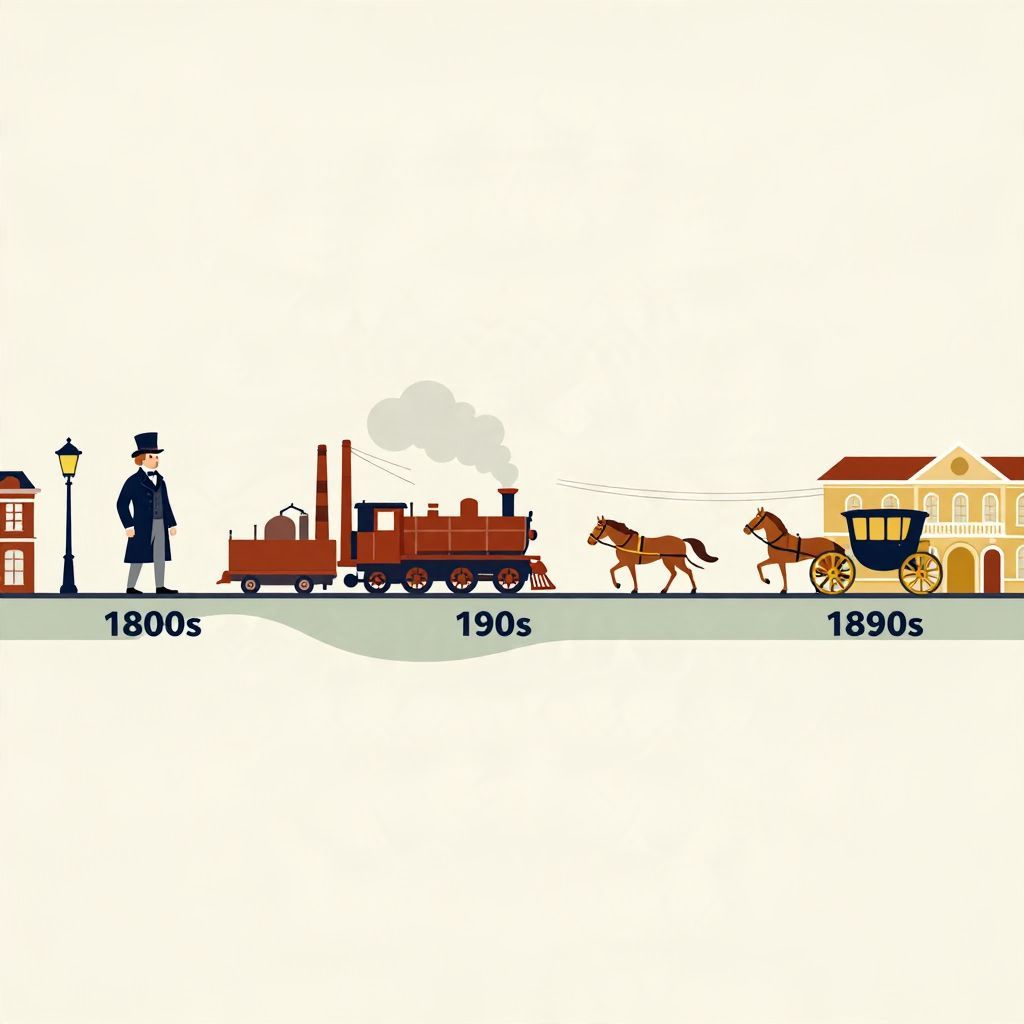
When is the 19th century? In the standard historical calendar, the 19th century runs from 1 January 1801 to 31 December 1900. That can feel counterintuitive, because people often think of the “1800s” as the 19th century, but centuries are counted from year 1, not year 0.
This period was one of dramatic change: revolutions, industrialization, empire-building, reform movements, and the rise of modern nation-states all reshaped daily life across much of the world.
When Is The 19th Century?
The 19th century is the hundred-year period from 1801 through 1900. It begins on 1 January 1801 and ends on 31 December 1900. This is the standard way historians, calendars, and most reference works define it, even though the years all begin with “18.”
Why the 19th century starts in 1801, not 1800
The confusion comes from the way centuries are numbered. The 1st century began with year 1 and ended with year 100. By the same logic, the 19th century begins with 1801 and ends with 1900. There was no year 0 in the traditional Gregorian calendar system, so each century starts with a year ending in 01.
The “1800s” versus the 19th century
In everyday speech, people often use “the 1800s” to mean the same thing as the 19th century. That is usually fine in casual conversation, but historians tend to prefer the precise century dates. Strictly speaking, the year 1800 belongs to the 18th century, while 1900 belongs to the 19th century.
A quick timeline of the 19th century
The 19th century is best understood as a period of acceleration. Political revolutions, new technologies, and global trade transformed societies at a speed that earlier generations had rarely experienced. A short timeline helps show how the century unfolded.
- 1801–1815: The Napoleonic era and the reshaping of Europe after the French Revolution.
- 1815–1848: Conservative restoration, growing liberal movements, and early industrial expansion.
- 1848: Revolutions across Europe, showing the pressure for constitutional and national change.
- 1850s–1870s: Industrial growth, railways, telegraphs, and major wars and unifications.
- 1880s–1900: High imperialism, mass politics, and the consolidation of modern industry and state power.
What made the 19th century historically significant?
The 19th century matters because it helped create the modern world. It saw the spread of industrial capitalism, the expansion of voting rights in some countries, the abolition of slavery in many places, the growth of scientific thinking, and the rise of global empires. At the same time, inequality, repression, and colonial violence remained central features of the era.
Industrialization changed work and daily life
One of the century’s defining developments was the Industrial Revolution, which began in Britain and spread unevenly to Europe, North America, and beyond. Mechanized textile production, steam power, railways, and factory labor altered how goods were made and how people lived. Cities expanded rapidly, often faster than housing, sanitation, or public health systems could keep up.
Revolutions challenged old political orders
The century opened in the shadow of the French Revolution and the Napoleonic wars. Across Europe and the Americas, people debated monarchy, citizenship, constitutions, and national identity. Revolutions in 1830 and 1848, independence movements in Latin America, and reform campaigns elsewhere showed that older dynastic systems were under pressure.
Empire expanded across the globe
The 19th century was also an age of empire. European powers expanded their control in Africa, Asia, and the Pacific, often through conquest, unequal treaties, or commercial domination. This imperial expansion was tied to industrial power, military technology, and economic interests, but it also produced resistance, adaptation, and long-term political consequences in colonized regions.
How historians divide the 19th century
Historians sometimes divide the century into broad phases to make sense of its changes. These divisions are not absolute, but they help explain why the era feels so dynamic. The century did not change overnight in 1801 or 1900; many developments began earlier or continued later.
Early 19th century: aftermath of revolution
The early decades were shaped by the aftermath of the French Revolution and the Napoleonic wars. The Congress of Vienna in 1814–1815 tried to restore political stability in Europe, but it could not erase the new ideas of nationalism, liberalism, and popular sovereignty that had spread during the revolutionary era.
Mid-19th century: reform and upheaval
By the mid-century, industrialization was deepening social change. Reform movements pushed for labor protections, expanded suffrage, religious toleration, and the end of slavery. At the same time, the revolutions of 1848 and conflicts such as the Crimean War and the American Civil War revealed how unstable the political order could be.
Late 19th century: mass society and global competition
In the later decades, railways, telegraphs, steamships, and new forms of finance shrank distances and intensified global connections. Political parties, newspapers, and mass movements became more influential. National unification in places such as Italy and Germany changed the balance of power in Europe, while imperial rivalry grew sharper overseas.
Major themes of the 19th century
Several themes help explain why the 19th century stands out in world history. These themes overlap and often contradicted one another. The century produced both liberation and coercion, reform and repression, progress and exploitation.
- Industrialization: factories, steam engines, railways, and mechanized production.
- Nationalism: the growing idea that peoples with shared language, culture, or history should form independent states.
- Liberal reform: demands for constitutions, civil rights, and representative government.
- Abolition and emancipation: the end of slavery in many parts of the Atlantic world, though not everywhere and not without struggle.
- Imperial expansion: European and other empires extending political and economic control.
- Scientific and technological change: advances in medicine, communications, transport, and industry.
Important events often associated with the 19th century
Some events are especially useful markers for understanding the century’s shape. They are not the only important developments, but they help show how the era moved from revolutionary upheaval to industrial and imperial modernity.
Napoleonic wars and the Congress of Vienna
The Napoleonic wars redrew Europe and spread revolutionary legal and administrative ideas. After Napoleon’s defeat, European leaders met at the Congress of Vienna to restore balance and prevent another continent-wide war. Their settlement brought a degree of stability, but it also preserved many conservative monarchies and ignored popular demands for self-rule.
Latin American independence movements
Across Spanish and Portuguese America, independence movements transformed the political map in the early 19th century. Leaders such as Simón Bolívar and José de San Martín became symbols of liberation, though the new states faced internal divisions, economic challenges, and uneven citizenship rights after independence.
The abolition of slavery
Slavery was abolished in many places during the century, including the British Empire in 1833 and the United States in 1865. These changes were the result of long abolitionist struggles, enslaved people’s resistance, and political conflict. Emancipation was a major moral and legal turning point, but racial inequality and coerced labor persisted in new forms.
National unification in Europe
Italy and Germany were unified in the 19th century through war, diplomacy, and political maneuvering. These unifications altered European diplomacy and strengthened the idea that nation-states should reflect shared national identity. Yet unification also created new tensions, especially in regions with mixed populations or competing loyalties.
Industrial and scientific breakthroughs
The century saw the spread of steam power, the telegraph, improved printing, modern medicine, and later electricity and the telephone. These innovations changed communication, warfare, business, and everyday life. They also created new forms of inequality between industrial and non-industrial regions.
What the 19th century looked like in everyday life
For ordinary people, the 19th century was not only a time of grand political events. It was also a period of changing work patterns, family life, education, and mobility. In industrial cities, many workers faced long hours and unsafe conditions. In rural areas, older rhythms of agricultural life still shaped the majority of the population in many countries.
Urban growth and social reform
As cities expanded, governments and reformers increasingly addressed sanitation, housing, public health, and schooling. Cholera outbreaks and other urban health crises exposed the costs of rapid growth. Over time, many states began to invest more heavily in infrastructure and public administration, though progress was uneven.
Education, literacy, and print culture
Literacy rates rose in many regions during the century, helped by public education reforms and the spread of cheaper printed materials. Newspapers, novels, pamphlets, and political tracts reached wider audiences than before. This expanded public debate and helped create modern political culture.
Was the 19th century the same everywhere?
No. The 19th century was a global period, but it did not unfold uniformly. Industrialization arrived at different speeds. Some regions experienced state-building and reform, while others faced conquest, colonization, or economic dependency. Even within the same empire, the century could mean very different things to elites, workers, enslaved people, farmers, or colonized communities.
Europe and North America
In Europe and North America, the century is often associated with industrial growth, constitutional politics, westward expansion, and major wars. But these regions also experienced labor conflict, dispossession of Indigenous peoples, and intense social inequality.
Asia, Africa, and the Middle East
In Asia, Africa, and the Middle East, the 19th century included both internal reform and external pressure from imperial powers. Some states modernized their armies, administrations, or economies in response to global competition. Others were weakened by invasion, unequal trade, or direct colonization. These experiences were diverse and should not be reduced to a single story.
Why the 19th century still matters today
Many institutions and conflicts of the modern world took shape in the 19th century. Modern nationalism, industrial capitalism, mass politics, colonial borders, and debates over rights and citizenship all have deep roots in this era. Understanding the century helps explain why the modern world developed as it did—and why its legacies remain contested.
So, when is the 19th century? It is the period from 1801 to 1900, but its historical importance goes far beyond a simple date range. It was the century that helped build the modern age, through revolution, industry, empire, and reform. For a related comparison with the next century, see when the 20th century began, or explore another 19th-century topic such as when the last penny was made.