
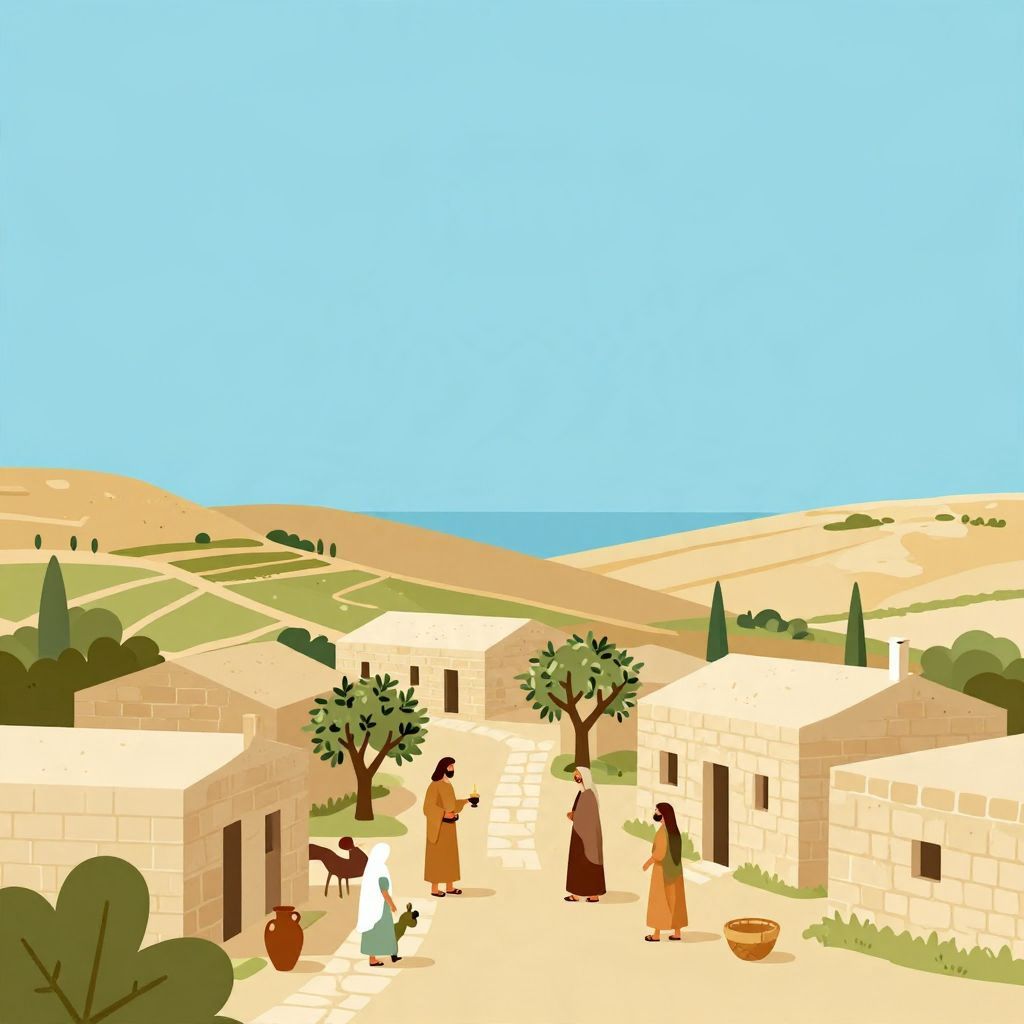
Where did Jesus live? The short historical answer is that Jesus of Nazareth lived in Roman-ruled Judea and Galilee, in the eastern Mediterranean region now divided mainly between modern-day Israel and the Palestinian territories. The best-supported tradition places his upbringing in Nazareth, a small village in Galilee, with later activity centered around towns and villages near the Sea of Galilee and Jerusalem.
Because the question touches both history and faith, it helps to separate what historians can say with confidence from later religious tradition. The evidence points to a first-century Jewish teacher whose life unfolded in a specific region, under Roman imperial control, in a world shaped by local Jewish customs, temple worship, and political tension.
Where did Jesus live?
Historically, Jesus is most closely associated with Nazareth in Galilee, where he is traditionally understood to have grown up, and with the wider region of Galilee and Judea, especially around Capernaum, Jerusalem, and nearby villages. He did not live in one grand palace or fixed urban center; he lived as a Jewish man of modest background in small settlements within Roman Palestine.
Nazareth: the place most associated with Jesus
The strongest and most enduring identification is with Nazareth, a village in lower Galilee. The New Testament repeatedly calls Jesus “of Nazareth” or “the Nazarene,” which is why the town became central to Christian memory. Historians generally accept Nazareth as Jesus’ home village, though the exact details of his childhood are not independently documented outside the Gospel traditions.
Nazareth in the early first century was likely a small rural settlement rather than a major town. That matters historically: Jesus’ background was not imperial, aristocratic, or urban. It was rooted in ordinary village life, agriculture, labor, and local Jewish religious practice.
Galilee, Judea, and the world of Roman Palestine
Jesus lived in a broader region often called Roman Palestine, though that label is a later historical convention. In his lifetime, Galilee was ruled by Herod Antipas, a client ruler under Roman authority, while Judea was under direct Roman administration for part of the period. This political setting shaped travel, taxation, public order, and the tensions visible in the Gospel accounts.
Galilee was more rural and densely populated with villages than Judea, while Jerusalem was the religious center because of the Temple. Jesus’ life moved between these spaces: village Galilee for much of his ministry, and Jerusalem for the final events of his life.
The historical setting of Jesus’ life
Jesus lived in the early first century CE, during the reign of the Roman Empire. The region was marked by Jewish religious diversity, peasant life, Roman taxation, and periodic unrest. This setting helps explain why Jesus’ message, which centered on the kingdom of God, resonated with many listeners and also drew suspicion from authorities.
Jewish life in first-century Galilee
Jesus was born into and lived within Second Temple Judaism, the form of Judaism that existed before the destruction of the Jerusalem Temple in 70 CE. This world included synagogue gatherings, Torah observance, pilgrimage festivals, purity practices, and debate over how best to live faithfully under foreign rule.
That context is essential. Jesus was not separated from Judaism; he emerged from it. His teachings, disputes, parables, and symbolic actions all make more sense when read against the background of Jewish scripture, village life, and Temple-centered religion.
What kind of place was Nazareth?
Archaeology and historical reconstruction suggest Nazareth was a small agricultural community. It was not a famous city in the way Jerusalem, Sepphoris, or Tiberias were. Its modest size fits the broader picture of Jesus’ life as a man from a low-status rural environment rather than from a wealthy or elite household.
Because Nazareth was small, some later readers have wondered whether it was significant enough to have been Jesus’ home. But from a historical perspective, that obscurity actually strengthens the plausibility of the tradition: a minor village would not have been the obvious place to invent for a messianic figure if one were trying to create prestige.
Did Jesus live only in Nazareth?
No. Although Nazareth is the place most associated with Jesus, the historical picture is broader. Jesus likely spent time in several places across Galilee and Judea. The Gospels present him traveling among villages, teaching in synagogues, visiting homes, and going to Jerusalem for major festivals. His life was mobile, not confined to one address.
Capernaum and the Galilean ministry
Capernaum appears prominently in the Gospel narratives as a base of activity during Jesus’ public ministry. It was a fishing and trade settlement on the northwestern shore of the Sea of Galilee. Several passages present Jesus teaching there, healing there, and staying in the homes of followers.
Historians generally view Capernaum as one of the most important places in the ministry tradition. Even if the precise details of every episode cannot be verified, the repeated association suggests that Jesus’ public work was deeply connected to the Galilean lake region.
Jerusalem and the final phase of his life
Jesus also lived, at least temporarily, in Jerusalem during the period leading to his execution. Jerusalem was the political and religious heart of Jewish life, especially during pilgrimage festivals. According to the Gospel accounts, Jesus went there near Passover, where his confrontation with Temple authorities and Roman power culminated in his crucifixion.
From a historical standpoint, this final movement to Jerusalem is highly significant. It shows that Jesus’ life was not only local and rural but also connected to the most contested and symbolically charged city in the region.
What historians can say with confidence
Historians work with limited evidence, mainly the New Testament writings, later Christian memory, and the broader historical context of first-century Judea and Galilee. That means some details are secure, while others remain probable rather than certain. The most careful answer is not a single pinpoint location, but a regional one.
- Most likely home region: Galilee
- Most likely home village: Nazareth
- Main area of ministry: Galilee, especially around the Sea of Galilee
- Final destination before death: Jerusalem
- Political setting: Roman-ruled Jewish Palestine in the early first century CE
This is the historically responsible answer because it reflects both the evidence and its limits. We can say where Jesus is most plausibly located in history, even if we cannot reconstruct every house, street, or exact route he took.
Why the location matters historically
Knowing where Jesus lived helps explain what kind of figure he was. A teacher from a small Galilean village would have had a different social outlook and audience than a priestly elite in Jerusalem or a philosopher in a Greco-Roman city. His sayings about farmers, fishermen, debt, seeds, meals, and village disputes reflect that environment.
Social class and everyday life
Jesus’ home region suggests a life shaped by ordinary labor and modest means. The Gospels portray carpentry or craft work associated with his family, though the exact occupation of Joseph and Jesus is discussed by scholars and should not be overstated. What is clear is that Jesus came from a non-elite setting in a largely agrarian society.
That background helps explain why his message often addressed the poor, the sick, the indebted, and the socially excluded. The geography of his life and the social world of his listeners were closely linked.
Religion, politics, and place
First-century Palestine was not just a backdrop; it shaped the meaning of Jesus’ life. Roman rule, local rulers, and the Temple system formed the political environment. Jewish hopes for divine justice, restoration, and liberation were alive in many forms. Jesus’ teachings about God’s kingdom made sense in that setting, which is one reason his movement spread so quickly after his death.
What about legends and later traditions?
Over time, Christian tradition expanded the memory of Jesus’ life with pilgrimage sites, shrines, and devotional stories. Some locations became sacred because believers associated them with events in the Gospels. These traditions are historically important, but they are not always the same as independently verifiable evidence.
It is also important not to confuse Jesus’ historical home with later theological ideas about his divine origin or heavenly identity. Those beliefs belong to Christian faith tradition. The historical question “Where did Jesus live?” is answered by geography and ancient context: he lived in Galilee and Judea, with Nazareth as the place most strongly tied to his upbringing.
So, where did Jesus live?
In historical terms, Jesus lived in first-century Roman Palestine, most likely grew up in Nazareth, carried out much of his ministry in Galilee, and spent his final days in Jerusalem. That answer reflects the best available historical evidence and the limits of what can be known with certainty.
For readers interested in broader ancient and religious history, related topics such as early Christianity and the history of the Roman Empire can provide helpful context; you can also explore more general background at HistoryOrg or browse introductory material at this history overview.