
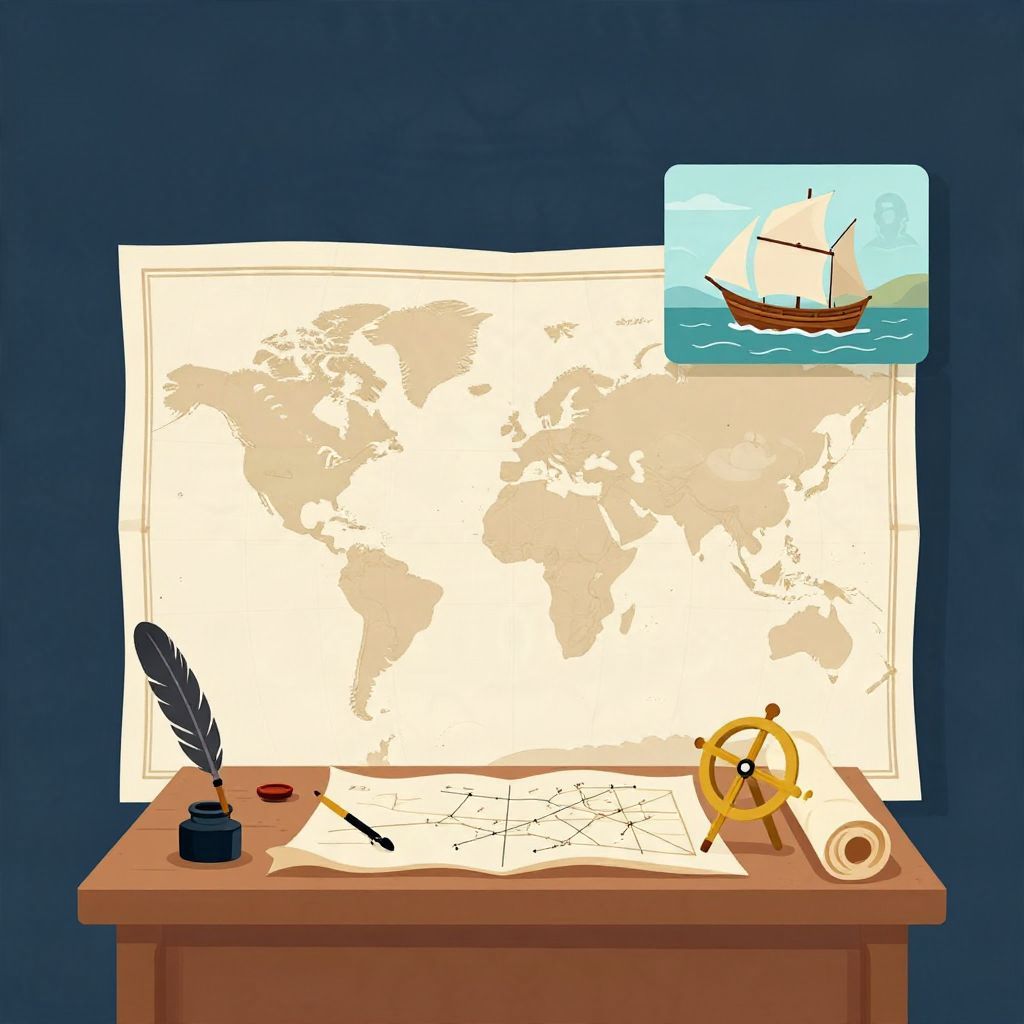
Where did the name America come from? The short answer is that it was named after Amerigo Vespucci, an Italian navigator whose accounts helped Europeans understand that the lands across the Atlantic were not Asia but a separate continent. The name was first attached to the new lands on a map made in 1507, and it gradually spread from there.
That simple answer hides a more complicated story about exploration, cartography, and European ideas about the world. The name did not come from the people already living in the Americas, and it was not chosen by a single government. Instead, it emerged from the work of mapmakers and writers in the early 16th century.
Where did the name America come from?
The name America comes from Amerigo Vespucci. In 1507, German cartographer Martin Waldseemüller used a feminine Latinized form of Vespucci’s first name, America, on a world map to label the newly recognized landmass in the Western Hemisphere. The name spread because Europeans increasingly accepted that these lands were a “New World,” not part of Asia.
Who was Amerigo Vespucci?
Amerigo Vespucci was a Florentine merchant, navigator, and explorer active at the turn of the 16th century. He took part in voyages along the coasts of South America and wrote letters describing what he believed were new lands. His importance lies less in “discovering” the Americas than in helping Europeans rethink the geography of the globe.
Why Vespucci mattered
Christopher Columbus reached the Caribbean in 1492, but he continued to believe he had arrived near Asia. Vespucci’s accounts, whether fully accurate in every detail or not, argued that the lands across the Atlantic were not the East Indies. That idea was crucial. Once Europeans accepted that this was a separate continent or continents, they needed a name for it.
Why was the new continent named after Vespucci?
The naming was the result of a scholarly and cartographic choice, not a royal decree. In 1507, Waldseemüller and his circle published a map and accompanying text that treated the lands in the west as a distinct fourth part of the world. Because Vespucci had described these lands in influential letters, the mapmakers proposed naming them after him.
The 1507 map and the name “America”
Waldseemüller’s map is the earliest known source to use the name America for the New World. The map shows the word on the southern portion of the western landmass, reflecting the limited European knowledge of the time. Later mapmakers extended the term to cover both North and South America.
The choice was partly inspired by a common Renaissance practice: naming lands after people, especially explorers or patrons. Waldseemüller also wrote that, since Europe and Asia had female names in classical geography, the new land should likewise receive a feminine name. He adapted “Amerigo” into “America” for that reason.
Was Amerigo Vespucci the only possible source?
Most historians agree that Vespucci is the direct source of the name, but there has been some debate about whether the name could have been influenced by other places or people. One older theory linked it to a Welsh merchant named Richard Amerike, but this idea has not gained broad scholarly support. The strongest evidence still points to Vespucci and the 1507 map tradition.
What historians generally accept
- The first known use of “America” for the New World appears on Waldseemüller’s 1507 map.
- The name was derived from Amerigo Vespucci’s first name.
- The label spread gradually through European cartography and publishing.
- It was not the name used by Indigenous peoples of the Americas, whose own place names and political geographies long predated European arrival.
How did the name spread from a map to a continent?
Maps were powerful in the early modern world. A printed map could circulate widely among educated readers, merchants, and rulers, shaping how they understood geography. As more maps adopted the term, “America” became the standard European label for the western lands. Over time, it came to mean the continents themselves rather than just one region.
From “New World” to “America”
Early Europeans used several terms for the lands across the Atlantic: the Indies, the New World, the western islands, and eventually America. The shift mattered because it marked a change in understanding. Europeans were no longer describing a mistaken route to Asia; they were recognizing a separate hemisphere with its own scale and complexity.
Did Columbus name America?
No. Christopher Columbus did not name America, and he did not believe he had reached a new continent. He died in 1506, before the name appeared on Waldseemüller’s map. Columbus’s voyages were historically decisive, but the naming of America came from later cartographers who interpreted the Atlantic discoveries differently.
Columbus and Vespucci in historical context
Columbus opened the route that brought Europe into sustained contact with the Americas, but Vespucci’s writings helped explain what those lands were. That distinction is important. Columbus’s role was exploratory; Vespucci’s was interpretive. The name America reflects the second of those contributions more than the first.
Why is the name historically significant?
The name America reveals how knowledge was made in the age of exploration. It was not just about sailing to new places; it was also about classifying, mapping, and naming them. The label became part of a larger European process of claiming, describing, and reorganizing the world after 1492.
What the name tells us about power
Names are never neutral. Calling the continents “America” reflects the dominance of European mapmaking in the early modern period. Indigenous nations had their own names, borders, and histories, but European maps often replaced them with a single continental label. The name therefore tells us as much about European expansion as it does about geography.
How the meaning of “America” changed over time
At first, “America” was a learned term used by a small circle of mapmakers and scholars. By the 16th and 17th centuries, it became more common in European writing. Eventually it came to refer not only to the continents but also, in everyday speech, to the United States of America, a much later political development.
Different meanings of America
- Early 1500s: a newly named landmass in the Western Hemisphere.
- Later 1500s–1600s: the broader continents of the New World.
- Modern era: often shorthand for the United States, especially in English usage.
This shift can cause confusion. Historically, “America” first meant the continents, not a country. The United States was founded centuries later and adopted the continental name in its official title.
What is the best historical answer to the question?
The best historical answer is that the name America came from Amerigo Vespucci, through a 1507 map by Martin Waldseemüller, who used a Latinized feminine form of Vespucci’s name to label the newly recognized lands of the Western Hemisphere. The name spread because Europeans increasingly understood these lands as a separate world.
In other words, America was not named by its inhabitants, by Columbus, or by a single nation-state. It was named by European mapmakers at a moment when the geography of the globe was being rewritten. That origin still shapes how we talk about the Americas today. For related background, you may also want to read about why colonists came to America and when America’s birthday is.