
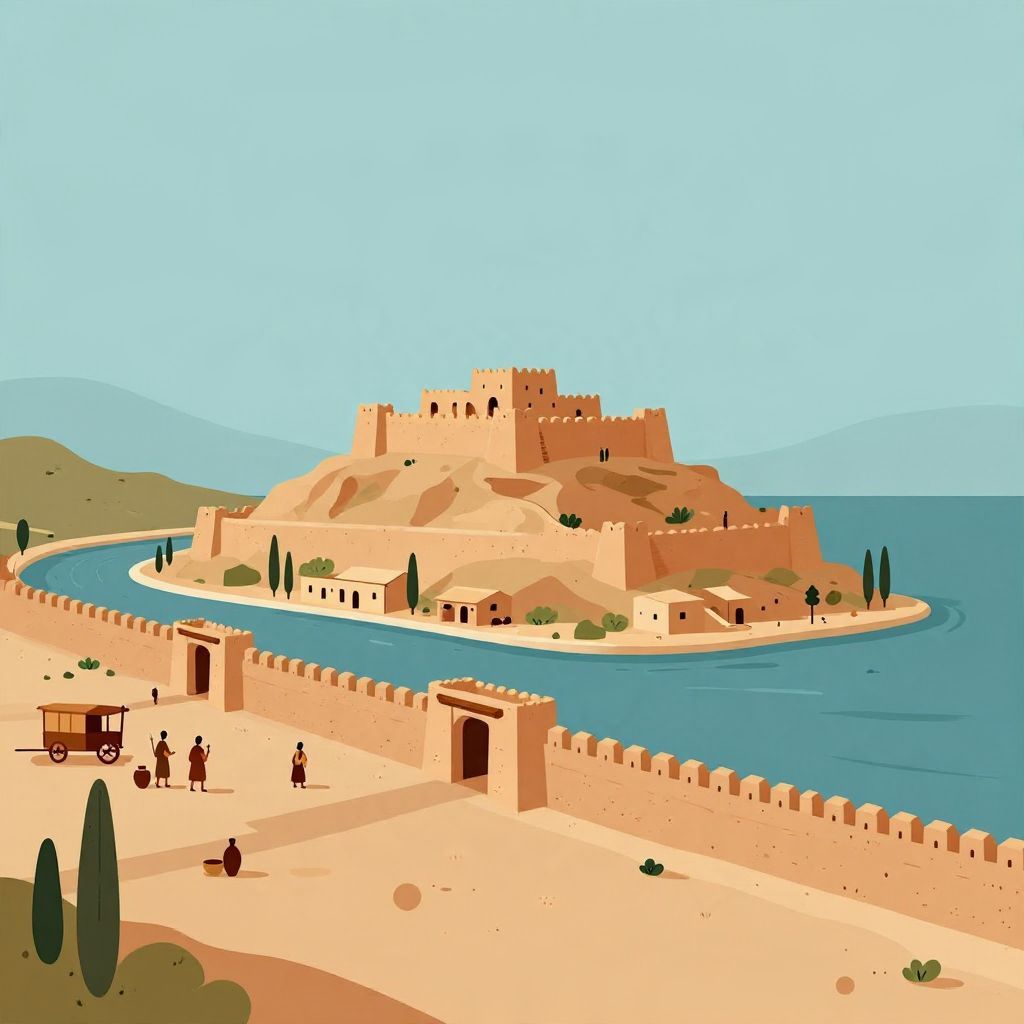
Where was Troy located? The ancient city associated with Homer’s Iliad was in northwestern Anatolia, in what is now modern-day Turkey, near the Dardanelles strait. Most historians and archaeologists identify Troy with the site of Hisarlik, a mound in today’s Çanakkale Province.
That identification is widely accepted, though the exact relationship between the archaeological site and the legendary Trojan War remains debated. Troy is both a real ancient settlement and a powerful literary setting, so its location matters for understanding history as well as myth.
Where Was Troy Located?
Troy was located at Hisarlik in northwestern Turkey, near the entrance to the Dardanelles and close to the Aegean Sea. The site sits on a strategic hill overlooking the plain of the Scamander River, a position that would have controlled movement between the Aegean world and the interior of Anatolia. This location made it valuable for trade, defense, and regional power.
The geographic setting
Hisarlik lies in the Troad, the ancient name for the region around Troy. It is near the modern city of Çanakkale and not far from the narrow waterway that links the Aegean Sea to the Sea of Marmara and, beyond that, the Black Sea route. In antiquity, this corridor was important for travel, commerce, and warfare.
The site’s prominence comes from geography as much as from legend. A settlement there could observe and influence traffic moving through the straits and across the surrounding plain. That strategic position helps explain why the place was occupied repeatedly over many centuries.
Why Historians Identify Troy with Hisarlik
Most scholars identify Troy with Hisarlik because excavations there revealed a long sequence of ancient settlements, including a fortified Bronze Age city that fits the general time and place of Homeric tradition. The evidence does not prove every detail of the Iliad, but it strongly supports Hisarlik as the historical core behind the Troy story.
Archaeological evidence at the site
Excavations at Hisarlik uncovered multiple layers of occupation, showing that the mound was rebuilt many times. Archaeologists commonly refer to these layers as Troy I, Troy II, and so on. This sequence shows that the site was inhabited from the Early Bronze Age into later periods, with one or more phases of strong fortification.
The most discussed levels are those from the late Bronze Age, especially Troy VI and Troy VIIa, which date roughly to the second millennium BCE. These levels show signs of a substantial settlement and possible destruction. Because the archaeological record is incomplete and interpretation is difficult, scholars disagree about which layer, if any, best matches the city remembered in epic tradition.
Schliemann and later excavations
The nineteenth-century excavations of Heinrich Schliemann brought international attention to Hisarlik. Schliemann believed he had found Homer’s Troy, and although some of his methods were destructive by modern standards, his work helped establish the site’s importance. Later archaeologists refined the chronology and showed that the mound contained a much more complex history than Schliemann first realized.
Subsequent research confirmed that Hisarlik was not a single city but a settlement mound built up over time. That long occupation history is one reason the site remains central to debates about Troy’s identity.
Troy in Myth and History
Troy is famous because of Greek epic poetry, especially Homer’s Iliad and Odyssey. In those poems, Troy is the city besieged by Greek forces after the abduction of Helen. The story became one of the foundational myths of the ancient Mediterranean world, but it should not be read as a straightforward historical account.
The Trojan War tradition
The traditional date of the Trojan War is often placed in the late Bronze Age, though ancient writers and modern scholars have proposed different chronologies. The war, as described in epic, blends memory, legend, and poetic invention. It may preserve echoes of real conflicts in western Anatolia, but the poems themselves were composed much later than the events they describe.
This means the question “Where was Troy located?” has two related answers: the legendary Troy of Homer was placed in the Troad near the Dardanelles, and the historical site most closely associated with that tradition is Hisarlik in modern Turkey.
What is certain and what is not
- Well supported: Troy was associated with the Hisarlik mound in northwestern Anatolia.
- Well supported: The site was occupied for many centuries and had a fortified Bronze Age settlement.
- Likely but debated: One of the Bronze Age layers may reflect a city remembered in later Greek tradition as Troy.
- Uncertain: The exact details of the Trojan War, including whether a single war occurred as described by Homer.
Why Troy’s Location Mattered in the Ancient World
Troy’s position was important because it sat at a crossroads between continents and seas. The Troad connected Anatolia with the Aegean, making it a useful place for controlling movement and exchange. A city there could benefit from trade routes, tolls, and regional alliances, but it could also become a target in times of conflict.
Strategic and economic importance
The narrow waterways near Troy were among the most significant in the ancient world. Control of access to the Dardanelles could affect shipping between the Aegean and the Black Sea region. Even if the Homeric war is legendary, the setting reflects a real strategic landscape that would have mattered to Bronze Age powers.
That strategic value helps explain why the site was repeatedly occupied and rebuilt. Cities in such locations often prospered, but they were also vulnerable to siege, conquest, and shifting political control.
Troy After the Bronze Age
Although the Bronze Age city is the most famous phase, Troy did not disappear after that period. The site continued to be inhabited in later centuries, and the memory of Troy remained important in Greek and Roman culture. In the classical and Hellenistic periods, the area was linked to heroic ancestry and cultural prestige.
Later significance in Greek and Roman times
Ancient Greeks and Romans visited and honored the supposed site of Troy, partly because the city had become a symbol of heroic age history. Roman writers in particular connected Troy with their own origin stories, especially through the figure of Aeneas. This gave the location a lasting political and cultural meaning far beyond its Bronze Age past.
Over time, the physical city changed, but the idea of Troy endured. The site became a place where archaeology, literature, and identity met.
How the Site Is Understood Today
Today, Troy is usually discussed as both an archaeological site and a literary landmark. Visitors to Hisarlik can see the remains of successive settlements, walls, gates, and reconstructed features that help explain the site’s long history. The ruins do not recreate Homer’s world exactly, but they show why the place captured ancient imagination.
The importance of careful interpretation
Modern scholarship treats Troy with caution. Archaeology can identify settlement layers, fortifications, and destruction horizons, but it cannot fully recover the events behind epic poetry. That is why responsible histories of Troy distinguish between the material site, the Bronze Age city, and the legendary narrative preserved in Greek literature.
In other words, Troy was real, but the Troy of Homer is a blend of history and myth. Its location at Hisarlik in northwestern Turkey is the strongest answer to the question, while its story remains one of the most enduring in world history. For readers interested in the wider ancient Mediterranean, related topics such as the Bronze Age Aegean and the history of ancient Greece help place Troy in its broader historical setting.