
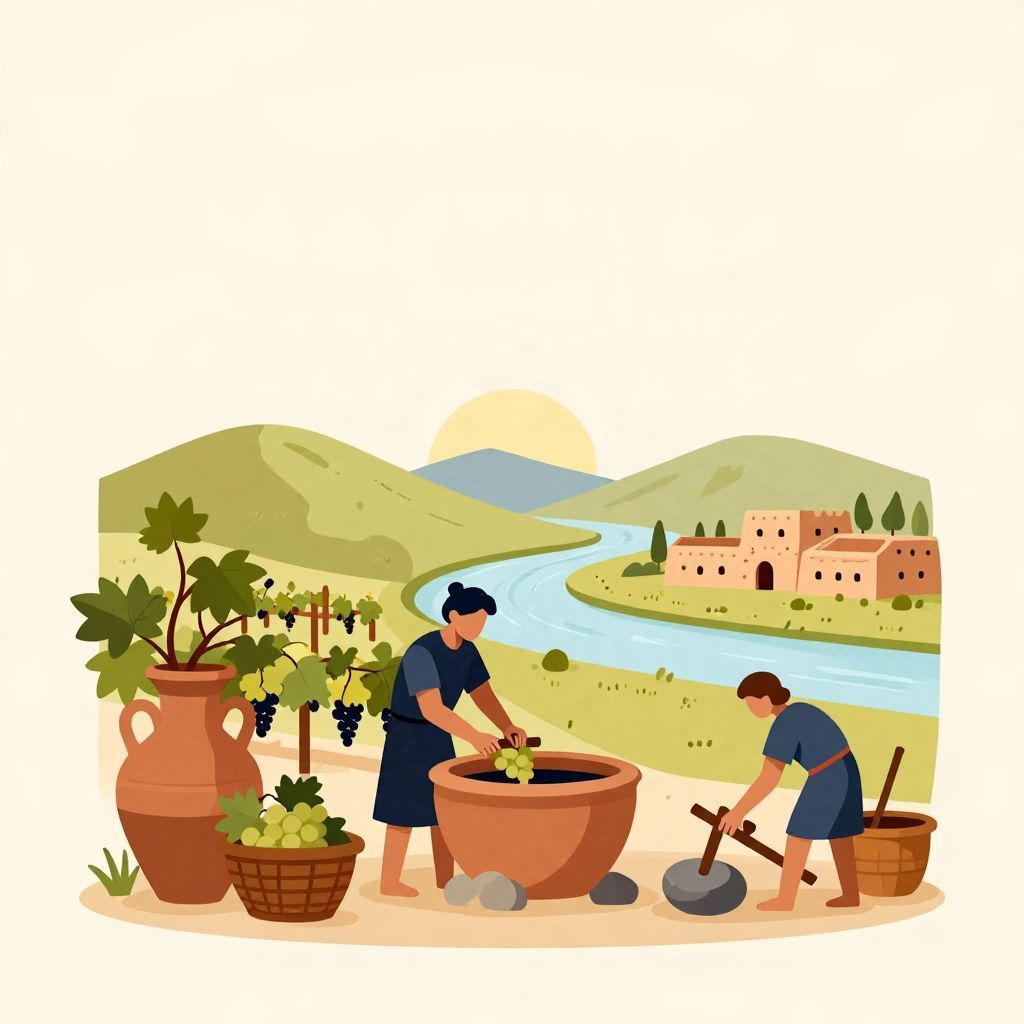
Where was wine invented? The short answer is that wine was most likely first made in the South Caucasus and nearby regions of the ancient Near East, especially in what is now Georgia, Armenia, and northeastern Turkey. Archaeological evidence suggests people were fermenting grape juice there as early as the late Neolithic period, thousands of years before written history.
Because wine arose long before modern borders, historians do not name a single “inventor.” Instead, they trace its origin to early farming communities that learned how to cultivate grapes and control fermentation. From that beginning, wine spread across the ancient world and became one of humanity’s most important ritual, social, and commercial drinks.
Where Was Wine Invented?
Wine was probably first invented in the South Caucasus and the adjacent Near East, with the strongest evidence coming from present-day Georgia. Archaeological finds from this broader region show that people were making grape wine by around 6000 BCE, though some scholars also point to early evidence in Iran and eastern Anatolia. The exact “first” place remains debated, but the origin zone is clearly in Southwest Asia, not Europe or the Americas.
The Earliest Evidence for Wine
Wine’s origin is reconstructed from archaeology rather than written records. The earliest secure evidence comes from pottery vessels, grape residues, and signs of fermentation. These finds indicate that ancient people were not just eating grapes; they were deliberately turning them into an alcoholic beverage.
Why archaeologists place the origin in the Caucasus
Several discoveries support the Caucasus as the most likely birthplace of wine. In Georgia, large clay vessels known as qvevri have been linked to very early wine-making traditions. Chemical traces of tartaric acid and other grape markers found in ancient jars suggest fermented grape juice. Similar early evidence appears in nearby regions, showing that wine production was part of a wider cultural landscape.
Important early sites and dates
- Georgia — evidence of wine-making around 6000 BCE, often cited as the strongest early case.
- Iran — pottery from sites such as Hajji Firuz Tepe has yielded grape-wine residues dating to around 5400–5000 BCE.
- Eastern Anatolia and the South Caucasus — likely part of the same early zone of domestication and fermentation.
These dates are approximate, and scholars continue to refine them as new methods improve. Still, the pattern is consistent: wine emerged in the ancient Near East during the transition from hunting and gathering to settled farming.
Why Wine Appeared Where It Did
Wine did not appear by accident in just any region. The South Caucasus and surrounding highlands had wild grapevines, a climate suitable for viticulture, and communities that were learning to store surplus food and drink. Once people settled into villages and began using pottery, they had the tools to ferment fruit juice and preserve it.
From wild grapes to cultivated vines
Wild grapes grew naturally across parts of the Near East and Mediterranean. Early farmers likely noticed that crushed grapes left in containers could ferment on their own because natural yeasts were present on the skins and in the environment. Over time, people selected better vines, planted them near settlements, and improved the reliability of production. This was not a single invention in the modern sense; it was a gradual process of experimentation.
Fermentation and early technology
Pottery mattered enormously. Before durable containers, it was difficult to store and transport fermented liquids safely. The appearance of ceramic vessels allowed people to control fermentation, age wine, and move it between households, villages, and eventually long-distance trade routes. Wine-making was therefore tied to broader changes in early agriculture and technology.
Was Wine Invented in One Place Only?
Probably not in the strictest sense. The strongest evidence points to a primary origin zone in the South Caucasus and neighboring areas, but early wine-making may have developed in more than one community within that region. Because grapevines were widespread and fermentation is a natural process, several groups may have discovered wine independently or shared the knowledge quickly through contact.
How historians handle uncertainty
When people ask where wine was invented, they often want a single birthplace. Historians are more cautious. The evidence supports a regional origin rather than a single named inventor or exact village. That means the best answer is geographic and approximate: wine emerged among early farming societies of the ancient Near East, especially around modern Georgia, Armenia, Iran, and eastern Turkey.
Wine in the Ancient Near East
Once wine-making began, it spread rapidly through trade, migration, and cultural exchange. By the Bronze Age, wine had become a valued product in Mesopotamia, Egypt, the Levant, and later the Mediterranean world. It was used in feasts, religious offerings, diplomacy, and elite display.
Mesopotamia and Egypt
In Mesopotamia, wine was known but often less common than beer, which fit local grain agriculture more naturally. Still, wine carried prestige because grapes were harder to grow in some areas and the drink could signal wealth or status. In ancient Egypt, wine became associated with the elite, temples, and funerary practices. Tomb paintings and jars show that Egyptians valued wine highly, especially imported varieties.
The role of trade
Wine spread because it was desirable and portable. Merchants transported it in jars and amphorae, and rulers used it as a luxury item and diplomatic gift. As viticulture expanded, people adapted grape-growing to new climates, especially around the Mediterranean basin. This helped turn wine from a regional innovation into a global cultural staple.
Wine in Greece and Rome
The Greeks and Romans did not invent wine, but they transformed its place in society. In Greece, wine was central to banquets, religious life, and philosophical culture. The symposium, a drinking gathering for elite men, helped shape Greek ideas about moderation, conversation, and social order.
The Romans expanded viticulture across much of Europe. They planted vineyards in Gaul, Iberia, and parts of Britain, helping wine become deeply embedded in European agriculture. Roman roads, trade networks, and military settlements carried vines and winemaking techniques far from the original Near Eastern homeland.
Why this matters historically
The spread of wine shows how an invention can become a civilization-wide practice. What began as local fermentation in the ancient Near East became a major agricultural system, a religious symbol, and an economic commodity. Wine was no longer just a drink; it was part of state power, identity, and daily life.
Popular Legends About the Origin of Wine
Many cultures have myths about who discovered wine. These stories are valuable as folklore, but they are not the same as historical evidence. A common theme is accidental discovery: grapes are left to ferment, someone tastes the result, and wine is born. Such stories reflect how natural fermentation can seem magical to people who do not understand the science behind it.
Myth versus history
Myths may preserve cultural memory, but they do not identify the real birthplace of wine. The historical answer comes from archaeology, not legend. The evidence points to early agricultural societies in Southwest Asia, where people had both access to wild grapes and the technology to ferment, store, and share the drink.
How Wine Spread Across the World
After its invention, wine followed the routes of agriculture, empire, and commerce. It spread west into the Mediterranean, north into Europe, and eventually to other continents through exploration and colonization. Each region adapted grape-growing to local conditions, creating distinct wine traditions.
- Neolithic period — early fermentation in the South Caucasus and nearby regions.
- Bronze Age — wine becomes a prestige drink in the ancient Near East.
- Classical antiquity — Greeks and Romans expand wine culture across the Mediterranean.
- Later centuries — wine spreads through Europe and beyond via trade, religion, and empire.
Why the Origin of Wine Still Matters
Knowing where wine was invented helps explain one of the oldest links between agriculture, ritual, and social life. Wine was not merely discovered; it was developed by early farming communities who learned to manage plants, containers, and fermentation. That makes wine a powerful example of how human innovation often grows out of everyday experimentation.
So, where was wine invented? Most likely in the South Caucasus and neighboring parts of the ancient Near East, especially in the area of modern Georgia, with early evidence also found in Armenia, Iran, and eastern Turkey. The precise first maker is unknown, but the historical origin is clear: wine began in Southwest Asia and then spread across the ancient world. If you want to explore more ancient food and drink history, related topics often include the history of beer and ancient Mesopotamian civilization.