
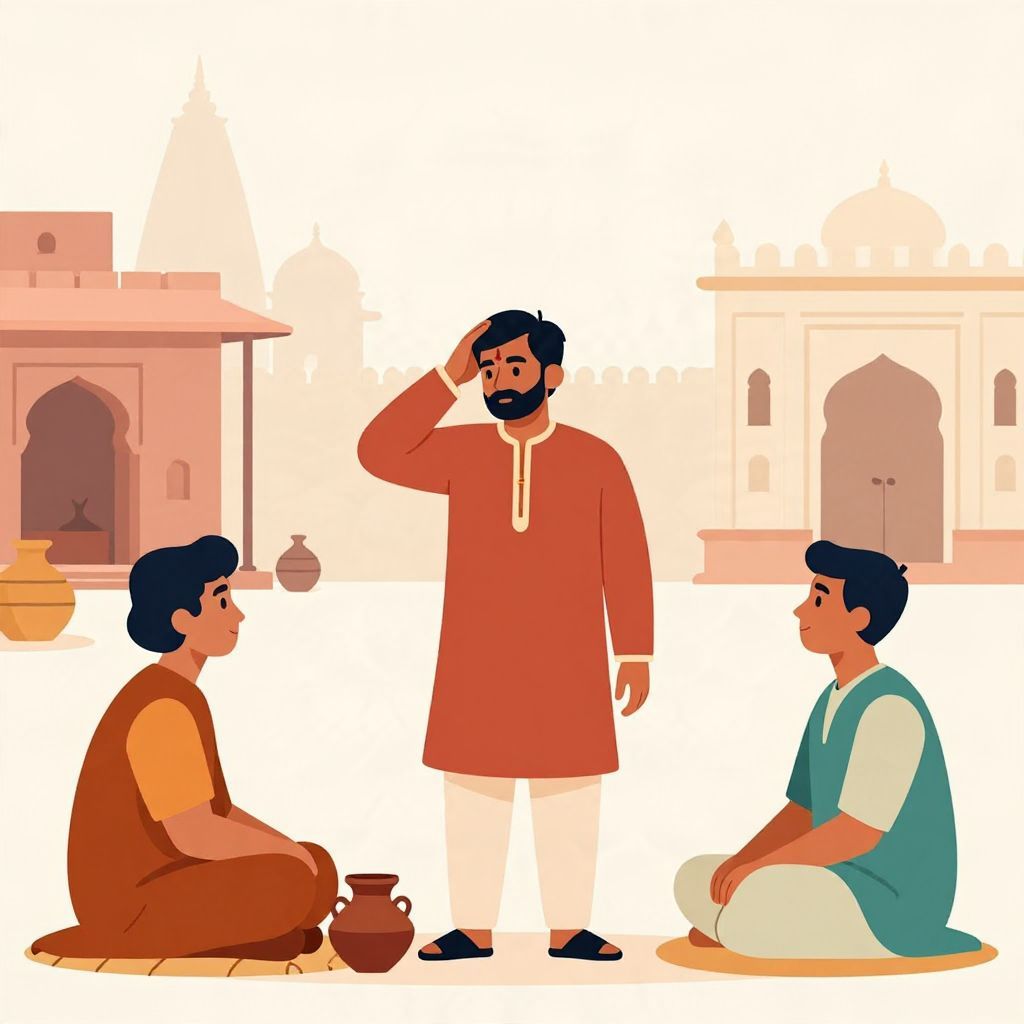
Why do Indians shake their heads? The short answer is that the gesture is a normal part of communication in many parts of India, but it does not mean just one thing. Depending on the angle, speed, and context, it can signal agreement, understanding, politeness, hesitation, or a soft refusal.
Its meaning is shaped by regional custom and social history. What can look puzzling to outsiders is often a subtle, efficient way of speaking without words, especially in a society where directness has long been balanced with courtesy.
Why Do Indians Shake Their Heads?
Indian head shaking is a culturally specific nonverbal gesture used to communicate nuance. It is not a single universal “yes” or “no.” In many settings it can mean “I understand,” “maybe,” “go on,” “that’s fine,” or a polite acknowledgment. Its meaning depends on context, relationship, and local habit.
The gesture in everyday Indian communication
To understand the gesture historically, it helps to begin with everyday life. In India, communication has often relied on indirect signals as well as speech. A small head movement can soften disagreement, show respect, or avoid blunt confrontation. In crowded markets, family homes, offices, and public spaces, this efficiency matters.
What the head wobble usually means
- Agreement or acknowledgment: “Yes,” “I hear you,” or “I understand.”
- Polite uncertainty: “Maybe,” “I’m not sure,” or “let me think.”
- Friendly reassurance: “It’s okay,” or “don’t worry.”
- Soft refusal: sometimes a gentle “no,” especially when direct rejection would seem rude.
- Encouragement to continue: a listener may wobble their head to show attention and interest.
Because the gesture is flexible, foreigners often misread it. A visitor may think the person is confused or disagreeing when, in fact, they are signaling understanding or courtesy. That ambiguity is part of its social usefulness.
Historical roots of the gesture
The head wobble is not tied to one ruler, one religion, or one exact date. It developed over time as part of South Asian social behavior. Scholars generally treat it as a long-standing cultural convention rather than a single invention. Its spread reflects the region’s diversity, multilingual life, and emphasis on socially smooth interaction.
Why indirect gestures became useful
For much of Indian history, people lived in multilingual environments. A village, town, or trading center might include speakers of several languages and dialects. In such settings, gestures helped bridge gaps in speech. A nod, tilt, or wobble could carry meaning even when words differed.
India’s social traditions also valued decorum. In many communities, open disagreement, especially with elders or superiors, could be seen as disrespectful. A subtle head movement allowed a person to respond without sounding harsh. Over time, this became a normal part of etiquette.
Connections to broader South Asian body language
Body language in South Asia has long been expressive. Hand gestures, eye movement, posture, and head movement all contribute to meaning. The Indian head wobble fits into this broader pattern of nonverbal communication. It is especially effective because it can be gentle, quick, and easily adjusted to the social situation.
It is important not to oversimplify it as uniquely “Indian” in a rigid sense. Similar gestures and expressive head movements exist elsewhere in South Asia too. But the particular side-to-side or diagonal wobble is especially associated with Indian social interaction in modern global perception.
How the gesture differs from a Western nod or shake
One reason the gesture stands out is that it does not match the simple yes/no system familiar in many Western cultures. In much of Europe and North America, a nod usually means yes and a shake means no. In India, the head wobble often sits between those meanings, making it more context-dependent.
Why outsiders find it confusing
Visitors often expect a clear binary answer. But Indian communication frequently allows room for nuance. A head wobble can mean “yes, but with conditions,” or “I am listening and I understand your point.” This can feel ambiguous to outsiders, yet it is often perfectly clear to those who share the cultural code.
The confusion is not evidence of inconsistency. It shows that gestures are learned social habits, not universal biological signals with fixed meanings. Like language, body language has regional grammar.
Politeness, hierarchy, and social harmony
Historical Indian societies, like many others, were shaped by hierarchy: age, caste, occupation, gender, and status could all affect how one spoke to another. In such a setting, indirect communication had practical value. A head wobble could show respect while still giving an answer.
A way to avoid open conflict
Direct refusal can create tension. The wobble offers a middle path. It lets a person acknowledge another’s words without committing to a blunt yes or no. In family life, business dealings, and public conversation, this can preserve harmony.
This does not mean Indians are uniquely indirect. Rather, the gesture reflects a broader historical preference in many settings for tactful communication. The exact balance between directness and indirectness varies by region, class, and situation.
Regional variation across India
India is not culturally uniform. A gesture that feels natural in one region may be interpreted differently in another. The head wobble is widely recognized, but its frequency and exact meaning vary across states, languages, and communities. Urban and rural settings can also differ.
Examples of variation
- In some places, the wobble is used constantly in conversation as a sign of active listening.
- In others, it may be more restrained and used mainly for polite acknowledgment.
- Some speakers combine it with a smile, which can make the meaning warmer and clearer.
- In formal settings, people may reduce the gesture and use more explicit verbal responses.
This regional diversity is one reason the gesture cannot be reduced to a single dictionary definition. It is a living social habit shaped by local norms.
Colonial encounters and outside interpretations
British colonial officials, travelers, and later foreign visitors often noticed Indian gestures and tried to classify them. Like many colonial observers, they sometimes misunderstood local customs because they interpreted them through European assumptions. What looked indecisive or evasive to outsiders was often simply polite and context-rich communication.
Colonial rule also changed Indian public life in many ways, but it did not erase older habits of nonverbal communication. In fact, the head wobble remained common because it was rooted in everyday social practice, not in formal institutions. It survived because it was useful.
From local custom to global stereotype
In the late 20th and 21st centuries, travel writing, film, and media turned the gesture into a recognizable symbol of “Indian-ness.” That visibility has a mixed effect. On one hand, it helps outsiders notice a real cultural pattern. On the other, it can flatten a rich and varied practice into a cliché.
Historically, the gesture is better understood not as a quirky national trait but as one element in a complex communication system shaped by social life over centuries.
Is there a single origin story?
No single origin story is well established. There is no reliable historical evidence that the head wobble began at one moment, in one dynasty, or through one famous event. It is more accurate to see it as an evolved social convention, gradually reinforced through repeated use across generations.
What historians can say with confidence
- The gesture is widely recognized in many Indian contexts today.
- It functions as a flexible, nonverbal form of communication.
- Its meaning depends heavily on context.
- It likely developed over a long period through everyday social practice.
- It reflects the importance of politeness, nuance, and social harmony in communication.
Because this is a cultural habit rather than a dated political event, historians rely more on observation, ethnography, and social interpretation than on a single documentary source.
Why the gesture still matters today
The Indian head wobble remains important because it shows how culture lives in small actions. It is not merely a “quirk”; it is a practical tool for managing conversation, respect, and uncertainty. In modern India, where people move between local languages, national media, and global settings, the gesture still helps people communicate quickly and gracefully.
At the same time, younger urban Indians may use it differently from older generations, and some people use it less often in formal or international settings. Like any living custom, it adapts. But it continues to carry recognizable social meaning.
Conclusion: a gesture with history behind it
Indians shake their heads because the gesture is a historically developed form of nuanced communication, not a random habit. It can mean agreement, acknowledgment, politeness, hesitation, or gentle refusal, depending on context. Its long life reflects India’s multilingual society, social etiquette, and preference for flexible expression. To understand it is to see how history shapes even the smallest movements. For more on cultural history and everyday life, explore related articles on Indian social customs and the history of nonverbal communication.