
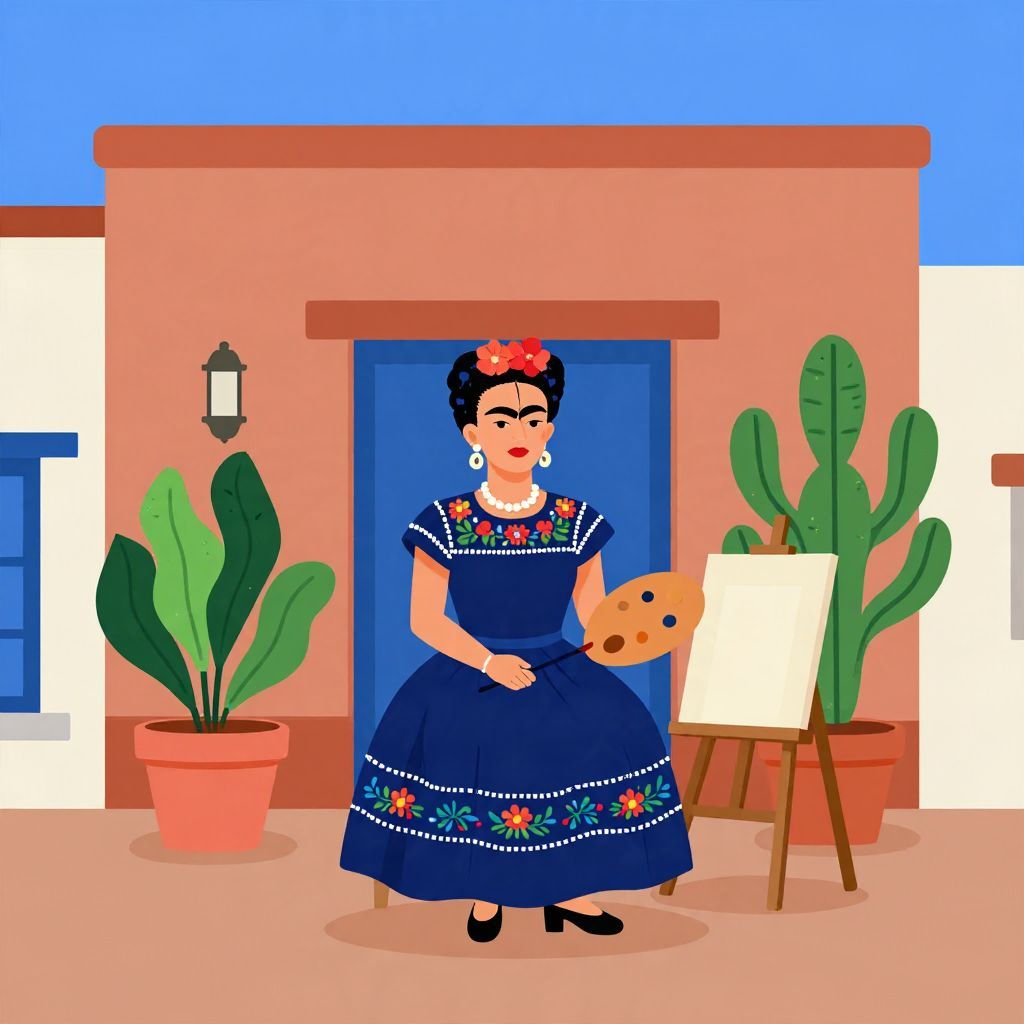
Why is Frida Kahlo famous? The short answer is that she became one of the most recognizable artists of the 20th century because her paintings turned personal suffering, identity, politics, and Mexican culture into powerful modern art. Her life story also helped make her a global icon.
But her fame did not come only from biography. It grew from the originality of her self-portraits, her association with Mexican nationalism and surrealism, and the way later generations embraced her as a symbol of resilience, feminism, and cultural identity.
Why is Frida Kahlo famous?
Frida Kahlo is famous because she created striking, highly personal paintings that made her pain, identity, and politics visible, while also becoming a symbol of Mexican culture and female artistic independence. Her reputation rests on both her art and the powerful story of her life: a serious childhood illness, a devastating accident, a difficult marriage, and a career that transformed private experience into public meaning.
The artistic reasons Frida Kahlo became famous
She made self-portraiture unforgettable
Kahlo is best known for her self-portraits. She painted herself again and again, often with direct, unsentimental gaze, symbolic objects, and vivid detail. These works were not simple likenesses; they were ways of exploring body, memory, pain, and identity. Because she used her own face as a recurring subject, her art became immediately recognizable.
Her style combined realism with symbolism. In many paintings, she included animals, plants, blood, medical imagery, or references to Mexican folk art. The result was personal, but also universal enough to speak to viewers far beyond Mexico.
Her work was emotionally direct
Unlike art that hides feeling behind abstraction, Kahlo’s paintings often confront the viewer with emotional and physical experience. She painted miscarriage, injury, heartbreak, and bodily vulnerability. This directness made her work stand out in the 20th century, when many artists were moving toward abstraction or formal experimentation.
Her art was not famous because it was decorative. It was famous because it was honest, unsettling, and memorable.
She developed a distinct visual identity
Kahlo’s fame also grew from her carefully constructed image. She often wore Tehuana dress, traditional Mexican clothing associated with indigenous and regional identity. This was both personal and political. It expressed pride in Mexican culture and helped create the visual persona that later audiences would remember.
That image became part of her legacy, but it should not be confused with mere costume. For Kahlo, dress, hairstyle, jewelry, and posture were part of how she presented herself in a modern world shaped by revolution, nationalism, and changing ideas about women.
The historical context behind her fame
She came of age in post-revolutionary Mexico
Kahlo was born in 1907 in Coyoacán, then a separate town near Mexico City. Her adult life unfolded after the Mexican Revolution, a period when artists and intellectuals were searching for a new national culture. This mattered because Mexican art in the 1920s and 1930s was closely tied to questions of identity, revolution, and indigenous heritage.
In that environment, Kahlo’s work resonated strongly. She was not just painting private feelings; she was painting in a country where art was often expected to engage with the nation’s history and future.
Her connection to Diego Rivera increased her visibility
Frida Kahlo’s marriage to muralist Diego Rivera in 1929 brought her into the center of Mexico’s artistic and political world. Rivera was already internationally known, and the couple attracted attention wherever they went. Their relationship was turbulent, and that turbulence became part of Kahlo’s public image.
It is important, however, not to reduce her fame to being Rivera’s wife. Their marriage did help her visibility, but her reputation endured because her own art proved distinctive and influential.
She was associated with surrealism, though she resisted the label
European surrealists admired Kahlo’s work, especially André Breton, who saw it as surrealist. Kahlo herself reportedly rejected being categorized that way, insisting that she painted her own reality rather than dreams. That distinction matters historically: her fame grew partly through surrealist circles, but her art was rooted in lived experience, Mexican visual culture, and self-examination rather than a formal surrealist program.
How her life story contributed to her fame
Her accident shaped her art and public image
At age 18, Kahlo was badly injured in a bus accident in 1925. She suffered severe fractures and other injuries that caused chronic pain and medical complications for the rest of her life. During long recoveries, she began to paint more seriously. The accident is central to her biography because it shaped both her subject matter and her physical reality.
Her later paintings often reflect this suffering. Corsets, hospital imagery, broken bodies, and divided selves appear repeatedly. These images made her work intensely personal and gave later audiences a dramatic framework for understanding her art.
She turned illness into artistic meaning
Kahlo had multiple surgeries and long periods of pain. She also experienced miscarriages and fertility struggles, which became important subjects in her work. Rather than hiding these experiences, she made them visible. That was unusual in mainstream art of her era, and it helped make her a powerful figure for later viewers who saw in her work an unflinching account of the body.
Still, historians are careful not to romanticize her suffering. Her fame was not simply the result of tragedy; it came from the way she transformed hardship into art with lasting force.
Why Frida Kahlo became a cultural icon after her death
Her reputation grew more slowly than her legend
During her lifetime, Kahlo was respected in artistic circles, but she was not yet the global phenomenon she is today. In the decades after her death in 1954, interest in her work expanded dramatically. Exhibitions, scholarship, feminism, Chicano cultural movements, and popular media all helped elevate her from important artist to international icon.
This means her fame is partly historical and partly retrospective. Later generations found in her life and art meanings that earlier audiences had not fully foregrounded.
Feminist readers embraced her independence
In the late 20th century, many feminists saw Kahlo as a woman who refused to be defined by conventional expectations. She painted female experience, challenged beauty norms, and lived publicly on her own terms. Her self-portraits seemed to reject passive femininity and instead present a woman who observed, judged, and represented herself.
That does not mean Kahlo was a modern feminist in a simple contemporary sense. But her life and art offered later audiences a powerful example of female self-definition.
She became a symbol of Mexican and Indigenous identity
Kahlo’s use of Mexican dress, folk motifs, and references to indigenous culture made her especially meaningful in discussions of national identity. For many viewers, she came to represent a proud, complex Mexican modernity. Her image was also adopted in broader conversations about decolonization, cultural pride, and hybridity.
At the same time, historians note that identity is not static. Kahlo’s self-presentation was personal, selective, and artistic. It should be understood as a crafted identity, not a simple mirror of one fixed tradition.
What makes Frida Kahlo different from other famous artists?
She fused autobiography and symbolism
Many artists paint themselves, and many artists explore suffering. What makes Kahlo unusual is the intensity with which she merged autobiography, symbolism, and national imagery. Her paintings are often small in scale but large in meaning. They invite viewers into a world where the personal and political are inseparable.
Her fame rests on image as well as art
Kahlo is one of the rare artists whose face is nearly as famous as her work. Her eyebrows, dress, flowers, and posture became instantly identifiable. This visual memorability helped her become a cultural icon, especially in the age of posters, books, fashion, and digital media.
That popularity can sometimes flatten her into a symbol. Yet the reason the symbol works is that the art behind it remains compelling.
She appeals across different audiences
Frida Kahlo is admired by art historians, political readers, feminists, designers, and general audiences. Some are drawn to her technical skill and symbolism; others to her biography or her image. Her fame endures because she can be read in many ways without being exhausted by any single interpretation.
Common misconceptions about Frida Kahlo’s fame
- Misconception: She was famous only because of Diego Rivera.
Reality: Rivera helped her visibility, but her lasting fame comes from her own art and public image. - Misconception: She was simply a surrealist artist.
Reality: Surrealists admired her, but she described her work as rooted in her own reality. - Misconception: Her fame was immediate and universal.
Reality: Her global reputation grew significantly after her death. - Misconception: Her life story is more important than her paintings.
Reality: The paintings are central; the biography helps explain why they matter.
Why Frida Kahlo still matters today
Frida Kahlo remains famous because her art continues to speak to modern concerns: bodily autonomy, gender, pain, identity, and the politics of representation. Her work is visually striking, emotionally intense, and historically grounded in Mexico’s post-revolutionary culture. She is not just remembered as a tragic figure, but as an artist who made a unique visual language out of personal experience.
In historical terms, Kahlo’s fame is the result of art, biography, and later cultural reinterpretation working together. If you want to explore more modern cultural history, related topics such as Mexican muralism and post-revolutionary art or the history of feminism in the 20th century can provide useful context.