
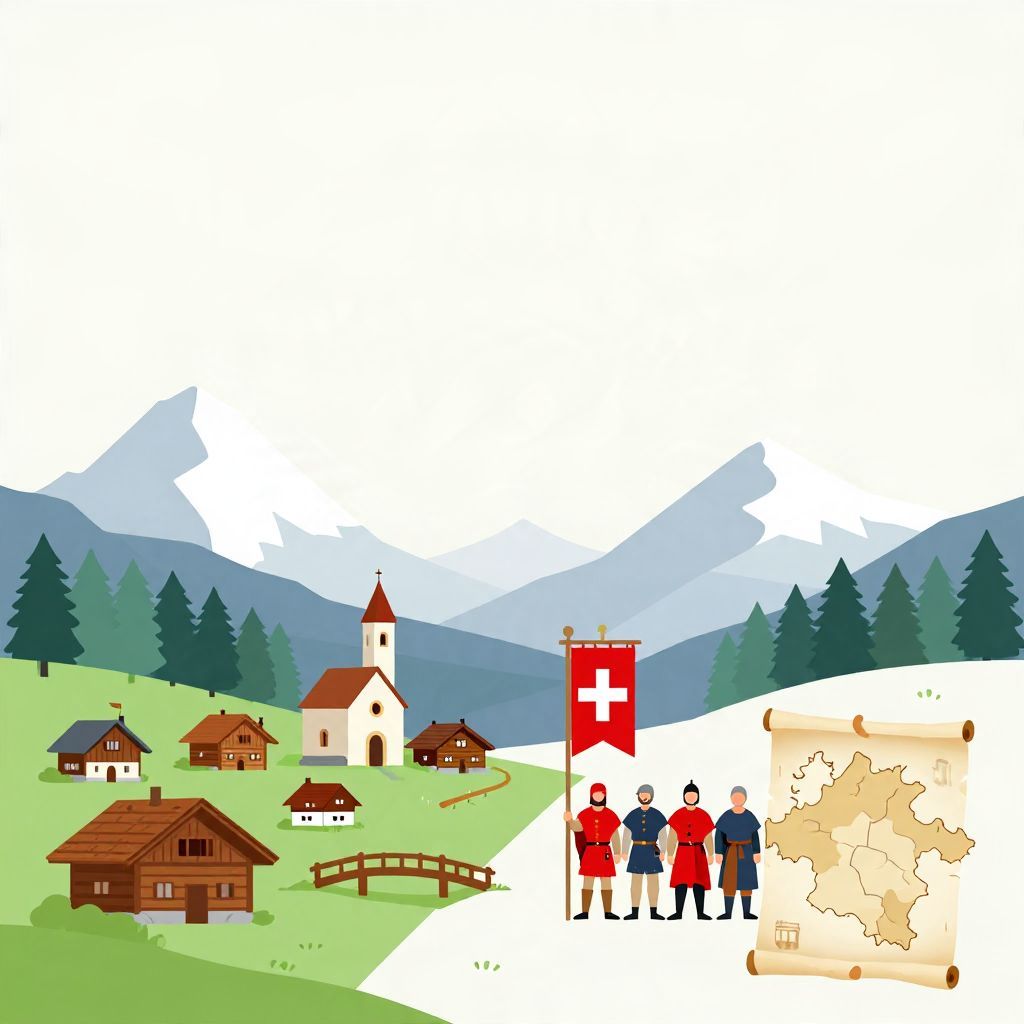
Switzerland is often described as “sui generis,” a Latin phrase meaning “of its own kind.” In historical writing, that label reflects how Switzerland developed a political system, identity, and foreign policy unlike most European states.
The short answer is that Switzerland became distinctive through a long process of mountain geography, local self-government, confessional division, and a hard-won tradition of neutrality. It was not born as a typical centralized kingdom or empire, but as a loose confederation that gradually turned into a federal state.
Why Is Switzerland Sui Generis?
Switzerland is considered sui generis because it evolved as a decentralized confederation of cantons rather than a centralized nation-state. Its political independence, multilingual society, direct democracy, and long-standing neutrality developed over centuries, especially from the late Middle Ages through the 19th century, making it historically unusual in Europe.
The Geographic Roots of Swiss Distinctiveness
Switzerland’s mountains mattered enormously. The Alps and Jura made travel difficult, limited large-scale conquest, and encouraged local communities to govern themselves. Valleys and alpine passes also connected regions to wider Europe, so Swiss communities were never isolated, but they were hard to rule from afar.
This geography helped preserve strong local identities. Villages, valleys, and towns often developed their own customs, assemblies, and legal traditions. Instead of one dominant capital imposing uniform rule, power remained scattered among many small political units. That pattern became one of the foundations of Swiss exceptionalism.
Why mountains encouraged autonomy
- They made centralized military control difficult.
- They strengthened local cooperation for defense and survival.
- They protected regional legal traditions and communal rights.
- They linked Switzerland to trade routes without fully absorbing it into surrounding kingdoms.
How the Swiss Confederation Began
The core of Swiss distinctiveness emerged in the late 13th and early 14th centuries. In traditional Swiss history, the forest cantons of Uri, Schwyz, and Unterwalden formed defensive alliances against Habsburg influence. The famous founding story is associated with 1291, though historians treat this date as the beginning of a political myth as much as a precise national birth certificate.
What is well established is that these communities were building alliances to protect local privileges, resist outside lordship, and manage shared security. Over time, more cantons joined the confederation. By the late Middle Ages, the Swiss Confederation had become a durable network of allied territories rather than a single kingdom.
Key stages in the early confederation
- Late 1200s to early 1300s: local alliances form in the central Alps.
- 14th to 15th centuries: the confederation expands through war, diplomacy, and mutual defense.
- 1499: the Swabian War helps confirm Swiss practical independence from the Holy Roman Empire.
- Early 16th century: the confederation remains loose, with cantons retaining major authority.
Why Swiss Politics Stayed So Decentralized
Unlike France or Spain, Switzerland never developed a strong royal center that absorbed local powers. Each canton kept significant control over taxation, law, religion, and military matters. This arrangement was messy, but it gave the Swiss political system a flexibility that outsiders often found unusual.
That decentralization was not a sign of weakness alone; it was also a practical solution. The cantons were different in language, religion, economy, and social structure. Some were rural and alpine, others urban and commercial. A loose confederation allowed these differences to coexist without forcing a single model on everyone.
Important political features
- Cantonal sovereignty: local governments retained broad authority.
- Collective defense: members cooperated in war but governed themselves at home.
- Negotiated rule: politics often depended on bargaining rather than absolute command.
- Limited central institutions: there was no early modern Swiss monarchy or strong central bureaucracy.
Religion and the Making of a Divided Switzerland
The Protestant Reformation in the 16th century made Switzerland even more distinctive. Some cantons became Protestant, while others remained Catholic. Instead of unifying the country, religion deepened internal diversity and conflict. Swiss history therefore became a story of coexistence under tension, not simple national unity.
Figures such as Huldrych Zwingli in Zurich and John Calvin in Geneva shaped Protestant thought across Europe, but even their influence did not produce a single religious Switzerland. The confessional divide helped preserve cantonal independence, because no side could easily dominate the whole confederation. This balance encouraged compromise, but it also made Swiss politics more fragmented.
Effects of the Reformation
- Created Protestant and Catholic cantons.
- Produced local wars and political rivalries.
- Encouraged a habit of negotiated coexistence.
- Strengthened the idea that different communities could remain under one loose political framework.
Neutrality: The Most Famous Part of Swiss Uniqueness
Swiss neutrality is one of the main reasons the country is seen as sui generis today, but it developed gradually. Switzerland’s neutrality was not simply an ancient tradition. It emerged from the realities of a small confederation surrounded by powerful states and from the political lessons of the early modern period.
A major turning point came after the Peace of Westphalia in 1648, which effectively recognized Swiss independence from the Holy Roman Empire. Later, after the upheavals of the Napoleonic era, the Congress of Vienna in 1815 formally recognized Swiss permanent neutrality. That decision was partly international diplomacy and partly a recognition of Switzerland’s strategic usefulness as a neutral buffer in Europe.
Why neutrality made sense historically
- Switzerland was too small to dominate its neighbors.
- Its cantons had different loyalties and interests.
- Neutrality reduced the risk of foreign occupation.
- European powers preferred a neutral buffer state in the Alpine center of the continent.
From Confederation to Federal State in 1848
For centuries, Switzerland remained a confederation of semi-independent cantons. The modern Swiss state was created much later, in 1848, after internal conflict and political change. The new federal constitution strengthened central institutions while preserving cantonal rights. This was a compromise between unity and local autonomy.
The move to federalism is crucial to understanding why Switzerland is still described as unusual. It did not become a unitary nation-state like France, nor did it remain only a loose medieval alliance. It created a middle path: a federal republic with strong local government, direct participation by citizens, and a political culture built on negotiation.
What changed in 1848
- A stronger federal government was established.
- Switzerland gained a more unified national framework.
- Cantons kept major powers in education, policing, and local administration.
- Modern Swiss institutions began to take shape without erasing regional diversity.
Language, Identity, and the Swiss Model
Another reason Switzerland is considered sui generis is its multilingual character. The country has long included German-, French-, Italian-, and Romansh-speaking communities. Rather than forcing one language to dominate completely, Swiss political culture developed ways to manage diversity through federalism and shared institutions.
This multilingualism did not automatically create harmony, but it helped make Swiss identity civic rather than ethnic. Swissness came to rest less on one language or one religion than on shared political habits: local self-rule, compromise, and loyalty to the federation. That made Switzerland unusual in a Europe often shaped by language-based nationalism.
Why Historians Avoid Treating Switzerland as “Natural” or Timeless
It is tempting to describe Switzerland as if it had always been neutral, democratic, and unified. Historically, that is too simple. Swiss uniqueness was built over time through conflict, negotiation, and adaptation. The country’s institutions were not inevitable; they were the result of repeated choices made by cantons, elites, and citizens under changing European pressures.
That is why the phrase sui generis is useful. It does not mean Switzerland is beyond history. It means its history followed a different path from many neighboring states. Its distinctiveness came from geography, confederation, confessional division, federal compromise, and international recognition of neutrality.
The Historical Meaning of Swiss Uniqueness
So why is Switzerland sui generis? Because it became a state without following the usual European pattern of monarchy, centralization, and uniform national identity. Instead, it grew from local alliances into a federal republic that balanced diversity and unity. Its unusual path was shaped by mountains, political bargaining, religious division, and the need to survive among stronger neighbors.
In short, Switzerland is “of its own kind” not because it stood outside history, but because history pushed it into a very uncommon form. If you want to explore the wider European background, you may also find what Prussia was and how imperialism led to World War I useful for comparison.