
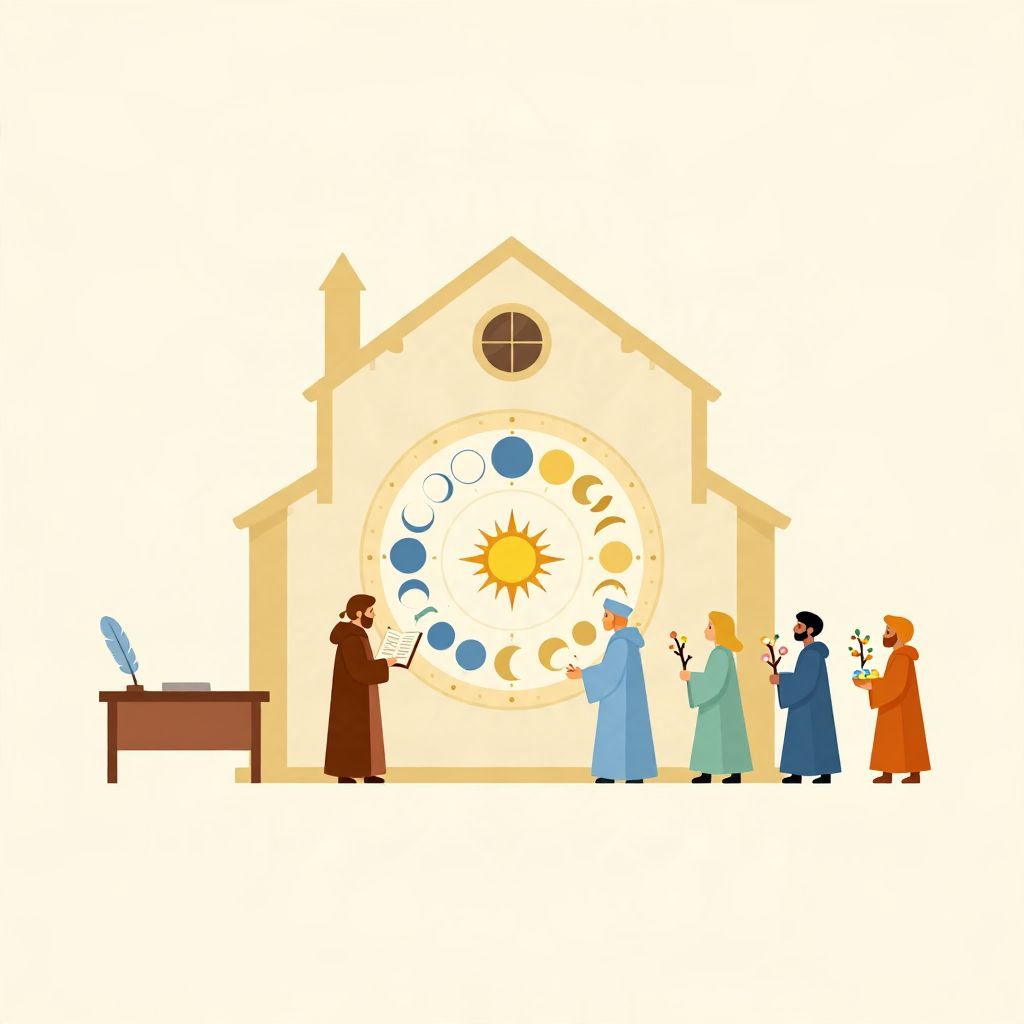
Easter changes every year because it is not fixed to a single calendar date. Instead, its timing follows a rule inherited from the early Christian world: Easter is celebrated on the first Sunday after the first full moon following the spring equinox. That formula links the feast to both the solar year and the lunar cycle.
The result is a moving date that can fall anywhere from late March to late April in Western Christianity, with different dates in some Eastern churches. Understanding why Easter changes means tracing ancient Jewish calendars, early Christian debates, and the long history of calendar reform.
Why does Easter change every year?
Easter changes because it is calculated from a lunisolar rule rather than a fixed day on the modern calendar. The date depends on the spring equinox, the full moon, and the following Sunday. This method was adopted to connect Easter to the biblical Passover season and to create a shared Christian observance.
How Easter got its changing date
The history of Easter’s date begins in the first centuries of Christianity, when believers debated how to relate Jesus’s resurrection to the Jewish Passover. The New Testament places the crucifixion and resurrection in that Passover context, so the feast was never meant to be detached from the seasonal and lunar rhythms of the Jewish calendar.
From Passover to a Christian feast
Early Christians did not all celebrate Easter in the same way. Some communities observed the resurrection on the same date each year according to the Jewish calendar, while others insisted it should always fall on a Sunday, the day associated with the resurrection. This disagreement became one of the major early calendar controversies in Christianity.
The issue was not simply mathematical. It was also theological and communal. Christians wanted a common feast day, but they also wanted the date to reflect the story of Jesus’s death and resurrection in relation to Passover and the weekly cycle of Sunday worship.
The Council of Nicaea and the search for unity
In 325 CE, the Council of Nicaea helped establish a broad rule for Easter: it would be celebrated on the Sunday after the Paschal full moon, with the spring equinox used as the seasonal marker. The council did not leave behind a single surviving technical formula in the way modern people might expect, but it did support a unified practice across the Christian world.
This decision mattered because it separated Easter from a fixed civil date. Instead of being tied to, say, March 25 every year, it would move according to the cycle of the moon and the calendar used to identify the equinox. That is why Easter can shift from year to year, even though its rule is stable.
What rule determines Easter’s date?
In Western Christianity, Easter is generally celebrated on the first Sunday after the first full moon on or after the spring equinox. In practice, church calculations use a standardized ecclesiastical equinox rather than the exact astronomical moment. That is why the date can vary and why different traditions sometimes calculate it differently.
Why the moon matters
The moon is central because the Jewish calendar, which shaped the timing of Passover, is lunisolar. Months begin with the new moon, and major festivals are tied to lunar phases. Early Christians inherited this seasonal framework and adapted it to the resurrection feast.
Because lunar months are shorter than solar months, the full moon moves through the solar calendar from year to year. If Easter depended only on the moon, it could fall on many different days of the week. The Sunday rule gives the feast a weekly Christian rhythm while still preserving the lunar connection.
Why the equinox matters
The spring equinox marks the seasonal turning point when day and night are roughly equal in length. In Christian tradition, it became the anchor for identifying the start of the Easter season. Historically, the equinox was also useful as a shared reference point in a world with imperfect calendars and regional differences in computation.
Over time, the church’s calendar calculations became more formalized. The date of Easter was not determined by direct astronomical observation in every place and year, but by ecclesiastical tables that approximated the moon and equinox. That is one reason the feast can seem slightly detached from the sky itself.
Why different churches sometimes celebrate Easter on different days
Not all Christians use the same calendar system. Most Western churches calculate Easter using the Gregorian calendar, introduced in 1582 to correct drift in the older Julian calendar. Many Eastern Orthodox churches still use the Julian-based method for determining Easter, which often places the feast later than in the West.
Julian and Gregorian calendars
The Julian calendar, introduced under Julius Caesar in 45 BCE, gradually fell out of sync with the solar year. By the late medieval period, the calendar no longer matched the seasons closely enough for church purposes. Pope Gregory XIII’s reform in 1582 adjusted the calendar and updated the rules for calculating Easter.
Because not all churches adopted the reform at the same time, and some never adopted it for liturgical purposes, Easter dates can differ. In many years, Western Easter and Orthodox Easter are on different Sundays, though they occasionally coincide.
Why Orthodox Easter can be later
Orthodox calculations often keep Easter after Passover and use a different set of ecclesiastical tables. This can push the celebration further into April or even early May in some years. The difference reflects historical continuity as well as the long separation between Western and Eastern calendar traditions.
So when people ask why Easter changes, the answer is not just “because of the moon.” It changes because Christianity preserved an ancient seasonal-lunar framework while also trying to standardize a feast across diverse communities and calendars.
The historical reasons Easter was never fixed to one date
There were several reasons early Christians did not simply assign Easter to a permanent day on the calendar. Those reasons were practical, religious, and historical, and they shaped the feast’s long-term development.
- Connection to Passover: The resurrection story is set during the Passover season, so the feast remained linked to that time of year.
- Sunday significance: Sunday was the day of resurrection and became central to Christian worship.
- Shared observance: A movable feast helped unify churches across regions with different local calendars.
- Lunar tradition: The inherited Jewish calendar framework made a fixed solar date less natural for the feast.
These factors made Easter’s date flexible from the beginning. The changing date is therefore not an accident of modern scheduling but a legacy of how early Christians understood sacred time.
How calendar reform changed Easter, but did not fix it
When the Gregorian calendar was introduced, it improved the accuracy of the calendar year, but it did not turn Easter into a fixed holiday. Instead, it refined the method used to calculate the same movable feast. The reform was meant to restore seasonal alignment, not to simplify Easter into a single date.
The problem of drift
By the 1500s, the Julian calendar had drifted enough that the equinox no longer fell where older church tables expected it. This affected Easter calculations and the broader liturgical year. The Gregorian reform corrected that drift by adjusting leap years and redefining the calendar framework used in the West.
Even after reform, Easter remained movable because its logic still depended on the full moon and the Sunday following it. The reform changed the calendar system, not the underlying principle.
What Easter’s changing date tells us about history
Easter’s movable date is a reminder that calendars are historical creations, not neutral tools. They reflect astronomy, religion, politics, and the needs of institutions. The story of Easter shows how early Christianity inherited Jewish timekeeping, negotiated internal disagreement, and later adapted to calendar reform.
It also shows why religious holidays can preserve very old patterns. Easter still carries traces of ancient lunar observation, Roman calendar reform, medieval church authority, and early Christian debates about unity. Its shifting date is therefore a living piece of history.
Common misunderstandings about Easter’s date
People often assume Easter changes because church leaders recalculate it randomly each year. In reality, the rule is fixed, even if the result moves. Others think Easter is based on the exact astronomical full moon everywhere, but churches usually rely on ecclesiastical tables rather than direct observation.
Another common misunderstanding is that Easter should be the same worldwide if Christianity is one religion. Historically, however, Christian communities developed different calendar traditions, and those differences still shape practice today. The variation is a product of history, not inconsistency alone.
So why does Easter change?
Easter changes because it was designed as a movable feast tied to the spring equinox, the full moon, and Sunday. That system grew out of early Christian efforts to connect the resurrection to Passover, honor the weekly resurrection day, and create a shared observance across the church. Calendar reform altered the calculation, but not the principle.
For a closer look at the traditions behind the holiday, see why Easter is different every year and how the date of Easter is determined.