
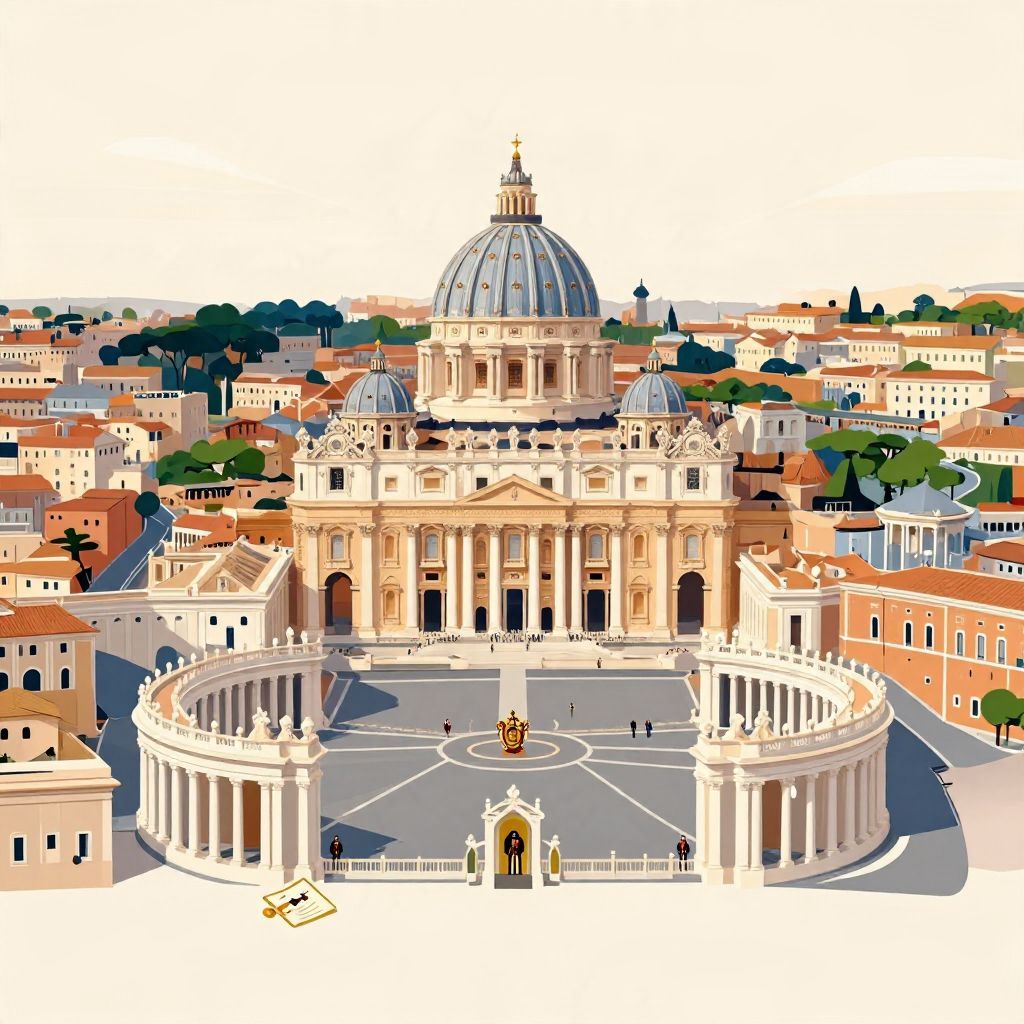
Is the Vatican its own country? Yes—today the Vatican is a sovereign city-state known as Vatican City, the smallest independent state in the world. But that simple answer hides a long history of papal power, Italian unification, and a 20th-century treaty that settled one of Europe’s most unusual political questions.
To understand why the Vatican is a separate country, it helps to trace how the pope’s authority developed, how the Papal States disappeared, and how Vatican City was created in 1929. The result is a unique state with its own government, borders, and international status, even though it is closely tied to the Roman Catholic Church.
Is the Vatican its own country?
Yes. Vatican City is an independent sovereign state, recognized internationally and governed by the Holy See. It has its own territory, laws, leadership, and diplomatic relations. It is not part of Italy, even though it lies entirely inside Rome and depends on Italy for many practical services.
What makes the Vatican unusual is that the state and the Church are closely connected but not identical. The Holy See is the central governing authority of the Catholic Church, while Vatican City is the territorial state that gives the Holy See a secure, independent base.
Why does the Vatican exist as a separate state?
The Vatican exists because the papacy long claimed temporal, not just spiritual, authority in central Italy. For centuries the popes ruled the Papal States, a large territory that made them secular rulers as well as religious leaders. When Italy unified in the 19th century, those lands were absorbed, creating a political conflict that lasted until 1929.
The Papal States and papal power
From roughly the 8th century until the 19th century, the popes governed the Papal States, which covered much of central Italy. This gave the papacy military, legal, and administrative power beyond religion. The pope was not only the head of the Church but also a ruler with land, taxes, and political interests.
That arrangement reflected medieval Europe, where church and state often overlapped. The papacy’s territorial role helped protect its independence from local kings and emperors, but it also drew the popes into Italian and European politics for centuries.
Italian unification and the loss of papal territory
In the 1800s, the movement to unify Italy steadily weakened papal rule. By 1870, Italian forces took Rome and ended the Papal States. The pope lost his territory and withdrew into the Vatican complex, refusing to recognize the new Italian state’s authority over Rome. This became known as the “Roman Question.”
For nearly 60 years, the popes considered themselves “prisoners in the Vatican,” though they continued to lead the Catholic Church worldwide. The dispute was political as much as religious: the papacy wanted enough independence to avoid being controlled by the Italian government.
How Vatican City was created
Vatican City was established on 11 February 1929 through the Lateran Treaty between the Holy See and the Kingdom of Italy. The treaty recognized Vatican City as a sovereign state and settled the Roman Question. In exchange, the papacy accepted the loss of the former Papal States and recognized Rome as the capital of Italy.
This was a practical compromise. Italy gained international legitimacy and peace with the Church, while the pope gained a tiny but fully independent territory. The new state was designed to preserve papal freedom, not to recreate the old Papal States.
What the treaty changed
- Created Vatican City as an independent sovereign state.
- Recognized the Holy See as the governing authority of the Catholic Church in international law.
- Ended the long dispute between the papacy and Italy over Rome.
- Gave the pope a secure territorial base free from Italian control.
What kind of country is Vatican City?
Vatican City is a city-state, meaning the entire country consists of one urban territory. It is also a theocratic monarchy in a limited sense: the pope is the head of state, and the government serves the needs of the Catholic Church. Unlike most countries, it has no ordinary population base, no electoral politics in the usual sense, and very limited citizenship.
Its sovereignty is real, but highly specialized. The Vatican’s purpose is not to function like a typical nation-state with a broad civilian society. Instead, it exists to guarantee the independence of the Holy See and the pope’s ability to govern the Church without outside interference.
Holy See vs. Vatican City
Many people use “the Vatican” and “the Holy See” interchangeably, but historians and diplomats distinguish them.
- Holy See: the central authority of the Catholic Church, headed by the pope; this is the entity that conducts diplomacy.
- Vatican City: the territorial state established in 1929 to support the Holy See’s independence.
This distinction matters because the Holy See has diplomatic relations with other states and holds observer status in many international organizations. Vatican City itself is the physical territory, while the Holy See is the governing and diplomatic personality.
How is Vatican City governed?
Vatican City is governed by the pope, who holds supreme legislative, executive, and judicial authority. In practice, he delegates many duties to officials and institutions, but ultimate authority rests with him. This structure reflects the state’s purpose: to support the Church’s mission and protect papal independence.
Key features of Vatican government
- The pope serves as head of state.
- Administration is handled through Vatican offices and commissions.
- Citizenship is limited and usually tied to service to the Holy See.
- The Vatican has its own police force, postal system, and legal framework.
Because of its size and purpose, Vatican City does not resemble a modern mass democracy. It is a sovereign state, but one built around a religious office rather than a national population.
How small is the Vatican?
Vatican City covers about 44 hectares (roughly 110 acres), making it the smallest internationally recognized independent state in the world. It is entirely enclosed by Rome, though a few properties associated with the Holy See lie elsewhere in Italy and have special status under the Lateran arrangements.
Its small size often causes confusion, but territory alone does not determine sovereignty. Many tiny states have full independence. The Vatican’s significance comes from its legal status, historical role, and global religious influence, not from its area.
Is the Vatican really independent if it is inside Italy?
Yes. Geographic enclosure does not erase sovereignty. A country can be surrounded by another state and still remain independent, as long as its sovereignty is recognized and protected by law and international agreement. Vatican City is a clear example of this principle.
Italy recognizes Vatican City’s independence, and the 1929 treaty established the legal basis for that relationship. The Vatican also maintains diplomatic relations with many countries, which is one of the strongest signs of statehood in modern international law.
Practical dependence and legal independence
At the same time, Vatican City depends on Italy in practical ways. It relies on Italian infrastructure around it and shares the euro through agreements with the European monetary system. But practical dependence is not the same as political control. The Vatican remains legally separate.
Why does the Vatican matter historically?
The Vatican matters because it shows how historical power can survive in transformed form. The papacy once ruled a large territory; after Italian unification, it lost that land but retained global religious authority. Vatican City was created to solve a modern political problem rooted in medieval history.
Its existence also reflects a broader historical pattern: religious institutions often had to adapt to the rise of nation-states. The Vatican is one of the most successful examples of a religious authority securing a protected place within the modern state system.
Lasting significance
Vatican City remains important not only as a religious center but also as a diplomatic actor. The Holy See continues to engage with governments on issues such as peace, education, human rights, and humanitarian concerns. Its unusual status gives it a voice that is both spiritual and political, though not in the same way as a secular government.
Common misconceptions about the Vatican
- “The Vatican is just a neighborhood in Rome.” Not legally. It is a sovereign state, even though it is physically inside Rome.
- “The Vatican and the Holy See are the same thing.” They are related but distinct.
- “It became independent in ancient times.” No. Vatican City was created in 1929, though the papacy’s territorial history is much older.
- “It functions like a normal country.” It does not. Its government is built around the Catholic Church’s needs.
Conclusion
So, is the Vatican its own country? Yes—Vatican City is a sovereign state created in 1929 to secure the independence of the Holy See and the pope. Its history stretches back through the Papal States, Italian unification, and the Roman Question, making it one of the most distinctive countries in the world. For related historical comparisons, you may also find is Scotland its own country and is Portugal in Spain useful reads.