
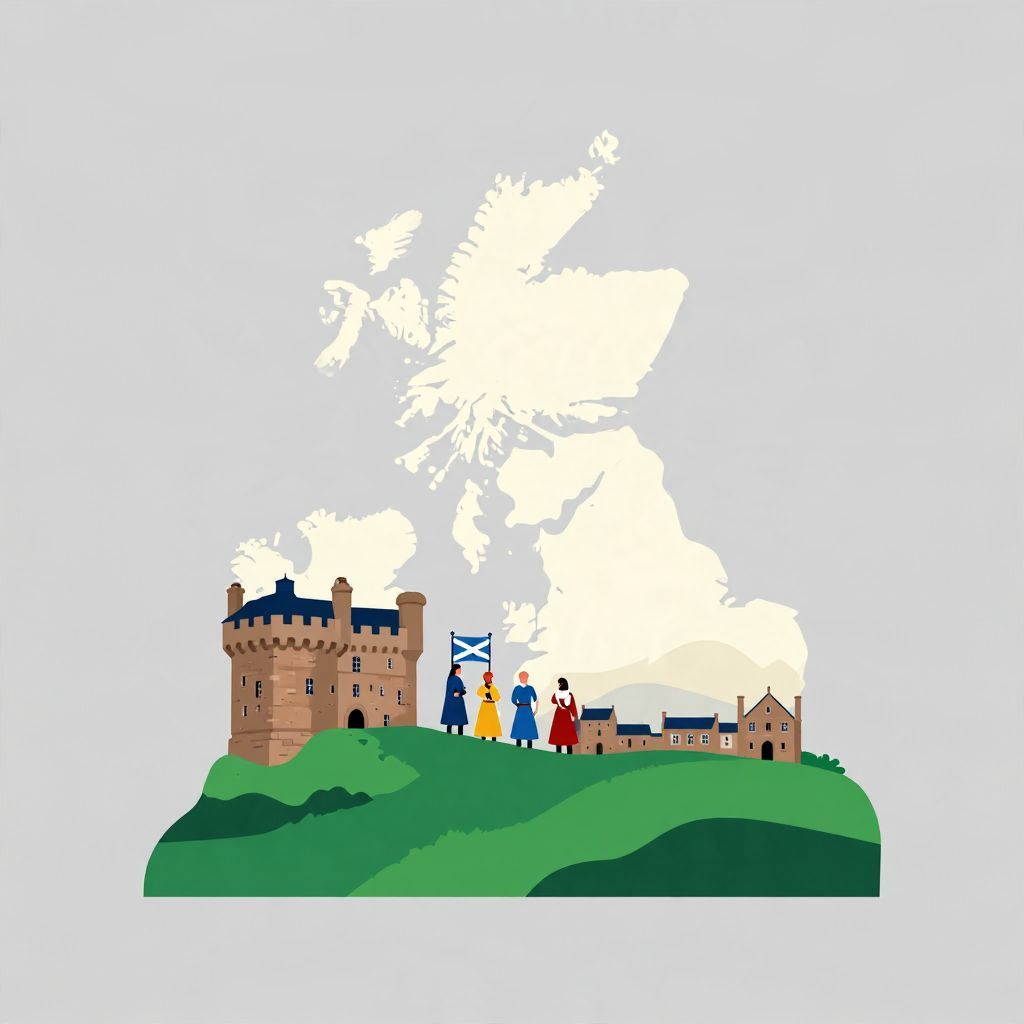
Is Scotland its own country? Historically, the answer is yes: Scotland developed as a distinct kingdom in the early Middle Ages, with its own monarchy, laws, institutions, and national identity. But its status has changed over time through union, shared rule, and later devolution, so the answer depends on which period you mean.
To understand Scotland’s history, it helps to separate medieval independence from the modern constitutional position. Scotland was long a sovereign kingdom, then joined with England under one crown in 1603 and one parliament in 1707, while retaining many separate legal and cultural institutions. Today it is a country within the United Kingdom.
Is Scotland its own country?
Yes, in historical and cultural terms Scotland has long been a distinct country, and for much of its history it was a sovereign kingdom. Since 1707 it has not been an independent state, but it remains a recognized country with its own legal system, education system, church traditions, and devolved government.
How Scotland became a distinct kingdom
Scotland emerged gradually from a mix of peoples and polities in the early medieval period. By the 9th and 10th centuries, a kingdom centered on the Scots of Alba had expanded and consolidated power over much of the territory that became Scotland. This was not a sudden founding moment, but a long process of political unification.
From Picts, Scots, and Britons to Alba
Early Scotland was home to several groups, including the Picts in the north and east, Gaelic-speaking Scots from Dál Riata in the west, and Brittonic peoples in the south. Over time, kings of Alba absorbed or replaced rival centers of power. By the reign of kings such as Kenneth MacAlpin in the 9th century, later tradition linked the emergence of a unified Scottish monarchy to dynastic change, though the reality was more complex than legend suggests.
Historians generally treat the kingdom’s formation as a centuries-long political consolidation rather than a single founding event. The result was a realm that increasingly identified itself as Scotland, with its own royal line and political traditions.
When was Scotland independent?
Scotland was an independent kingdom for most of the medieval and early modern period. It had its own kings, foreign policy, and legal order, even while facing pressure from England. Its independence was recognized in major diplomatic agreements, especially the Treaty of Edinburgh-Northampton in 1328, which confirmed Scottish sovereignty after years of war.
The Wars of Independence
The struggle for independence is one of the best-known chapters in Scottish history. After the death of King Alexander III in 1286 and the crisis that followed, English intervention under Edward I triggered a succession dispute and conflict. Figures such as William Wallace and Robert the Bruce became central to later national memory.
The decisive moment came with Bruce’s victory at Bannockburn in 1314, which strengthened Scotland’s position. The later treaty of 1328 formally acknowledged Scottish independence, though conflict with England did not end permanently. The medieval kingdom remained politically vulnerable, but it was still a separate state.
What independence meant in practice
Medieval independence did not mean modern democracy or stable borders. Scotland was a monarchy, and power was often contested among nobles, church leaders, and regional magnates. Still, it maintained its own institutions, including parliament, royal administration, and a legal tradition that developed separately from English common law.
The Union of the Crowns in 1603
Scotland’s status changed dramatically in 1603, when James VI of Scotland inherited the English throne and became James I of England. This created the Union of the Crowns: the same monarch ruled both kingdoms, but Scotland and England remained legally separate states with separate parliaments.
Why 1603 did not end Scottish statehood
It is a common misunderstanding that Scotland “became part of England” in 1603. That is not correct. The crowns were united in one person, not the governments. Scotland kept its own parliament, laws, church structures, and administrative systems. In constitutional terms, it remained an independent kingdom in personal union with England.
This arrangement mattered because it preserved Scottish identity while also creating closer political and dynastic ties. Over the next century, however, economic pressures, trade disputes, religious tensions, and succession concerns pushed the two kingdoms toward fuller union.
The Acts of Union in 1707
The decisive constitutional change came in 1707 with the Acts of Union, passed by the parliaments of Scotland and England. These acts dissolved the separate Scottish and English parliaments and created the Kingdom of Great Britain. From that point, Scotland was no longer an independent sovereign state.
Why the union happened
The union was shaped by several forces. Scotland faced economic strain, especially after the failure of the Darien scheme in the 1690s, a costly attempt to establish a Scottish colony in Central America. There were also concerns about succession and security after the Glorious Revolution. Many elites saw union as a way to stabilize trade and politics, though opposition in Scotland was substantial.
The union was not simply imposed from outside, nor was it universally welcomed. It was negotiated by political elites, influenced by financial incentives, strategic calculations, and the realities of power. For many ordinary Scots, the change felt distant at first, but over time it transformed the state structure of the islands.
What Scotland kept after 1707
Even after the union, Scotland did not disappear as a nation. It retained its own legal system, church organization, and education traditions. These institutions helped preserve a distinct Scottish identity inside the new British state. That is why Scotland is often described as a country rather than merely a region.
- Law: Scotland kept a separate legal system.
- Church: The Church of Scotland remained distinct from the Church of England.
- Education: Scottish schooling and universities developed along separate lines.
- Identity: Scots continued to see themselves as Scottish as well as British, in varying degrees.
Scotland in the modern United Kingdom
In the modern era, Scotland is not an independent country in the international legal sense, but it is a constituent country of the United Kingdom. That means it has a distinct national identity and some self-government, but sovereignty rests with the UK state as a whole.
Devolution and self-government
In 1999, the Scottish Parliament was restored as part of devolution. This gave Scotland authority over many domestic matters such as health, education, and transportation, while Westminster retained control over areas like defense and foreign policy. Devolution did not restore full independence, but it did revive a separate political arena within the UK.
This modern arrangement reflects Scotland’s layered history. It is neither a fully sovereign state nor a mere administrative division. Instead, it is a nation with a long historical memory of statehood and a continuing constitutional role inside the UK.
Why the answer depends on the time period
The question “Is Scotland its own country?” has different answers depending on whether you mean medieval, early modern, or contemporary history. Before 1707, Scotland was a sovereign kingdom, except for the shared monarchy after 1603. Since 1707, it has not been an independent state, though it remains a distinct country within the United Kingdom.
A simple timeline
- 9th–10th centuries: Kingdom of Alba emerges and consolidates.
- 1328: Scottish independence recognized in treaty form after the Wars of Independence.
- 1603: Union of the Crowns links Scotland and England under one monarch.
- 1707: Acts of Union create Great Britain and end Scottish sovereignty.
- 1999: Devolved Scottish Parliament is restored.
Scotland’s identity beyond statehood
Historical statehood is only part of the story. Scotland’s identity has also been shaped by language, religion, law, literature, migration, and memory. Gaelic, Scots, and English all played roles in different regions and periods. National heroes, clan traditions, and medieval independence struggles became part of a powerful historical narrative that still matters today.
At the same time, historians caution against treating national identity as fixed or timeless. “Scotland” has meant different things in different centuries. Its borders, ruling class, and political institutions changed, but the idea of Scotland as a distinct place endured.
So, is Scotland its own country?
Historically, yes: Scotland was long an independent kingdom with its own monarchy and institutions. In the present constitutional sense, no: it is not a sovereign state, because it is part of the United Kingdom. The most accurate answer is that Scotland is a country with a deep history of statehood, but not an independent country today.
That distinction explains why Scotland occupies such a unique place in European history: it has been both separate and joined, sovereign and shared, for centuries. For readers interested in the wider context, related topics include the Wars of Scottish Independence and the Acts of Union of 1707.