
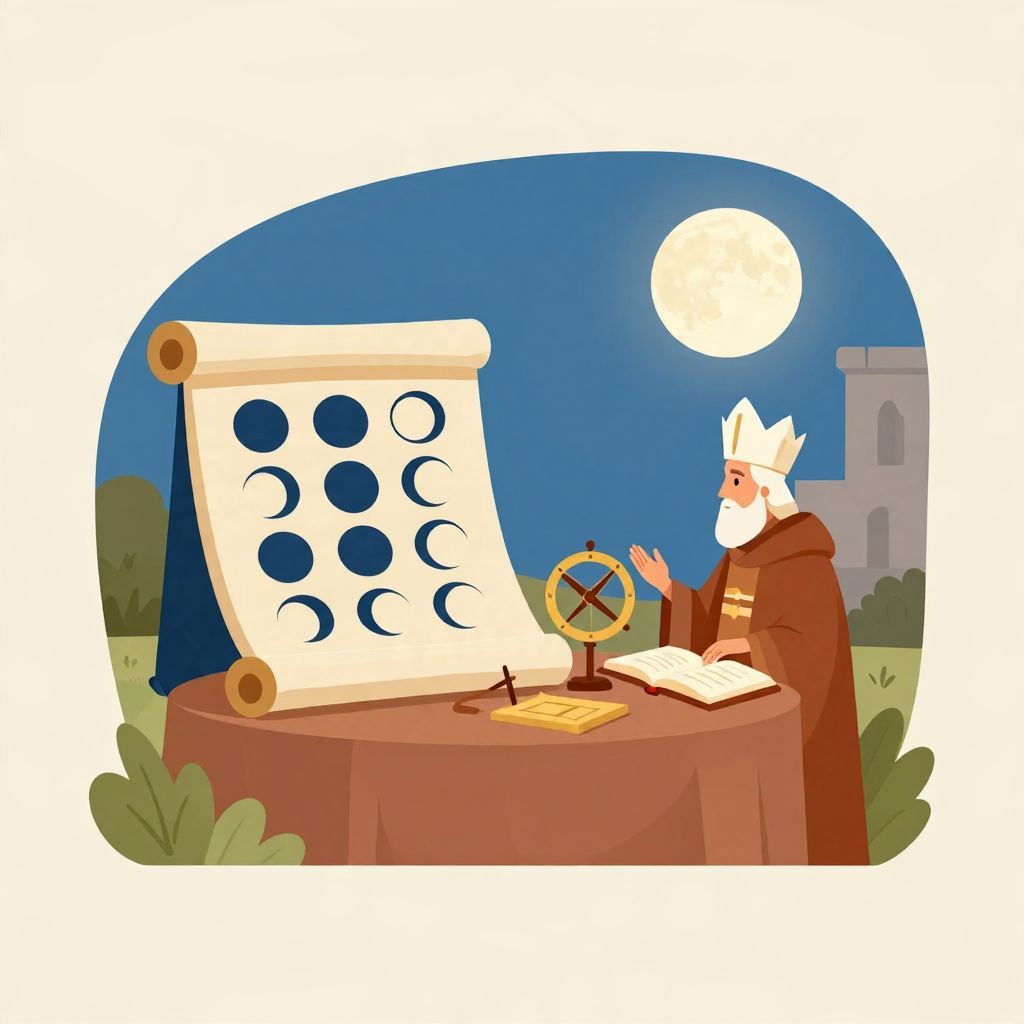
How is the date of Easter determined? The short answer is that Easter is a movable feast set by a combination of the spring equinox and the full moon, then observed on the following Sunday. This formula developed in the early Christian world to keep the celebration tied to the Passover season while also giving it a distinct Christian calendar of its own.
The rule sounds simple today, but it reflects centuries of debate, astronomy, and church authority. Different Christian traditions have used different calendar systems, which is why Easter can fall on different dates in Western and Eastern churches.
How Is The Date Of Easter Determined?
Easter is usually celebrated on the first Sunday after the first full moon on or after the ecclesiastical spring equinox, fixed for calendar purposes at March 21. In Western Christianity this means Easter can fall between March 22 and April 25. The rule is ecclesiastical, not purely astronomical, and it was standardized over time to unify Christian practice.
Where Did the Easter Date Rule Come From?
The earliest Christians inherited their calendar world from Judaism and the Roman Empire. Jesus’ crucifixion and resurrection were linked in the Gospels to Passover, so the timing of Easter was always connected to the lunar Jewish calendar. But Christians did not all agree on whether to celebrate on the same date as Passover or on the following Sunday.
The Quartodeciman Controversy
In the second century, some Christians in Asia Minor, often called Quartodecimans, observed the Christian Passover on the 14th day of the Jewish month of Nisan, the date associated with Passover. Others insisted that the resurrection should always be celebrated on a Sunday. This disagreement was not a minor calendar issue; it touched on how Christians understood the relationship between Jesus’ death, resurrection, and Jewish tradition.
By the early fourth century, church leaders wanted a single rule. The First Council of Nicaea in 325 did not leave behind a surviving detailed formula in its own canons, but later tradition strongly associates the council with the decision that Easter should be celebrated independently of the Jewish calendar and on a Sunday. The council’s broader significance was to promote unity across a growing Christian empire.
Why the Spring Equinox and Full Moon Matter
The Easter calculation uses two natural cycles: the solar year and the lunar month. The spring equinox marks the seasonal turning point into spring, while the full moon echoes the lunar timing of Passover. Easter is then placed on the Sunday after that full moon to preserve both the biblical background and the Christian emphasis on Sunday as the day of resurrection.
Ecclesiastical, Not Astronomical
It is important to distinguish the church’s calculation from modern astronomy. The “ecclesiastical equinox” is fixed at March 21 for the purpose of the calendar, even though the actual astronomical equinox can vary slightly from year to year. Likewise, the “Paschal full moon” is a calculated church full moon, not always the exact moment of the real lunar full moon visible in the sky.
This distinction matters because the Easter date was designed for consistency. Medieval and early modern churches needed a reliable rule that could be computed in advance, long before modern astronomical tables or digital calendars.
A Brief Timeline of How Easter’s Date Was Standardized
- 1st century: Early Christians connect Jesus’ death and resurrection to Passover and the first day of the week.
- 2nd century: Regional disagreement emerges over whether to observe Easter on 14 Nisan or always on Sunday.
- 325: The Council of Nicaea is traditionally linked to the move toward a unified Easter rule.
- 4th–5th centuries: Church writers and bishops develop methods for calculating Easter more consistently.
- 6th century: The monk Dionysius Exiguus helps spread computus, the Christian system for calculating the date of Easter.
- 1582: The Gregorian calendar reforms the Julian calendar, changing how Western churches calculate Easter.
- Present: Western churches generally follow the Gregorian method; many Eastern Orthodox churches use the Julian calendar for the Paschal calculation.
What Is Computus?
Computus is the traditional Christian system for calculating Easter. Medieval scholars treated it as a serious intellectual discipline, combining theology, astronomy, mathematics, and calendar reform. Monasteries and cathedral schools taught it because knowing the date of Easter was essential for determining Lent, Holy Week, Pentecost, and many other movable feasts.
Dionysius Exiguus and Early Tables
In the sixth century, Dionysius Exiguus compiled Easter tables that influenced later Western practice. He is also known for helping popularize the dating system that eventually became the Anno Domini era. His work did not create the Easter rule from nothing, but it helped make the calculation more systematic and widely usable.
Earlier and later scholars refined these tables as calendar errors accumulated. Because the Julian calendar was slightly too long, the date of the equinox drifted over centuries. That drift eventually contributed to the Gregorian reform in 1582, which corrected the calendar and adjusted the method used in Catholic and many Protestant lands.
Why Do Eastern and Western Christians Sometimes Celebrate Easter on Different Dates?
The difference usually comes from the calendar, not from a different belief about Easter itself. Western churches generally use the Gregorian calendar to determine the date. Many Eastern Orthodox churches continue to calculate Easter using the Julian calendar for the Paschal rule, then convert that date into the civil calendar used in their country.
Because the Julian calendar runs behind the Gregorian calendar, Orthodox Easter often falls later than Western Easter. In some years the two dates coincide, but in many years they do not. This difference is a reminder that calendar reform was never merely technical; it also reflected church authority, tradition, and identity.
The Historical Significance of Easter’s Date
The way Easter is dated shaped the Christian year. Once Easter became the central feast, other observances were organized around it. Lent led up to it, Pentecost followed it, and the rhythm of worship, fasting, and celebration depended on the correct calculation. In that sense, the Easter date helped structure Christian time itself.
It also reveals how premodern societies understood time. The calendar was not just a tool for counting days; it was a framework for sacred history. By linking Easter to both the moon and the Sunday resurrection tradition, Christian communities expressed a theology of continuity with biblical Israel and distinctiveness from it.
Political and Cultural Consequences
Disputes over Easter were sometimes about more than liturgy. A shared date could symbolize unity across regions, while different dates could mark separate ecclesiastical identities. The Gregorian reform, for example, was accepted unevenly across Europe and became entangled with confessional conflict after the Reformation. Even a calendar change could carry political weight.
Common Misunderstandings About Easter’s Date
- “Easter is always on the same day each year.” False. It is a movable feast.
- “Easter is determined by the exact astronomical full moon.” Not exactly. The church uses an ecclesiastical calculation.
- “All Christians celebrate Easter on the same date.” Not always. Western and Eastern calculations can differ.
- “The Council of Nicaea created the modern formula in full detail.” The council is important, but the surviving evidence does not preserve a complete formula in the way later tradition sometimes suggests.
So, How Is The Date Of Easter Determined Today?
Today, the answer depends on the tradition. In most Western churches, Easter is the first Sunday after the first ecclesiastical full moon on or after March 21. In many Eastern Orthodox churches, the calculation is based on the Julian calendar and then translated into the modern civil calendar, which usually makes the date later. The rule is ancient in origin, but its present form is the result of long historical development.
Easter’s date is not arbitrary: it is the product of early Christian debates, medieval scholarship, and calendar reform. If you want to explore the broader background, you may also enjoy reading about the history of the Gregorian calendar and the Council of Nicaea. Together, they show how religion, astronomy, and politics shaped the Christian calendar for centuries.