
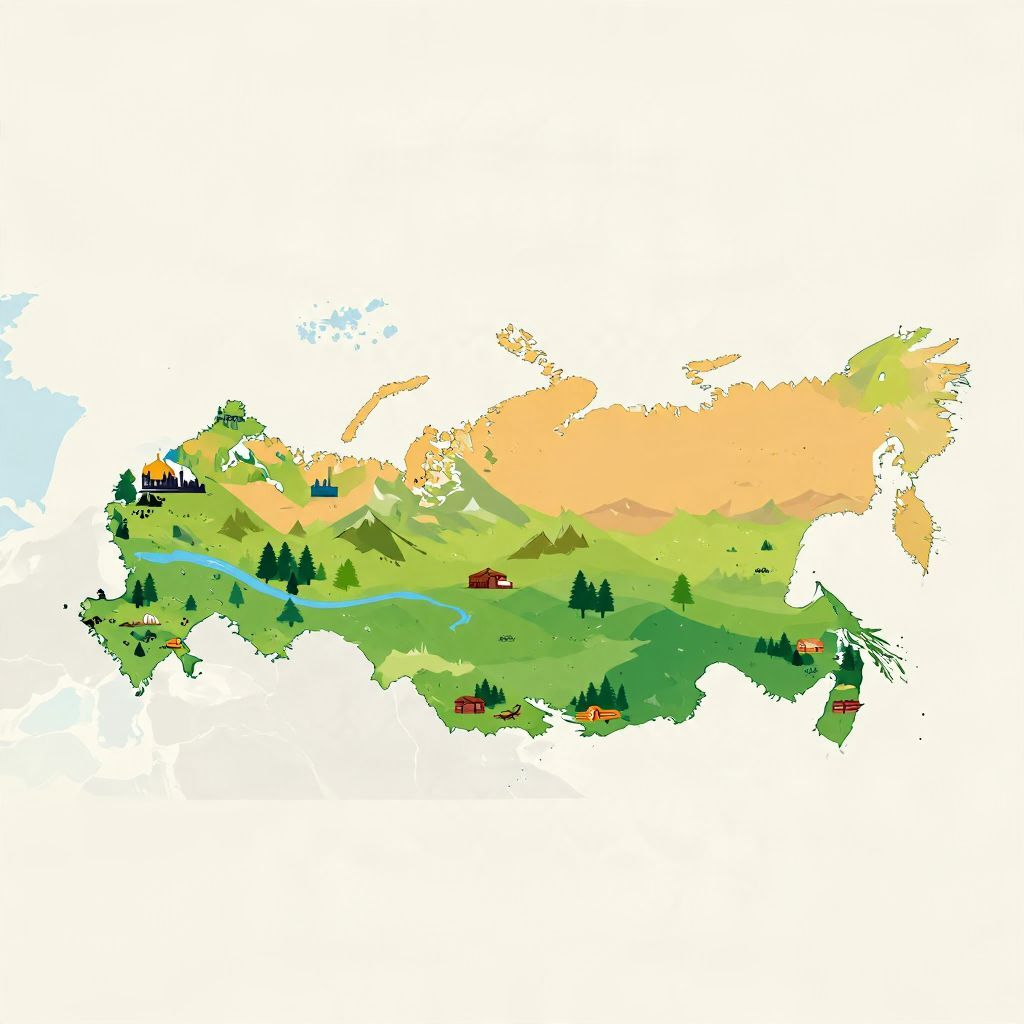
Is Russia part of Asia? The short historical answer is yes and no: Russia is a transcontinental state, with territory in both Europe and Asia. For centuries, its rulers, merchants, and thinkers debated which side of the continental divide mattered most. The answer depends on whether you mean geography, politics, culture, or history.
That ambiguity is not a modern confusion. It comes from Russia’s enormous landmass, its expansion across the Urals and Siberia, and its long interaction with both European and Asian worlds. To understand Russia’s place in history, it helps to look at how borders, empires, and identities changed over time.
Is Russia Part of Asia?
Geographically, about three-quarters of Russia lies in Asia, east of the Ural Mountains, while most of its population and major cities are in European Russia. Historically, Russia has been shaped by both continents, but it is usually described as a transcontinental country rather than simply Asian or European.
Why the Answer Is Not Simple
Modern geography uses the Ural Mountains, the Ural River, the Caucasus, and parts of the Caspian region as rough boundaries between Europe and Asia. By that standard, the vast Siberian and Far Eastern regions of Russia are in Asia. Yet Russia’s political center, historical capitals, and most of its population have long been in the European part of the country.
Geography versus identity
The question “Is Russia part of Asia?” can mean different things. In physical geography, yes, a large share of Russian territory lies in Asia. In cultural and historical terms, Russia has often defined itself as a bridge between Europe and Asia, borrowing from both while belonging fully to neither in the eyes of some observers.
How Russia Became a Eurasian State
Russia did not begin as a continental empire. Its early political core developed in the medieval lands of Kievan Rus’, centered farther west than modern Russia, in the region of present-day Ukraine and Belarus. After the fragmentation of Kievan Rus’ in the 12th and 13th centuries, new centers of power emerged in the northeast, especially around Moscow.
The Mongol period and eastern influence
The Mongol invasions of the 13th century transformed the political landscape of eastern Europe and northern Asia. Many Russian principalities came under the influence of the Golden Horde, a Mongol successor state. This did not make Russia “Asian” in a simple sense, but it did connect Russian political development to the steppe world of Eurasia and shape military, fiscal, and diplomatic practices for generations.
Moscow’s rise
By the late 15th century, Moscow had become the dominant Russian principality. Under rulers such as Ivan III and later Ivan IV (“the Terrible”), the Muscovite state expanded rapidly. It absorbed neighboring lands and increasingly presented itself as an independent, centralized power. As it expanded eastward, Russia crossed the natural and symbolic boundary of the Urals and entered Siberia.
Russia’s Expansion Into Asia
Russia’s Asian footprint grew through conquest, colonization, trade, and state-sponsored exploration. From the 16th century onward, Russian forces and settlers moved across the Urals into western Siberia. Over time, this expansion carried the Russian state all the way to the Pacific Ocean.
Siberia and the eastward advance
The conquest of Siberia began in the late 1500s, often associated with the campaigns of Yermak Timofeyevich and the push of Russian frontier forces. What followed was not a single event but a long process of fort building, fur trading, settlement, and imperial control. By the 17th century, Russian explorers had reached the Pacific coast.
Imperial Russia in Central and East Asia
During the 18th and 19th centuries, the Russian Empire expanded deeper into Asia. It absorbed territories in the Caucasus, Central Asia, and the Far East. Russian influence grew in places such as Kazakhstan, Turkestan, and the Amur region. This expansion made Russia one of the great Eurasian empires of the modern age, alongside the Ottoman and British empires.
Important milestones included:
- 16th–17th centuries: expansion across Siberia
- 18th century: consolidation in the Far East and northern Pacific
- 19th century: annexation and control of large parts of Central Asia and the Caucasus
Europe, Asia, and Russian Self-Image
Russia’s relationship to Asia has never been purely geographic. Russian elites often looked westward for models of government, education, art, and science, especially from the time of Peter the Great in the early 18th century. Peter’s reforms pushed Russia toward European-style administration, military organization, and court culture. At the same time, the empire continued to expand eastward into Asian territories.
A debate within Russian history
Russian intellectuals later argued over whether the country was fundamentally European, Asian, or something distinct. In the 19th century, some thinkers emphasized Russia’s special civilizational path and its ties to the steppe and Orthodox world. Others saw Russia as part of Europe and wanted deeper integration with Western institutions. This debate never produced a single answer.
The idea of Eurasia
Modern historians and geographers often use the term Eurasia to describe Russia’s position. That word captures the reality that Russia spans two continents and has been shaped by both. It is not merely a matter of land area; it reflects centuries of exchange, conflict, migration, and empire-building across a vast zone.
How Much of Russia Is in Asia?
By area, most of Russia lies in Asia. Siberia and the Russian Far East make up the bulk of the country’s territory. However, the European side contains the capital, Moscow, as well as Saint Petersburg and the majority of the population, industry, and political power. So while Russia is mostly Asian in landmass, it is often European in historical orientation and demographic concentration.
Population and settlement patterns
This imbalance matters. The Asian part of Russia is enormous but relatively sparsely populated because of harsh climate, long distances, and difficult transport. The European part has denser settlement, better infrastructure, and the historical centers of state power. That is one reason many people instinctively think of Russia as a European power even though its territory extends far into Asia.
Russia in Asian History
Russia is not only a European state with Asian territory; it is also an important actor in Asian history. Its presence affected the peoples of Siberia, the Caucasus, Central Asia, Mongolia, China, and the Pacific frontier. Russian expansion altered trade routes, borderlands, and imperial rivalries across northern Asia.
Encounters with Asian neighbors
Russian history in Asia included diplomacy and conflict with the Qing Empire, steppe polities, and Central Asian khanates. The Russian Empire’s advance changed the balance of power across the region. In the 19th century, Russia became one of the major imperial competitors in Asia, especially in the “Great Game” rivalry with Britain in Central Asia.
Soviet and post-Soviet realities
Under the Soviet Union, Russia remained the largest republic within a multiethnic state that stretched across Europe and Asia. After 1991, the Russian Federation inherited the same transcontinental shape. Today, Russia continues to govern territories on both sides of the continental divide, reinforcing its status as a Eurasian state rather than a purely Asian or European one.
So, Is Russia Asian or European?
The most accurate answer is that Russia is both, but in different senses. Geographically, most of its land is in Asia. Historically and politically, its main centers of power developed in Europe, even as the state expanded across Asia. Culturally, Russia has long been influenced by both worlds and has often defined itself through that tension.
In other words, Russia is best understood as a transcontinental empire-state with a Eurasian history. Its story cannot be reduced to one continent alone, because its borders, people, and institutions were formed through centuries of movement across Europe and Asia.