
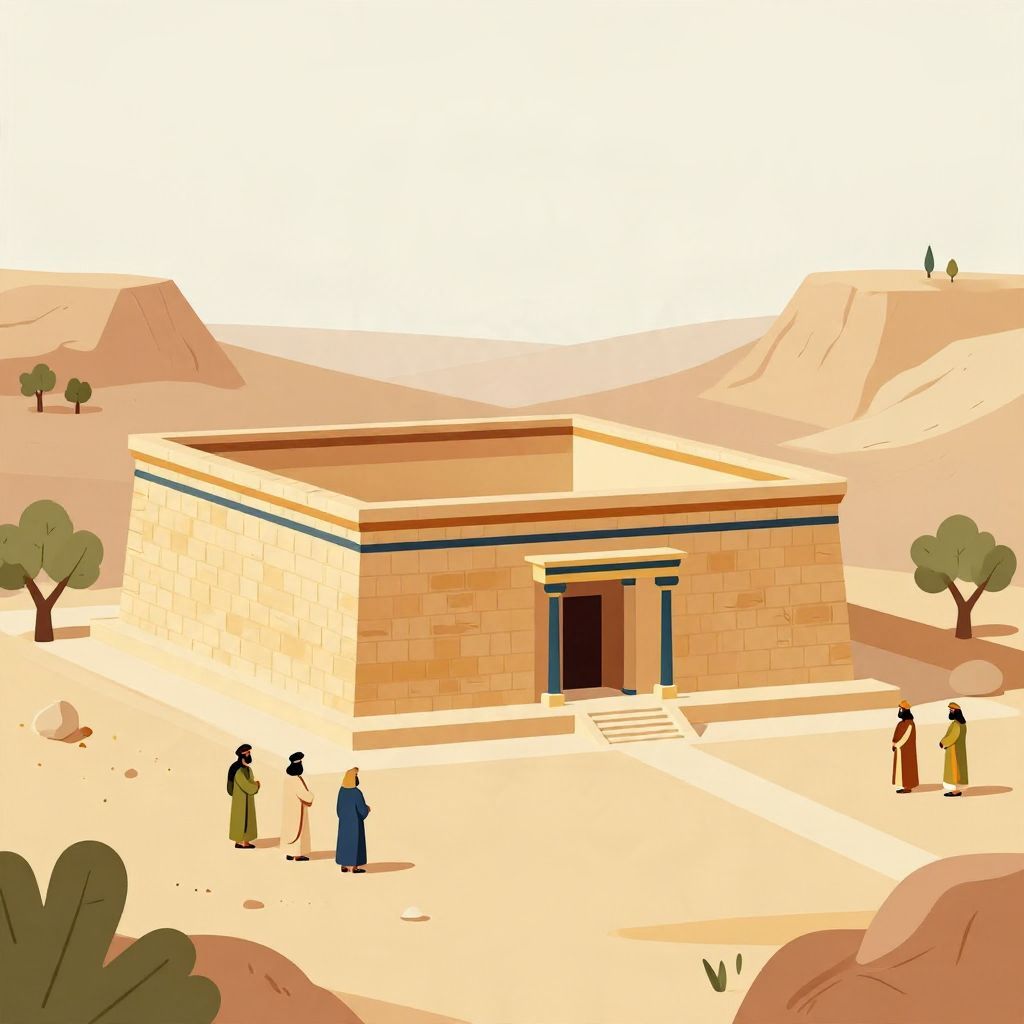
What did Solomon’s Temple look like? The short answer is that it was probably a small but richly decorated Iron Age royal sanctuary in Jerusalem, not the vast marble complex many people imagine today. Most of what we “know” comes from the Hebrew Bible, especially the books of Kings and Chronicles, with archaeological context and comparisons to other ancient Near Eastern temples helping fill in the gaps.
Because the building no longer survives and no uncontested remains have been identified, any reconstruction must be cautious. Historians can outline its likely layout, materials, and symbolic meaning, but the exact appearance of Solomon’s Temple remains partly uncertain.
What Did Solomon’s Temple Look Like?
Solomon’s Temple was likely a rectangular, tripartite sanctuary on a raised platform in Jerusalem, with a porch, a main hall, and an inner holy chamber. It was probably built of stone and cedar, richly fitted with carved wood, bronze furnishings, and gold decoration. Its design reflects ancient Near Eastern temple architecture rather than later monumental synagogue or church styles.
The basic layout described in the Bible
The biblical account presents three main spaces: the Ulam or porch at the front, the Hekhal or main hall, and the Debir, the inner sanctuary or Holy of Holies. The Holy of Holies housed the Ark of the Covenant in the biblical tradition and was the most sacred space, entered only in exceptional ritual contexts.
This tripartite plan is not unique to Jerusalem. Similar temple layouts are known from the wider ancient Near East, where sacred buildings often separated public, semi-sacred, and restricted zones. That makes the biblical description historically plausible, even if the exact measurements and features are debated.
Probable size and scale
The temple was probably modest by modern expectations. Ancient sources give dimensions in cubits, but cubit lengths varied, and the figures may reflect idealized or symbolic proportions. Even so, scholars generally agree that Solomon’s Temple was far smaller than the enormous later Herodian Temple complex that once stood on the same mount.
Rather than a sprawling compound, it was likely a compact sanctuary designed for ritual, sacrifice, and royal religious legitimacy. Its importance came less from physical size than from its role as the central shrine of the kingdom of Judah.
Materials and decoration
The biblical texts emphasize cedar from Lebanon, stone walls, gold overlay, bronze furnishings, and carved motifs of flowers, palms, and cherubim. Cedar was prized across the ancient world for prestige and durability, while bronze and gold signaled wealth and sacred status.
Many details may be literary or idealized, but they fit the broader pattern of elite temples in the region. Royal sanctuaries often combined practical construction with symbolic splendor, using expensive imported materials to express divine favor and political power.
How historians reconstruct the temple’s appearance
Because Solomon’s Temple was destroyed long ago and no direct archaeological remains can be securely identified, historians rely on three main kinds of evidence: biblical descriptions, comparisons with other ancient temples, and the archaeology of Jerusalem and the broader Levant. The result is a careful reconstruction, not a photograph of the past.
Biblical texts as historical evidence
The main narrative appears in 1 Kings 6–7 and 2 Chronicles 3–4. These passages describe the temple’s dimensions, furnishings, and decorative program. They are essential sources, but they were written and edited within religious and literary traditions, so they may reflect theology, memory, and later interpretation as much as direct architectural reporting.
That means historians read them critically. Some details may preserve authentic early traditions; others may be stylized to present Solomon as a wise, wealthy king whose temple embodied divine order.
Comparisons with neighboring temples
Archaeologists compare Jerusalem’s temple with known temples at sites such as Arad, Hazor, Megiddo, and temples in Syria and Mesopotamia. These comparisons suggest that a tripartite sanctuary with an entrance porch, main hall, and inner shrine was normal for the region. Sacred standing stones, altars, and cult objects also appear in related contexts.
These comparisons do not prove every biblical detail, but they help historians judge what is likely. A temple built in Judah during the early Iron Age would have looked like a regional royal sanctuary, not a later Greco-Roman or medieval religious building.
What archaeology can and cannot tell us
Jerusalem’s Temple Mount is one of the most sensitive archaeological sites in the world, and excavation there is extremely limited. As a result, there is no universally accepted archaeological identification of Solomon’s Temple itself. This is why reconstructions vary so widely in books, museums, and popular media.
The absence of direct remains does not mean the temple was fictional. It means the evidence is incomplete, and scholars must work with texts, indirect finds, and historical context rather than a surviving ruin.
What the temple probably looked like in practice
Imagine a stone building on a sacred elevated precinct, approached by steps or a raised platform. The entrance may have led through a porch into a larger hall used for ritual activity, with the most restricted chamber at the rear. The interior likely held cult furnishings, including an altar, lampstands, tables, and symbolic objects associated with worship.
The temple would have been visually impressive through color, metal, and carved surfaces rather than sheer height. Ancient temples often relied on controlled access, sacred light, incense, and precious materials to create awe. In that sense, Solomon’s Temple was probably more about concentrated sanctity than architectural grandeur.
The two pillars, Jachin and Boaz
One of the most famous features in the biblical description is the pair of bronze pillars named Jachin and Boaz. Scholars debate whether these were structural supports, freestanding ritual pillars, or symbolic markers at the entrance. Their exact function is uncertain, but they almost certainly carried strong religious and royal meaning.
Such pillars fit the ancient Near Eastern habit of placing monumental symbols at temple entrances. Whether functional or ceremonial, they would have made the approach to the sanctuary memorable and solemn.
The Holy of Holies
The inner chamber was the most sacred and least accessible part of the temple. In biblical tradition, it housed the Ark of the Covenant, though historians cannot verify that the Ark was actually present in Solomon’s time or even existed in the form later texts describe. What matters historically is that the inner sanctuary symbolized divine presence and separation.
Its restricted nature was central to the temple’s meaning. The architecture itself taught hierarchy: ordinary space outside, sacred space within, and a final chamber reserved for the divine.
When was Solomon’s Temple built?
Traditional chronology places the temple’s construction in the 10th century BCE, during the reign of Solomon. Many historians treat this date cautiously, since the scale and centralized power of Solomon’s kingdom are debated. Some scholars think the biblical account preserves a memory of an early royal sanctuary, while others argue that later writers expanded or idealized the monarchy’s achievements.
What is generally accepted is that a major temple stood in Jerusalem before its destruction by the Babylonians in 586 BCE. Whether Solomon himself built the first version exactly as described is less certain than the fact that Jerusalem became the central cult site of Judah before the exile.
A brief timeline
- c. 10th century BCE: Traditional date for Solomon’s Temple’s construction.
- 8th–7th centuries BCE: Jerusalem temple worship becomes increasingly central in Judah.
- 586 BCE: Babylon destroys Jerusalem and the temple.
- Late 6th century BCE: A Second Temple is built after the exile.
- Second Temple period: The site remains the religious center of Jewish life until Roman destruction in 70 CE.
Why Solomon’s Temple mattered historically
Solomon’s Temple mattered because it linked kingship, worship, identity, and memory. In the biblical narrative, the temple represented the union of divine favor and royal authority. It also helped define Jerusalem as the chosen center of national and religious life.
Over time, the temple became more than a building. It became a symbol of covenant, sacred order, loss, and hope. Its destruction in 586 BCE was a political catastrophe and a theological turning point. Later Jewish tradition remembered the temple not only as a place of sacrifice, but as the heart of a lost world.
From royal sanctuary to enduring symbol
Even after the first temple was destroyed, its memory shaped later Jewish worship, literature, and expectation. The Second Temple rebuilt after the exile carried forward the same sacred geography, while later traditions continued to look back to Solomon’s Temple as the original model of holiness.
That long memory explains why the question “What did Solomon’s Temple look like?” remains so compelling. It is not only an architectural question; it is also a question about origins, identity, and how ancient people imagined the presence of God in a city.
So what should you picture?
If you want a historically responsible mental image, picture a relatively small but richly adorned royal temple in ancient Jerusalem: stone walls, cedar beams, bronze fittings, gold accents, carved sacred motifs, and a carefully divided interior culminating in a hidden sanctuary. It was probably impressive, but not enormous; symbolic, but also practical; and deeply tied to the politics of Judah.
In the end, Solomon’s Temple is known through a mixture of text, archaeology, and interpretation. For more context on Jerusalem’s later temple history, see what the Western Wall is, and for the wider ancient Near Eastern backdrop, what happened to Babylon.