
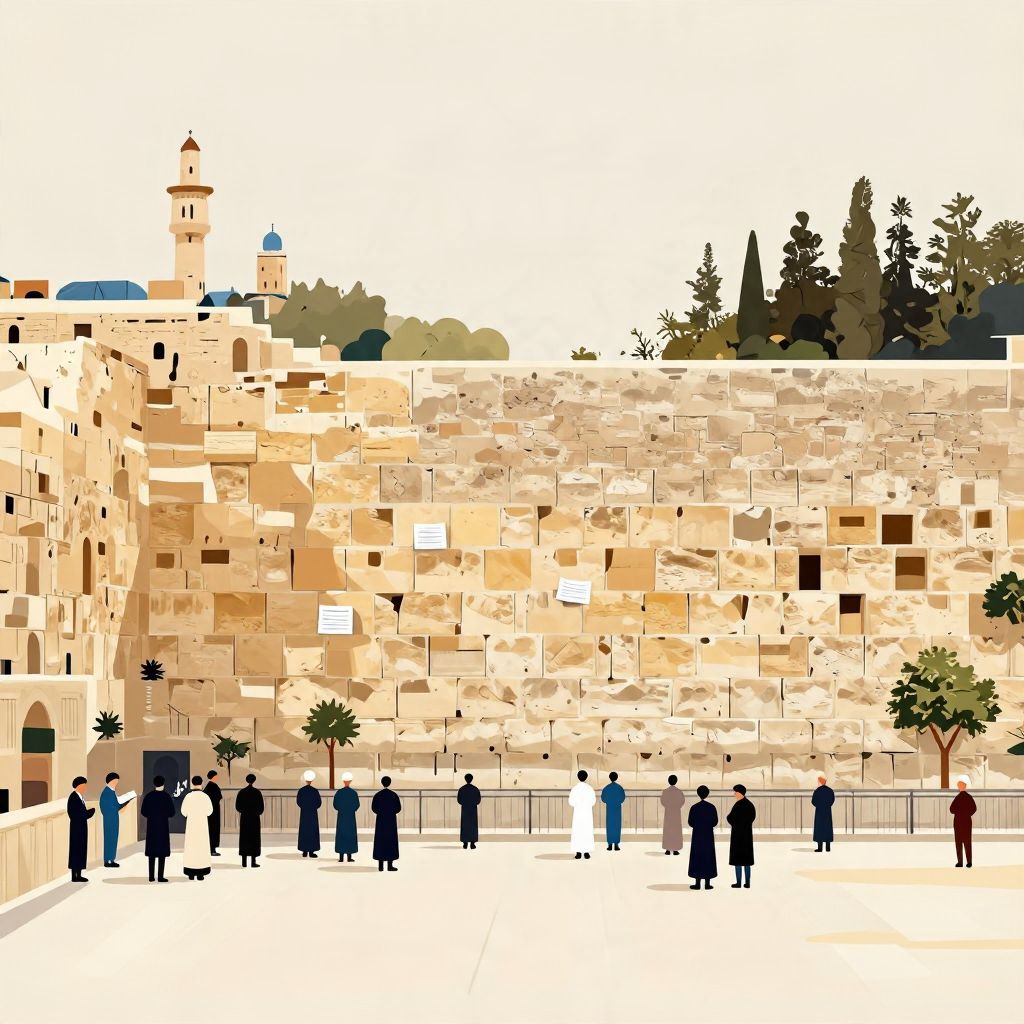
The Western Wall is one of the most important religious and historical sites in Jerusalem. It is the surviving retaining wall of the large platform that once supported the Second Temple complex, and it has become a sacred place of prayer, memory, and national identity for Jews around the world.
When people ask what the Western Wall is, they are usually asking both about its ancient origins and its modern meaning. The answer reaches back to the time of Herod the Great, through the Roman destruction of Jerusalem in 70 CE, and into the long history of Jewish devotion, Islamic stewardship, and modern political conflict.
What Is the Western Wall?
The Western Wall, often called the Wailing Wall in older English usage, is an ancient limestone retaining wall in Jerusalem’s Old City. It is the closest accessible remnant of the Temple Mount’s monumental enclosure from the late Second Temple period, and it has long been revered by Jews as a place near the site of the ancient Temple.
Where Is the Western Wall Located?
The wall stands in Jerusalem’s Old City, along the western side of the elevated platform known to Jews as the Temple Mount and to Muslims as the Noble Sanctuary, or Haram al-Sharif. The visible prayer area today is only a small part of the wall’s full length; much of it lies behind buildings and beneath surrounding streets.
The Temple Mount and its setting
The Western Wall is not the wall of the Temple building itself. Instead, it is part of the massive retaining system built to enlarge and stabilize the Temple platform. That distinction matters historically: the wall survived because it helped support the platform, not because it was the sanctuary’s sacred inner structure.
The Western Wall and the Second Temple Period
The wall’s origins are usually linked to the reign of Herod the Great, who ruled Judea under Roman authority from 37 to 4 BCE. Herod undertook an enormous renovation and expansion of the Second Temple complex, creating a vast platform with retaining walls on several sides. The Western Wall is one of those supports, likely completed in the late first century BCE.
Why Herod rebuilt the Temple complex
Herod’s project served both religious and political purposes. It enhanced the grandeur of Jerusalem’s most important sanctuary, but it also displayed Herod’s power, wealth, and ability to work within the Roman imperial world. The enlarged platform made the Temple complex one of the most impressive religious centers of the ancient Near East.
Why Is the Western Wall So Important to Jews?
The Western Wall became sacred not because it was the Temple itself, but because it was the nearest surviving structure to the place where the Jewish Temples once stood. After the destruction of the Second Temple by the Romans in 70 CE, Jewish tradition increasingly associated the wall with mourning for the loss of the Temple and hope for restoration.
From ruin to sacred memory
Over time, the wall came to symbolize continuity after catastrophe. Jews living under Roman, Byzantine, Islamic, Crusader, Mamluk, and Ottoman rule continued to remember Jerusalem and the Temple in prayer, liturgy, and pilgrimage. The Western Wall became a focal point for lamentation, especially on fast days such as Tisha B’Av, which commemorates the destruction of the Temples.
What Happened in 70 CE?
In 70 CE, Roman forces under Titus suppressed the Great Jewish Revolt and destroyed much of Jerusalem, including the Second Temple. Ancient sources and later Jewish tradition agree that the Temple was devastated in the Roman campaign, though the exact sequence of destruction and the fate of every structure around the platform are still discussed by historians and archaeologists.
What survived and why
The Western Wall survived because it was part of the retaining infrastructure of the platform, not because it was spared for religious reasons. Much of the surrounding complex was ruined, rebuilt, or altered over centuries, but sections of the ancient substructure remained visible and accessible in different periods.
How Did the Wall Become a Place of Prayer?
By the medieval period, Jewish visitors to Jerusalem were known to pray near the remaining western side of the Temple platform. The exact customs varied by era, and access was often limited by political conditions. Still, the site gradually developed into the most important outdoor prayer location associated with the destroyed Temple.
Ottoman-era Jerusalem
Under Ottoman rule, especially from the 16th century onward, the area near the wall became more clearly associated with Jewish prayer. Accounts from travelers and local communities describe Jews gathering there to lament the destruction of the Temple and to pray for redemption. Access, however, was often constrained by local regulations and tensions over space and ownership.
Why Is It Sometimes Called the “Wailing Wall”?
The name “Wailing Wall” is a modern European term that emphasized Jewish mourning at the site. It is not the preferred Jewish name and can sound misleading or dismissive. “Western Wall” is more accurate historically and geographically, since it identifies the wall’s location on the western side of the Temple Mount enclosure.
Names and meanings
Different communities have used different names for the site, reflecting religious perspective and political context. Jews commonly refer to it as the Western Wall, or Kotel in Hebrew. Muslims refer to the area as part of the Haram al-Sharif, and the wall’s meaning has often been shaped by broader debates over sovereignty, worship, and access in Jerusalem.
The Western Wall in the Modern Era
The wall’s modern history is closely tied to the rise of nationalism, the end of Ottoman rule, the British Mandate, and the Arab-Israeli conflict. In the 19th and 20th centuries, the site became not only a place of devotion but also a symbol in competing national and religious claims over Jerusalem.
British Mandate and rising tensions
During the British Mandate after World War I, disputes over prayer rights and access at the wall intensified. Tensions culminated in the violence of 1929, when clashes over the site contributed to broader unrest in Mandatory Palestine. These events showed that the wall had become more than a religious landmark; it had become a political flashpoint.
1948 to 1967
After the 1948 Arab-Israeli War, East Jerusalem, including the Old City and the Western Wall, came under Jordanian control. Jewish access to the wall was cut off during this period. In 1967, during the Six-Day War, Israel captured East Jerusalem and the Old City, and the Western Wall became accessible to Jewish worshippers again.
What Does the Western Wall Mean Today?
Today the Western Wall functions as a major Jewish prayer site, a place of pilgrimage, and a symbol of historical endurance. It is also part of one of the most sensitive religious landscapes in the world, because its significance cannot be separated from the broader status of Jerusalem and the Temple Mount/Haram al-Sharif.
Prayer, archaeology, and public memory
Visitors often place written prayers into the cracks of the stones, a modern custom that reflects the site’s role as a place of intimate devotion. Archaeological study has also deepened understanding of the wall’s construction and history, though excavation around such a politically charged site remains delicate and sometimes controversial.
What Can Be Said with Confidence, and What Remains Debated?
Historians are on firm ground in saying that the Western Wall is part of Herod’s enlarged Temple platform, that it survived the Roman destruction of 70 CE, and that it later became the most important Jewish site of mourning and prayer connected to the destroyed Temple. Less certain are some details of early post-70 use, since the documentary record is limited.
Evidence and interpretation
There is broad agreement on the wall’s ancient function and its later religious importance, but interpretations can differ on how continuously Jews prayed there in every period, how access was regulated under different rulers, and how specific customs developed. In a site with deep religious meaning, legend and memory sometimes traveled alongside evidence.
Why the Western Wall Still Matters
The Western Wall matters because it links architecture, destruction, survival, and memory across more than two millennia. It is a physical remnant of ancient Jerusalem, a living center of Jewish worship, and a symbol of the enduring power of sacred places to shape history long after the empires that built them have vanished.
In short, the Western Wall is the surviving retaining wall of the Second Temple platform in Jerusalem, built in the late Second Temple period and later transformed into a global symbol of Jewish prayer and historical loss. For readers interested in related history, the wider story of the Second Temple and Jerusalem’s history offers essential context for understanding its enduring significance.