
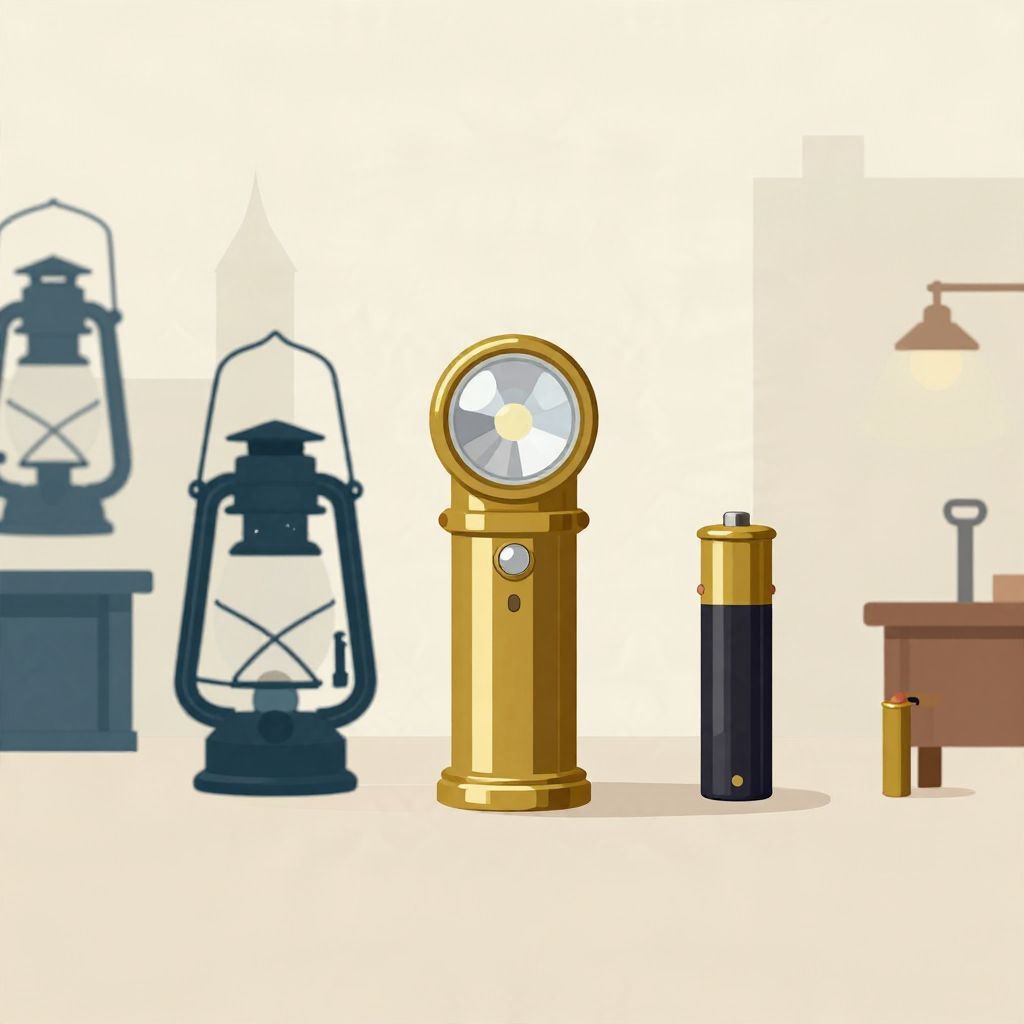
When were flashlights invented? The short answer is that the first practical flashlight appeared in the late 1890s, with the modern battery-powered version emerging around 1898–1899. Earlier portable lights existed, but they were limited by weak batteries and short runtimes.
The flashlight’s invention was not a single moment so much as the result of several late-19th-century breakthroughs: the dry cell battery, the incandescent bulb, and safer electrical contacts. Together, they made a handheld electric light useful enough for everyday life.
When Were Flashlights Invented?
Flashlights were invented in the late 1890s, most commonly dated to 1898 or 1899 for the first commercially practical models. These early devices used dry-cell batteries and small incandescent bulbs, but they were dim and could only produce light for short periods. The flashlight became truly practical only as battery technology improved in the early 20th century.
The Origins of the Flashlight
The flashlight grew out of 19th-century experimentation with portable electricity. By the time inventors began combining compact batteries with miniature bulbs, the basic idea of a handheld electric lamp was already possible. What changed in the 1890s was not the concept alone, but the ability to make it portable, affordable, and dependable enough to sell.
What had to exist first?
Three inventions made the flashlight possible:
- The dry cell battery, which could be carried upright without spilling liquid electrolyte.
- The incandescent light bulb, which produced light from a heated filament.
- Improved electrical switches and contacts, which let users turn the light on and off.
Without these developments, a handheld electric light would have been too bulky, fragile, or short-lived to be practical.
The First Practical Flashlights in the 1890s
The first commercially successful flashlights appeared in the United States in the late 1890s. One of the best-known early companies was the American Electrical Novelty and Manufacturing Company, founded by Conrad Hubert, which later became associated with the Eveready brand. These early lights were called “flashlights” because they produced brief flashes of light rather than a steady beam.
Why were they called flashlights?
The name reflected their limitations. Early models were not powerful enough to stay bright for long, so users got short bursts of illumination. In other words, the “flash” in flashlight originally described the device’s weak and intermittent output, not a sharp beam like the modern version.
How early flashlights worked
Early flashlights were simple devices. A small bulb sat inside a metal or cardboard tube with batteries and a switch. When the circuit closed, current flowed through the filament and produced light. Because the batteries of the day had limited capacity, the light faded quickly and often needed frequent replacement or recharging in later versions.
A Brief Timeline of Flashlight Development
The flashlight did not emerge from nowhere. It developed through a series of electrical innovations over several decades.
- 1800 – Alessandro Volta develops the voltaic pile, an early battery.
- 1870s–1880s – Incandescent lighting becomes more practical with improved bulbs and electrical systems.
- 1880s–1890s – The dry cell battery becomes widely available, making portable electric devices more feasible.
- 1898–1899 – The first practical commercial flashlights appear.
- Early 1900s – Flashlights become more reliable as batteries and bulbs improve.
- Mid-20th century – Better materials, stronger batteries, and later alkaline cells make flashlights common household tools.
Who Invented the Flashlight?
There is no single universally agreed inventor in the way there is for some inventions. The flashlight was the product of multiple contributors, but Conrad Hubert is often associated with the first commercially successful flashlight business in the United States. Other inventors and manufacturers helped refine the design, and the broader invention depended on earlier electrical pioneers rather than one isolated breakthrough.
Why the inventor question is complicated
Invention history often works this way: one person may build the first marketable version, while others create the underlying technologies. The flashlight depended on battery science, bulb design, and mass production. So the answer to “who invented the flashlight?” depends on whether you mean the first workable device, the first commercial product, or the first widely adopted model.
Why Early Flashlights Were Not Immediately Popular
Although the flashlight was invented in the 1890s, early models had real drawbacks. They were expensive relative to usefulness, batteries drained quickly, and bulbs were fragile. Many households still relied on candles, oil lamps, and gas lighting, which were often cheaper and more familiar.
From novelty to necessity
As batteries improved, flashlights became far more useful. They were especially valuable in places without reliable electric service and in situations where open flame was dangerous. Over time, they moved from novelty item to everyday tool in homes, workshops, mines, railways, and emergency kits.
The Historical Significance of the Flashlight
The flashlight mattered because it changed how people moved and worked after dark. It offered a safer alternative to candles and kerosene lamps, reducing fire risk and making portable light easier to carry. Its development also reflected a larger historical shift: the electrification of daily life.
Impact on daily life and work
Flashlights improved nighttime travel, household tasks, industrial inspection, and emergency response. They became essential in military use, camping, policing, and rescue work. In each case, the same advantage applied: portable light without flame.
Part of a larger electrical revolution
The flashlight’s history belongs to the broader story of late-19th- and early-20th-century electrification. Just as electric lighting transformed streets and homes, the flashlight brought that same technology into the hand. It was a small device with a large cultural effect, helping normalize electricity as an everyday convenience.
How the Flashlight Evolved After Its Invention
After the first practical models appeared, the flashlight improved steadily. Better batteries extended runtime, stronger bulbs increased brightness, and new casing materials made the devices more durable. Later innovations such as rechargeable batteries, halogen bulbs, LEDs, and waterproof housings transformed the flashlight from a short-lived novelty into a highly efficient tool.
Modern flashlights versus early ones
Today’s flashlights bear little resemblance to the earliest versions in performance, even if the basic idea is the same. Modern models are brighter, smaller, and more energy-efficient. LED technology, in particular, has extended battery life dramatically and made flashlights more reliable than their late-19th-century ancestors could ever have been.
So, When Were Flashlights Invented?
Flashlights were invented in the late 1890s, with the first practical commercial versions appearing around 1898–1899. They emerged from the meeting of dry-cell batteries, incandescent bulbs, and compact electrical design. Their invention marked an important step in the history of portable technology and everyday electrification.
For readers interested in the broader context of technological change, you may also enjoy exploring more history topics and related background on the Dust Bowl. The flashlight’s story is a reminder that even modest inventions can reshape daily life in lasting ways.