
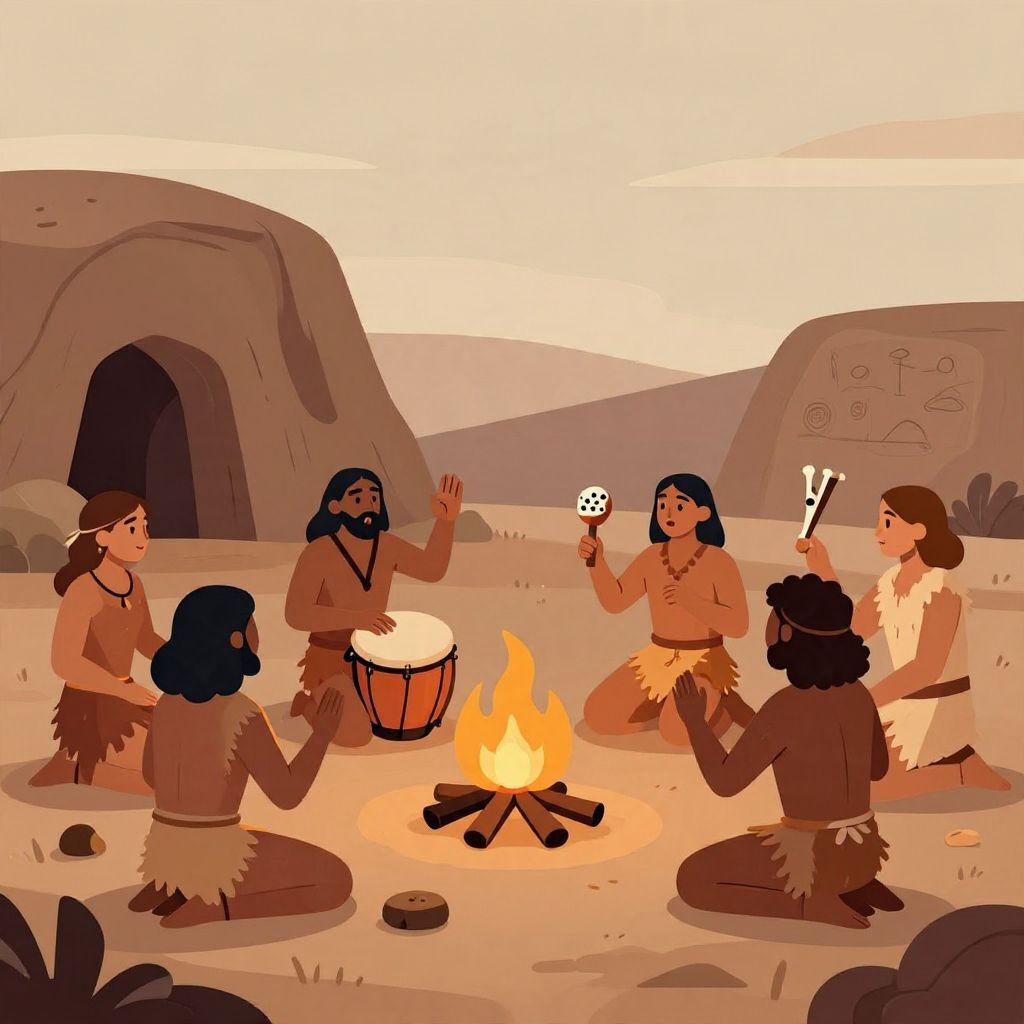
People often ask what the first song ever made was, but history cannot give a single certain answer. Song existed long before writing, and the earliest music was probably sung, improvised, and passed from person to person without being recorded.
What we can say is that the oldest surviving written song is far older than most people expect, and the oldest known musical traditions likely began in prehistoric societies thousands of years before that. The answer depends on whether you mean the first song ever sung, the first song written down, or the oldest song still performed today.
What Was The First Song Ever Made?
There is no identifiable “first song ever made.” The earliest songs were almost certainly prehistoric vocal traditions that left no record. The oldest surviving notated music comes from ancient Mesopotamia, especially a Hurrian hymn from around 1400 BCE, but that is not the first song in history—only the oldest one we can partially reconstruct.
Why There Is No Single First Song
Song predates writing by a vast margin. Humans likely sang for ritual, storytelling, bonding, mourning, and work long before anyone developed a system to preserve music on clay, papyrus, or parchment. Because early songs were oral, they changed with each performance and disappeared unless later written down.
Oral tradition came first
In early human communities, music was part of everyday life rather than a separate art form. Rhythm, chant, and melody may have helped coordinate labor, comfort children, mark ceremonies, and strengthen social groups. Those uses made song widespread, but also hard to trace historically.
“First” depends on the definition
- First song ever sung: unknown and unrecoverable.
- First song written down: among the oldest is the Hurrian hymn from ancient Mesopotamia.
- Oldest surviving complete song tradition: some ancient liturgical and folk traditions have very long histories, but their exact beginnings are uncertain.
The Oldest Known Song We Can Study
The best-known candidate for the oldest surviving song is the Hurrian Hymn No. 6, found on a clay tablet at Ugarit in present-day Syria and dated to about 1400 BCE. It is not the first song ever made, but it is the oldest substantial piece of notated music known to historians.
What the Hurrian hymn tells us
The tablet preserves part of the lyrics and musical instructions. Scholars have debated how exactly the music should be performed, because ancient notation was not the same as modern sheet music. Even so, the hymn shows that by the Bronze Age, people were already writing down music in a structured way.
Why it matters historically
This tablet proves that music was important enough to preserve in writing, likely for religious or ceremonial use. It also shows that ancient people had systems for tuning instruments and organizing melody, which means song had already developed over a long period before it was ever recorded.
How Early Songs Probably Began
Most historians and archaeologists believe song emerged gradually, not in one single moment. Human beings likely began with speech-like chant, repeated rhythm, and simple melodic patterns. Over time, these sounds became more structured and culturally meaningful.
Possible prehistoric functions of song
- Ritual: chanting in ceremonies, burials, or religious observances.
- Communication: using repeated vocal patterns to signal or remember information.
- Labor: keeping time during group work.
- Storytelling: preserving myths and communal memory.
- Social bonding: creating shared emotional experience.
Because these functions leave little archaeological trace, scholars infer them from anthropology, comparative study of living oral cultures, and the deep human connection between rhythm, language, and emotion.
Ancient Civilizations and the First Written Songs
Once writing appeared, music became visible in the historical record. Different civilizations preserved songs in different ways, and several early examples survive in fragmentary form. None can be called the absolute first, but they help map the long history of music.
Mesopotamia
In ancient Mesopotamia, especially in Sumerian and Hurrian contexts, music was tied to temples, courts, and ritual life. Clay tablets show that scribes could record lyrics and musical instructions. These sources are among the earliest evidence that songs were formally composed and transmitted.
Ancient Egypt
Egyptian art and texts show musicians playing harps, flutes, and percussion in religious and social settings. Some hymns and devotional songs survive, though often only in partial form. Egyptian music was likely rich and varied, but much of it was preserved visually rather than in a system we can fully decode.
Ancient Greece
The Greeks left some of the clearest surviving examples of notated music from the ancient world. The Seikilos epitaph, usually dated to the first century CE, is one of the oldest complete surviving musical compositions with notation. It is much later than the Hurrian hymn, but easier for modern readers to understand because more of it survives intact.
Could the First Song Have Been a Lullaby, Chant, or Work Song?
No one knows, but many scholars think the earliest songs were probably simple and practical rather than polished artistic compositions. A lullaby, chant, or work song makes sense because each could arise naturally from repeated speech and rhythm.
Why these forms are plausible
Lullabies soothe children through repetition and gentle melody. Chants help groups remember words and coordinate movement. Work songs synchronize effort. These forms appear across many cultures, which suggests they may reflect deep human tendencies rather than a single invention by one person or society.
What we should not assume
Popular stories sometimes claim that the first song was a sacred hymn or a famous poem set to music. That is speculation. Without written evidence, the earliest song cannot be identified by title, author, or exact melody.
The Difference Between the Oldest Song and the First Song
It is important to separate history from survival. The oldest song we possess is not the first song that ever existed. It is only the earliest one that happened to survive long enough for modern scholars to study it.
Why survival is so selective
- Organic materials decay.
- Oral traditions change over time.
- Wars, fires, and environmental damage destroy archives.
- Many early societies did not write music at all.
As a result, the historical record is shaped by preservation, not just by creation. That is why the “first song ever made” remains unknowable, even though music itself is almost certainly as old as human culture.
What the Search for the First Song Reveals About Human History
The question matters because it points to something fundamental: humans have always used sound to make meaning. Song is one of the oldest forms of cultural expression, connecting language, memory, emotion, and community. Its origins likely lie deep in prehistory, before states, writing, and formal literature.
A shared human inheritance
Across time and place, people have sung to mourn the dead, honor gods, teach children, celebrate harvests, and tell stories. That continuity suggests that song is not a luxury added to civilization; it is part of what makes civilization possible.
So, what was the first song ever made? Historically, we do not know. The earliest surviving written song is the Hurrian hymn from around 1400 BCE, but the first song itself was almost certainly much older, born in the unwritten world of prehistoric human life. If you want to explore more broad historical questions, you can also browse history topics and timelines or look at a specific modern-year overview such as what happened in 2013.