
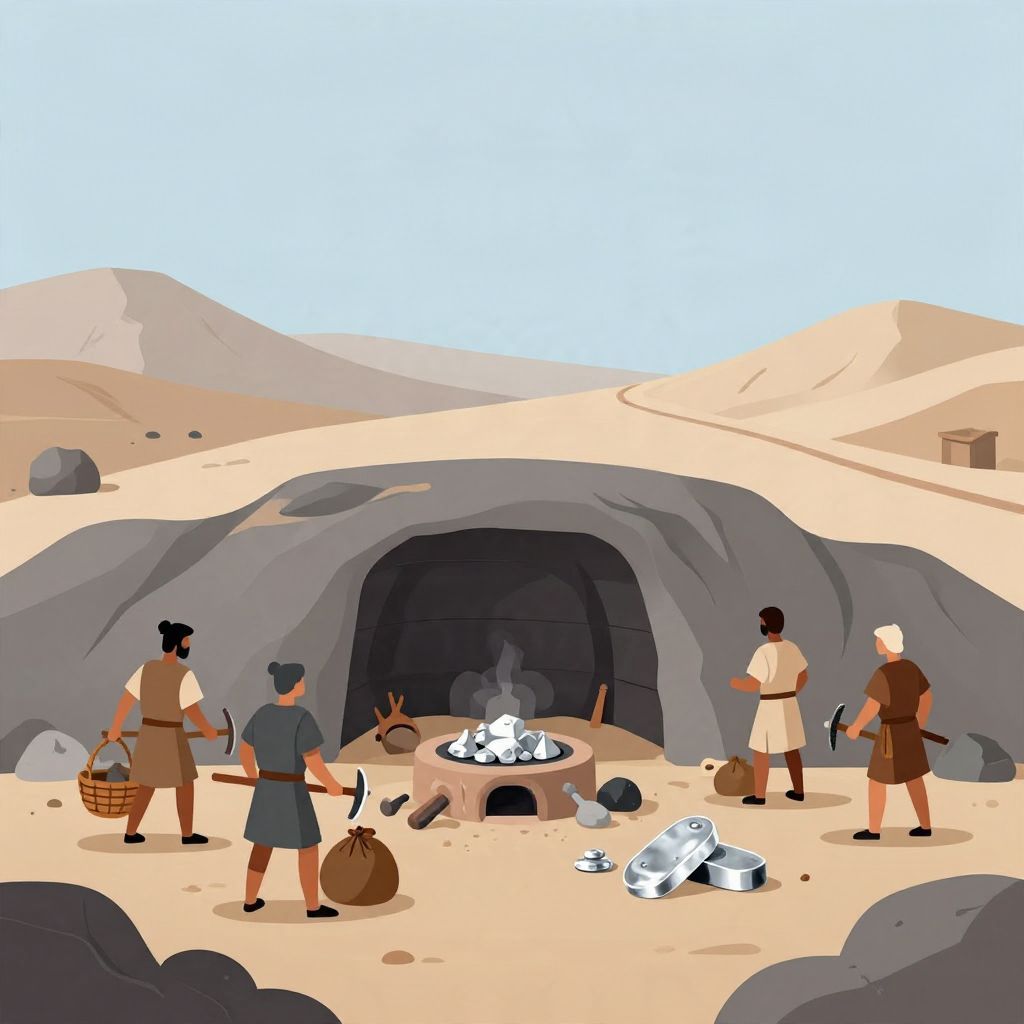
Silver has been mined and refined by humans for thousands of years, but the answer to “where does silver come from” depends on whether you mean its geological source or its historical use. Geologically, silver is a natural metal found in the Earth’s crust, often mixed with other ores rather than appearing as pure metal.
Historically, people first obtained silver from mining regions in Anatolia, the Aegean, the Iberian Peninsula, and later the Americas. Its rarity, brightness, and usefulness in coinage and trade made silver one of the most important metals in world history.
Where does silver come from?
Silver comes from the Earth’s crust, where it occurs in ore deposits, usually combined with sulfur, lead, copper, or other metals. It is extracted through mining and smelting, not grown or manufactured. Historically, major silver supplies came from ancient mines in the Mediterranean world and, after the 16th century, from enormous deposits in Mexico and South America.
Silver in nature: the geological source
Silver is a chemical element, so it is not “made” by human activity. It formed long before human history, created in cosmic events such as supernovae and neutron-star collisions before becoming part of the material that formed Earth. In the ground, silver is rarely found as pure native metal; more often it appears in mineral ores.
Common silver-bearing ores
- Argentite and related silver sulfides
- Galena, a lead ore that often contains silver as a byproduct
- Copper ores that carry small amounts of silver
- Native silver, which is rarer but can occur in visible metallic form
This is why silver production has often depended on mining other metals as well. In many historical periods, silver was recovered as a byproduct of lead and copper mining rather than from silver-only mines.
How silver was first obtained in history
People likely noticed silver very early because it can appear shiny and workable even in natural form. Archaeological evidence suggests that ancient communities in the Near East and Anatolia were using silver by the 4th millennium BCE, and probably earlier in limited ways. At first, silver was valued less for industrial use than for ornament, ritual objects, and prestige.
Ancient mining centers
One of the most important early silver sources was the ancient Mediterranean world. The Greeks and later the Romans drew heavily on mines in places such as Laurion near Athens, where silver helped finance coinage, trade, and naval power. In the Roman period, silver mining expanded across Iberia and other parts of the empire.
These mines mattered because silver was not just a luxury metal. It became a foundation for money. Once states began striking silver coins, control of silver deposits became a strategic concern, tied directly to taxation, armies, and imperial expansion.
Where silver came from in the ancient and medieval world
For much of antiquity and the Middle Ages, the main silver-producing regions were in the Mediterranean, Central Europe, and parts of the Middle East. Mining methods were labor-intensive and dangerous. Workers dug shafts, broke ore with tools and fire-setting, and then smelted the metal in furnaces to separate silver from surrounding rock.
Important historical silver regions
- Anatolia and the Aegean – early extraction and coinage in the ancient world
- Laurion in Greece – a major source for classical Athens
- Iberia – heavily mined under the Romans
- Central Europe – later medieval mines in areas such as Bohemia and Saxony
By the late Middle Ages, European silver production had become more sophisticated, especially with improvements in mining engineering and metallurgy. Still, supply remained limited compared with what would come later from the Americas.
The American silver boom
The biggest turning point in silver history came after European expansion into the Americas in the 16th century. Vast deposits in present-day Mexico, Bolivia, and Peru transformed global silver supply. Mines such as Potosí in the Andes and Zacatecas in New Spain became famous for extraordinary output.
This was not a simple story of discovery and abundance. Indigenous labor systems were often exploited, and African slavery and coerced labor also became part of the mining economy in some regions. Silver from the Americas helped finance Spanish imperial power, global trade, and the circulation of coinage across Europe and Asia.
Why the American mines mattered
- They greatly increased the world supply of silver
- They linked the Americas to European and Asian trade networks
- They helped spread silver coinage across global markets
- They intensified colonial labor exploitation and environmental damage
From a historical perspective, this was one of the most important resource shifts in world history. Silver stopped being a relatively scarce regional metal and became a truly global commodity.
How silver was extracted and refined
Silver usually had to be separated from ore through a sequence of mining and metallurgical processes. In ancient times, miners used smelting to heat ore and separate metal from waste rock. Later, more advanced methods allowed better extraction from complex ores, especially those containing lead.
Historical methods of silver production
- Mining: digging shafts and tunnels to reach ore bodies
- Crushing and washing: breaking ore into smaller pieces
- Smelting: heating ore to separate metal
- Refining: removing impurities to produce usable silver
One especially important process was cupellation, an ancient refining technique used to separate silver from lead. This method was crucial because much historical silver came from lead-silver ores. The technique allowed miners and metalworkers to recover silver in a purer form suitable for coins, jewelry, and plate.
Silver and power in history
Silver’s importance was never only economic. It shaped politics, warfare, and empire. States that controlled silver mines or silver trade routes could pay soldiers, mint coins, and purchase goods from far away. In many eras, silver was the metal of everyday money, while gold was reserved for larger stores of wealth and prestige.
Because silver was so useful for coinage, its supply affected inflation, trade balances, and state finance. The influx of American silver in the 16th and 17th centuries, for example, helped integrate Europe, the Atlantic world, and East Asia into a more connected commercial system.
Silver in the modern era
Today, silver still comes from mining, but modern production is more diversified and industrialized. It is extracted from primary silver mines and, very often, as a byproduct of mining copper, lead, zinc, and gold. Industrial uses now matter as much as coinage once did, including electronics, solar technology, photography in the past, and medical applications.
Historically, this marks a shift in silver’s role: from a metal that symbolized wealth and powered coin systems to one that also serves modern manufacturing. Yet the basic source remains the same—ore in the Earth, refined through mining and metallurgy.
So, where does silver come from in historical terms?
Historically, silver came first from ancient mines in the Mediterranean and the Near East, then from medieval European ore fields, and finally in overwhelming quantities from the Americas after the 1500s. In every era, it was dug from the ground, processed from ore, and shaped by the labor systems and political powers that controlled it.
The short answer is that silver comes from mineral deposits in the Earth, but the historical answer is broader: it comes from mining regions, labor networks, and empires that turned a rare metal into one of the most influential substances in world history. For related reading, see what year they stopped making silver quarters and what year dimes are silver.