
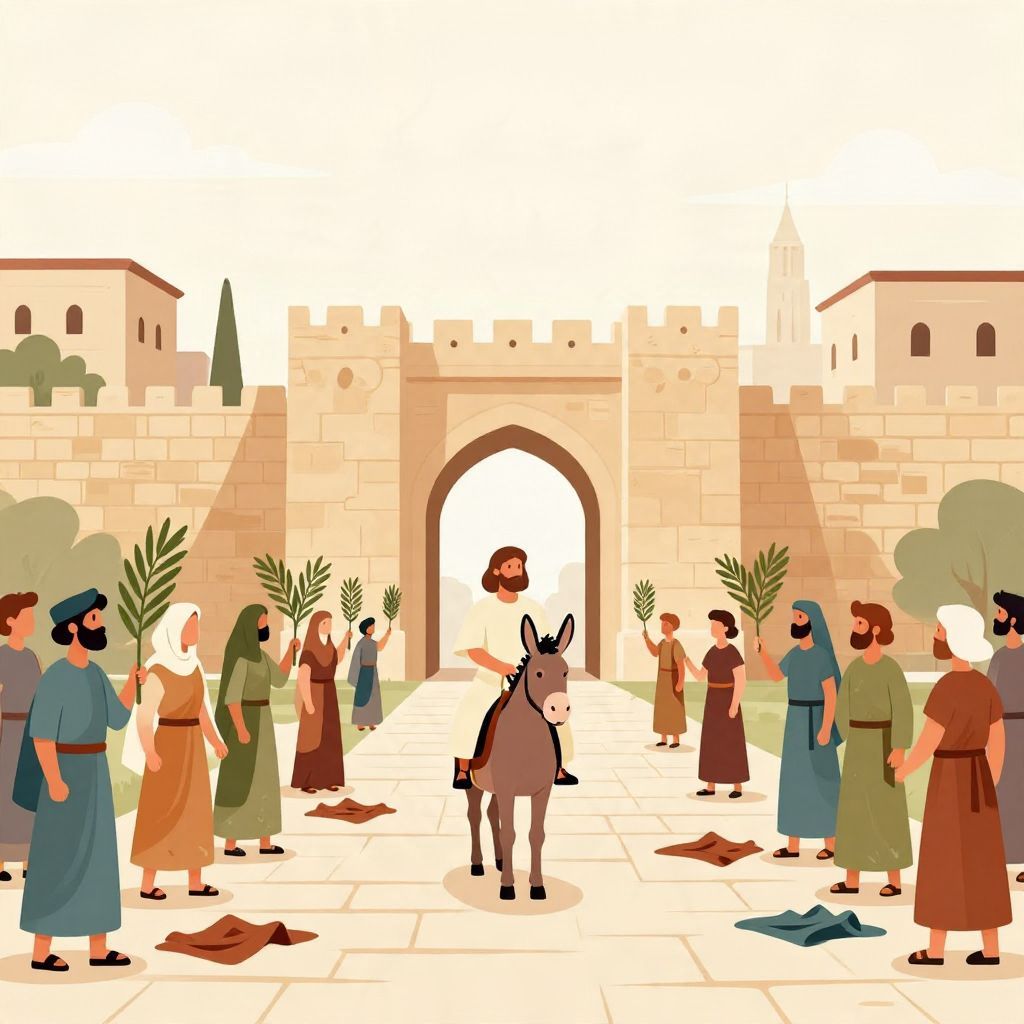
Palm Sunday marks the beginning of the final week of Jesus’ life in the Christian calendar. It remembers his arrival in Jerusalem, where crowds greeted him with palm branches and shouted acclamations, an event recorded in the New Testament and later commemorated by churches around the world.
Historically, Palm Sunday is both a religious observance and a narrative about public expectation, political tension, and the events that led to the crucifixion of Jesus. Its meaning comes from the story of Jesus entering Jerusalem shortly before Passover, a moment that Christians later understood as the start of Holy Week.
What Happened On Palm Sunday?
Palm Sunday commemorates Jesus’ entry into Jerusalem, when supporters spread cloaks and palm branches before him and hailed him as a king or messianic figure. The event, dated by Christian tradition to the Sunday before Easter, is described in the four Gospels and is seen as the opening scene of the Passion story.
The Historical Setting: Jerusalem at Passover
To understand Palm Sunday, it helps to picture Jerusalem in the first century CE. Passover drew large crowds to the city, and Roman authorities would have been alert to any sign of unrest. Jesus’ arrival therefore took place in a charged atmosphere shaped by Jewish hopes for deliverance and Roman concerns about order.
Jerusalem was not a neutral stage. It was the religious center of Judaism, the site of the Temple, and a place where symbolic actions could carry political meaning. A public procession into the city could be interpreted in more than one way: as a prophetic act, a royal claim, or a challenge to existing power.
Why the crowd mattered
The Gospel accounts describe people greeting Jesus with praise and with branches cut from trees. In the ancient Mediterranean world, branches and cloaks could signal honor. The use of palms became especially important in Christian memory, although the exact mix of gestures likely varied among the Gospel traditions.
The Palm Sunday Timeline
The New Testament does not give a minute-by-minute schedule, and scholars caution against treating the Gospel accounts as modern journalistic reports. Still, the broad sequence is clear: Jesus approached Jerusalem, entered the city in a public way, was acclaimed by crowds, and then moved into the events that led to his arrest and crucifixion later that week.
- Approach to Jerusalem: Jesus travels toward the city with his disciples during the Passover season.
- Public entry: He enters Jerusalem riding on a donkey or colt, a detail associated with humility and, in Christian interpretation, with fulfillment of prophecy.
- Crowd acclamation: Supporters spread garments and branches and shout praise.
- Temple confrontation: In the days that follow, Jesus is linked in the Gospels to actions and teachings that intensify conflict with religious authorities.
- Arrest and trial: The week culminates in Jesus’ arrest, trial, and crucifixion under Roman authority.
Why a donkey or colt?
The Gospel writers connect Jesus’ mounted entry with biblical imagery, especially prophetic language associated with a peaceful king. In Christian interpretation, the animal choice signals humility rather than military power. Historically, it also distinguishes Jesus’ entry from the kind of triumphal parade a Roman victor might stage on horseback.
What the Gospels Say
All four Gospels include some version of the entry into Jerusalem, though they differ in details. Matthew, Mark, Luke, and John agree on the basic event but vary in emphasis, wording, and surrounding scenes. These differences are important because they show that the story circulated in more than one form in early Christian tradition.
Shared elements across the accounts
- Jesus comes to Jerusalem near the time of Passover.
- He enters in a public, symbolic manner.
- The crowd responds with praise and visible signs of honor.
- The event leads into the final sequence of Jesus’ ministry.
John’s Gospel is especially explicit about palm branches, while the Synoptic Gospels—Matthew, Mark, and Luke—emphasize cloaks and acclamation. This does not mean one version is “right” in a simple sense and the others are wrong; rather, it reflects the way early Christian communities preserved the memory of the event with different emphases.
Why Palm Sunday Became Important in Christian Tradition
Palm Sunday became important because it gave Christians a way to begin Holy Week with a dramatic contrast: public celebration followed by suffering and death. The same week that began with praise ends with the crucifixion narrative, making Palm Sunday a bridge between joy and sorrow in the Christian liturgical year.
By the fourth century, Christian communities were already marking the final days before Easter with special observances. In Jerusalem, pilgrims and local believers developed processions that retraced the route associated with Jesus’ entry. Over time, these customs spread more widely, though local forms varied across Christian traditions.
How the observance developed
The use of palm branches in worship became especially associated with Palm Sunday in many churches, but not everywhere. In regions where palms were not available, other branches were used. The symbol mattered more than the plant itself: it represented welcome, victory, and remembrance.
Historical Meaning: A Peaceful Entry with Political Overtones
Palm Sunday is often described as a humble procession, but it also had political resonance. In a city under Roman occupation, any public movement that suggested kingship could attract attention. Jesus’ entry may have been interpreted by followers as messianic, while authorities could have seen it as potentially destabilizing.
That tension helps explain why Palm Sunday is not just a devotional memory. It points to the larger historical question of how Jesus’ movement was understood in its own time. The entry into Jerusalem placed him at the center of competing expectations: spiritual renewal for some, threat or disorder for others.
Messianic expectation in context
Many Jews in the first century hoped for divine intervention, restoration, or liberation. The term “messiah” meant an anointed one, but expectations varied widely. Some imagined a royal deliverer, others a priestly figure, and still others a prophetic reformer. Palm Sunday sits within that world of expectation rather than outside it.
From Palm Sunday to the Crucifixion
Palm Sunday matters historically because it introduces the final chain of events leading to Jesus’ death. The Gospels present the entry, the teaching in Jerusalem, the conflict over the Temple, the arrest, and the trial as connected parts of one week. Whether every detail unfolded exactly as narrated is debated by scholars, but the overall trajectory is central to Christian history.
The crucifixion itself, generally placed under the Roman prefect Pontius Pilate, is one of the best-attested facts about Jesus’ life. Palm Sunday is therefore not an isolated festival; it is the opening scene in the Passion story that shaped Christian theology, worship, and identity.
How Christians Observe Palm Sunday Today
Today, Palm Sunday is celebrated in many Christian churches with processions, readings from the Passion narratives, and blessings of palms or branches. The tone can vary from festive to solemn, because the day contains both triumph and foreshadowing. In many congregations, the liturgy moves from praise to the reading of Jesus’ suffering.
Some traditions emphasize the procession into church, while others focus on the Gospel reading and the beginning of Holy Week. In either case, the observance is meant to invite reflection on the contrast between public acclaim and the events that followed.
Lasting Historical Impact
Palm Sunday has had a lasting impact because it shaped how Christians remember the final week of Jesus’ life. It also influenced art, music, liturgy, and public ritual. The image of a humble king entering a city became one of the most enduring scenes in Christian culture.
Beyond religion, Palm Sunday illustrates how historical memory works. A short event, described in ancient texts and reinterpreted across centuries, became a major annual observance. Its meaning has shifted from a local first-century procession to a global ritual of remembrance.
In Short
Palm Sunday commemorates Jesus’ entry into Jerusalem shortly before his crucifixion. The event was remembered by early Christians as both a sign of welcome and a prophetic act, and it became the traditional start of Holy Week. Its historical importance lies in the way it links public expectation, political tension, and the Passion narrative.
For related context, see how old Jesus was when he was crucified and why Easter changes date each year.