
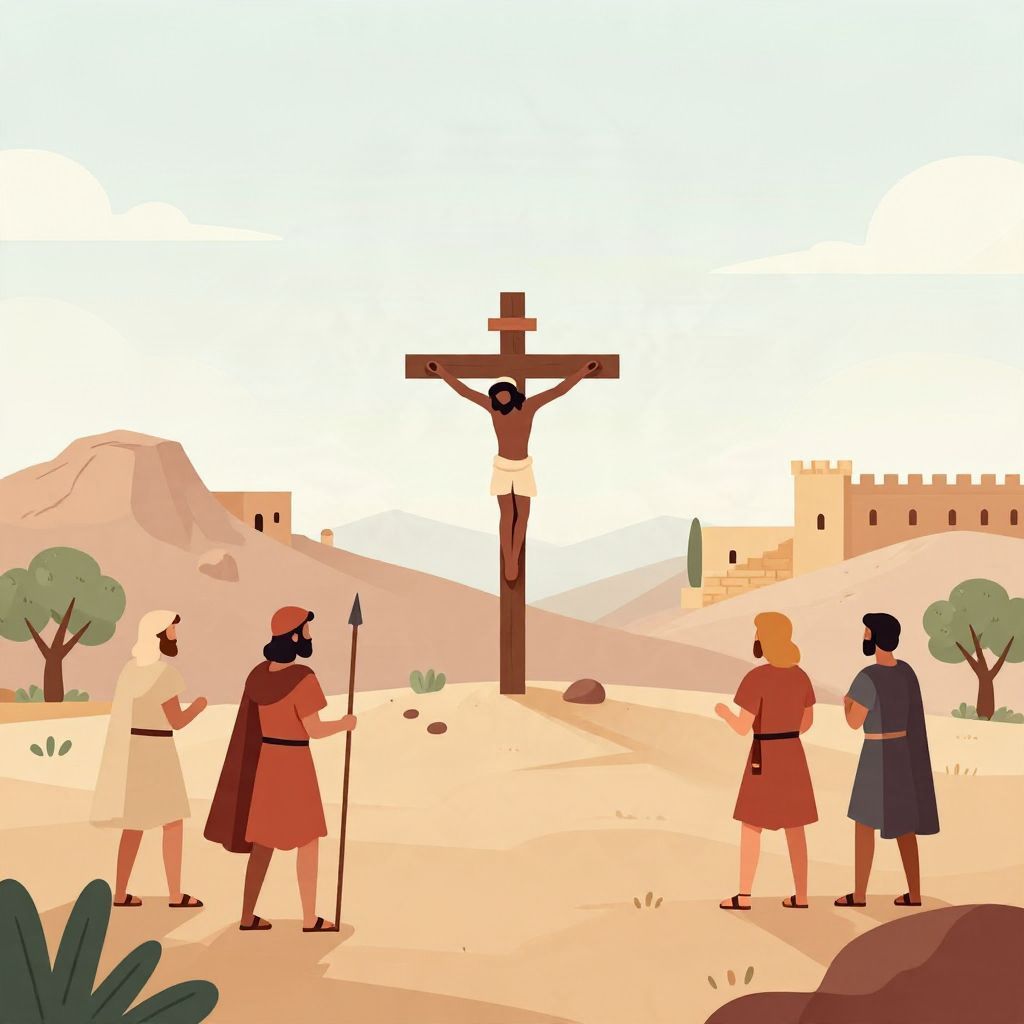
How old was Jesus when he was crucified? The most careful historical answer is that Jesus was probably in his early 30s, though the exact age cannot be proven from surviving sources. The New Testament gives clues, but it does not record a birth date, and ancient chronology is partly reconstructed from later evidence.
Because of that, historians usually speak in estimates rather than certainties. The best-supported range is roughly 30 to 33 years old, with many scholars favoring about 33 if Jesus was born a few years before the common calendar begins.
How old was Jesus when he was crucified?
Jesus was likely around 33 years old when he was crucified, though some reconstructions place him a little younger, in his early 30s. The exact age depends on which birth year is assumed and which date is chosen for the crucifixion, both of which remain debated among historians.
Why historians give an estimate instead of an exact age
There is no surviving birth certificate, census record, or contemporary Roman document that states Jesus’ age at death. The Gospels provide narrative details, but they do not give a precise birth year. As a result, historians work backward from clues such as the reigns of Roman rulers, references to John the Baptist, and the likely date of the crucifixion itself.
The phrase often associated with Jesus’ public life is that he was “about thirty” when he began his ministry. That wording appears in the Gospel of Luke and is approximate, not exact. If Jesus began preaching around age 30 and his ministry lasted one to three years, then a crucifixion in his early 30s is the most reasonable conclusion.
The historical timeline behind Jesus’ age
To estimate Jesus’ age, historians usually combine several chronological markers from the first century. None of them is perfectly secure on its own, but together they create a fairly narrow range.
1. Jesus’ birth year is uncertain
Jesus was almost certainly born before 4 BCE, because the Jewish ruler Herod the Great, who appears in the infancy narratives, died in that year. Many scholars place Jesus’ birth between about 6 BCE and 4 BCE, though some argue for slightly different dates depending on how they interpret the sources.
This means that the traditional calendar label “AD 1” is not the actual year of Jesus’ birth. The calendar system was developed later and does not align perfectly with modern historical reconstruction.
2. His public ministry likely began around age 30
Luke says Jesus was “about thirty” when he began his public work. In the ancient world, thirty was a socially meaningful age for beginning mature public activity, especially in religious settings. This does not mean Jesus had just turned 30; it suggests an age near that point.
His ministry appears to have included preaching, healing, teaching, and gathering disciples in Galilee and Judea. Depending on how one reads the Gospel chronology, it may have lasted about one year, two years, or perhaps slightly longer.
3. The crucifixion probably occurred under Pontius Pilate
The crucifixion is generally dated to the governorship of Pontius Pilate, who ruled Judea from 26 to 36 CE. Most historians think Jesus died either in 30 CE or 33 CE, with those two dates receiving the most attention.
If Jesus was born around 6 BCE and died in 30 CE, he would have been about 35 or 36 by modern counting. If he was born closer to 4 BCE and died in 33 CE, he would have been about 36 or 37. But because ancient and modern year-counting systems differ, and because the birth year itself is uncertain, historians usually summarize the result more loosely as “early 30s.”
Why the common answer is “33”
The number 33 is popular because it fits a traditional reading of the Gospel timeline and a common Christian chronology. It is also a neat round figure, which has made it memorable in preaching, art, and devotional writing. But “33” should be understood as an informed estimate, not a documented fact.
Some reconstructions produce a crucifixion date in 30 CE, others in 33 CE. If Jesus was born a few years before the start of the common era and died in 33 CE, then he may indeed have been about 33. If he was born earlier, or if the crucifixion occurred in 30 CE, then the age could shift upward or downward slightly.
What the Gospel of John contributes
The Gospel of John mentions several Passovers during Jesus’ ministry, which some readers use to argue for a ministry lasting about three years. That is one reason the age of 33 became so widely accepted. However, not all scholars interpret the timeline in the same way, and the Gospel of John is read differently from the Synoptic Gospels of Matthew, Mark, and Luke.
Historical reconstruction therefore remains probabilistic. The sources support a man who was not young in the sense of adolescence or early adulthood, but not old by modern standards either.
What the sources actually tell us
Understanding the question requires separating what is stated in the texts from what historians infer from them. The sources are important, but they are not the same as a modern biography.
- Luke 3:23 says Jesus was “about thirty” when he began his ministry.
- Matthew and Luke include infancy narratives, but they are not identical and are not precise chronological records.
- Mark, Matthew, Luke, and John all place the crucifixion during the prefecture of Pontius Pilate.
- Roman and Jewish historical context helps narrow the likely date of death to the early 30s CE.
These clues do not yield a single exact birthday or death date. They do, however, support the broad conclusion that Jesus died as a man in his early 30s.
How historians date the crucifixion
Dating the crucifixion involves more than reading the Gospel accounts. Scholars also consider the Jewish calendar, the day of the week, and the relationship between Passover and the Roman administration in Judea.
30 CE or 33 CE?
The two leading proposals are 7 April 30 CE and 3 April 33 CE, though not every scholar agrees on those exact dates. Both fit some of the available evidence, but each requires assumptions about lunar calendars, Passover timing, and the interpretation of the Gospel chronology.
Because the evidence is incomplete, historians usually avoid presenting one date as universally settled. Instead, they explain why one reconstruction is preferred over another. In popular history writing, 33 CE is often mentioned because it aligns well with the idea that Jesus was around 33 years old at death.
Why the age matters historically
Jesus’ age at crucifixion is not just a devotional detail. It helps historians place his life within the political and social world of Roman-occupied Judea in the early first century. A man in his early 30s would have been old enough to have established a public reputation, but still young enough to be seen as a rising teacher rather than an elder authority.
That matters because Jesus’ movement emerged in a period of tension: Roman rule, local religious leadership, economic pressure, and messianic expectation all shaped the environment in which he preached. His age fits the profile of someone who could gather followers, challenge established authority, and be executed as a political threat.
Common misconceptions about Jesus’ age
Several misunderstandings appear frequently in popular discussions of the crucifixion.
- “We know his exact age.” We do not. The evidence supports an estimate only.
- “He was definitely 33.” That is a traditional and plausible figure, but not a proven one.
- “The Bible gives the exact year.” It does not. The texts provide clues, not a modern chronology.
- “The calendar proves the date.” The calendar system was created later and does not precisely match the historical birth year.
These clarifications are important because ancient history often survives in fragments. Careful reconstruction is possible, but certainty is rare.
So, how old was Jesus when he was crucified?
The best historical answer is that Jesus was probably in his early 30s, with 33 years old being the most common estimate. That figure is consistent with the broad chronology of his ministry and the likely date of his death under Pontius Pilate, but it remains an informed approximation rather than a fixed fact.
In other words, the question has a historically responsible answer, but not an exact one. If you are exploring related questions about the first-century world, you may also want to read more about general history topics or broader chronology and dating questions on history timelines.