
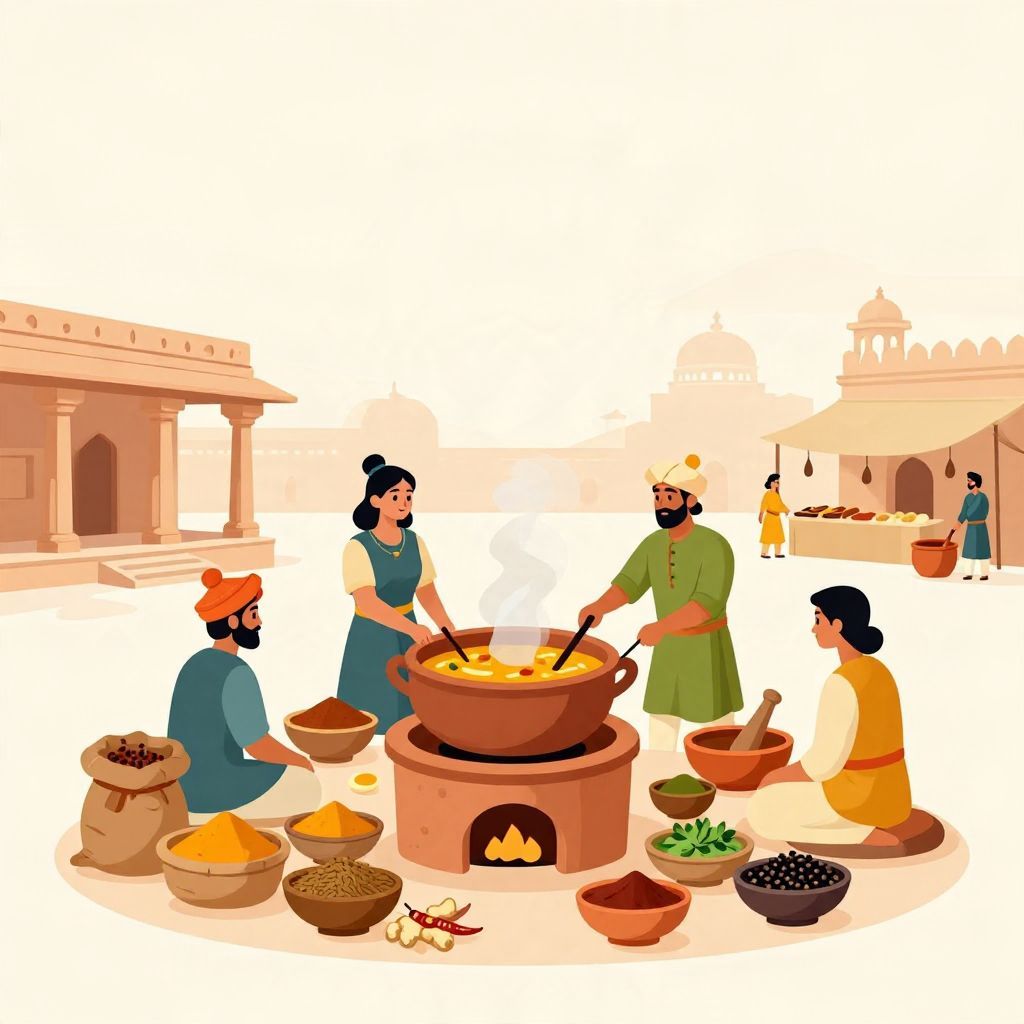
People often ask where curry is from because the word seems to point to one place, but the history is more complex. Curry is not a single ancient dish with one inventor. It is better understood as a family of spiced dishes that developed over centuries in South Asia and later spread across the world.
The answer depends on what you mean by “curry”: a spice blend, a sauce, or a style of cooking. Its deepest historical roots are in the Indian subcontinent, especially in the diverse food traditions of India, Sri Lanka, and neighboring regions, though the modern global idea of curry was shaped by colonial exchange and migration.
Where is curry from?
Curry comes primarily from South Asia, especially the Indian subcontinent. The earliest historical roots of curry lie in regional South Asian cooking traditions that used turmeric, ginger, garlic, coriander, cumin, pepper, mustard seed, and other spices in sauces, stews, and dry dishes. The modern English word “curry” later became a broad label for many of these foods, and even for dishes outside South Asia.
The historical roots of curry in South Asia
Curry did not begin as one fixed recipe. In South Asia, cooks had long combined local spices, herbs, legumes, vegetables, meat, and rice into complex dishes. Archaeological and textual evidence suggests that spiced cooking was deeply established in the region by ancient and early medieval times, though exact “first curry” claims are not historically reliable. What existed was a broad culinary tradition, not a single origin point.
Ancient and early medieval food traditions
Long before the modern word curry appeared in English, South Asian cuisines were already using spice mixtures and simmered dishes. The climate encouraged the use of spices for flavor, preservation, and balance. Different regions developed their own methods: coconut-based dishes in the south, mustard and fish preparations in Bengal, yogurt and dairy-based gravies in the north, and many vegetarian traditions shaped by religious and local practice.
This diversity matters. When people ask “where is curry from,” they are often imagining one dish, but historically curry is a category of foods, not a single invention. The common thread is the use of a spiced sauce or seasoning base, often served with rice or flatbread.
How the word “curry” developed
The English word “curry” is not originally Indian in form. It likely entered English through contact with South Asia during the early modern period, especially through Portuguese and then British trade and colonial presence. The term is usually linked to South Indian words such as kari, meaning sauce or relish in some Dravidian languages, though the exact linguistic path is debated.
From local food terms to a global label
European visitors often struggled to describe the wide range of South Asian dishes they encountered. Rather than learning each regional name, they used a general word to group many spiced preparations together. Over time, “curry” became an umbrella term in English for dishes that were quite different from one another in India, Sri Lanka, Burma, and beyond.
That broad use was a colonial simplification. It blurred regional distinctions and made a diverse food culture seem more uniform than it was. In historical terms, then, curry is both South Asian in origin and global in its later meaning.
Why curry is associated with India
India is the place most closely associated with curry because the subcontinent contains many of the culinary traditions that shaped it. Indian cooking has long emphasized spice blends, layered sauces, and regional variation. When British writers and travelers encountered these foods, they often called them curry, and the term stuck in English-speaking countries.
Regional diversity within India
- North India: often uses dairy, ghee, onions, tomatoes, and warming spices in gravies and stews.
- South India: often features coconut, tamarind, curry leaves, mustard seeds, and lentils.
- West India: includes coastal seafood dishes and vegetarian preparations with strong spice profiles.
- East India: includes fish curries, mustard-based sauces, and subtle spice combinations.
These are not separate inventions of curry so much as different regional expressions of a long culinary tradition. The modern idea of curry emerged from this variety, not from a single standardized recipe.
Was curry invented in one place?
There is no credible evidence that curry was invented in one exact city, village, or year. That kind of origin story is too simple for a food with such a long and varied history. Instead, curry evolved gradually across South Asia as a style of cooking that changed from region to region and from household to household.
Why origin stories can be misleading
Food history often gets reduced to a single birthplace, but cuisines usually develop through exchange. Ingredients move along trade routes, techniques spread between communities, and political change alters what people eat. Curry is a good example: it reflects local agriculture, trade in spices, religious dietary rules, and later colonial contact.
So if the question is “where is curry from?” the most accurate answer is: from South Asia, especially the Indian subcontinent, with no single inventor or exact point of origin.
How trade and empire spread curry beyond South Asia
Curry’s global history began when traders, sailors, soldiers, and migrants carried South Asian foods abroad. Portuguese, Dutch, British, and other European powers encountered these dishes through commerce and empire. As South Asian workers and cooks moved to Southeast Asia, the Caribbean, East Africa, and elsewhere, they helped transform local food cultures and spread curry-like dishes further.
British colonial influence
British rule in India had a major impact on how curry was understood in the West. British colonists adapted South Asian dishes to their own tastes, sometimes simplifying spice mixtures or thickening sauces. In Britain, “curry” eventually came to mean a wide range of dishes inspired by South Asian cooking, even when they were heavily modified.
This period also helped create the modern restaurant curry. Dishes served in colonial clubs, railway hotels, and urban restaurants were often tailored to non-Indian customers. Over time, curry became part of British food culture, though in a form quite different from its many South Asian originals.
Curry outside India: Sri Lanka, Southeast Asia, and beyond
Although India is central to curry’s history, it is not the only place where curry developed. Sri Lanka has its own long tradition of curries, often using coconut, chili, and local spices. In Southeast Asia, similar spiced stews and sauces appear in Thai, Malaysian, Indonesian, and Burmese cuisines, though they are not always called curry in the same way.
Examples of related traditions
- Sri Lankan curry: often intensely spiced, with coconut and local ingredients.
- Thai curry: usually built from curry paste, coconut milk, herbs, and chilies.
- Malaysian and Indonesian curries: influenced by Indian, local, and Islamic culinary traditions.
- Japanese curry: introduced through British influence in the 19th century and adapted into a milder, thicker dish.
These foods show how curry became a global culinary idea. Yet each region adapted it differently, so “curry” does not mean exactly the same thing everywhere.
What curry means today
Today, curry can refer to many things: a spice blend, a sauce, a stew, or a broad category of dishes. In South Asia, people usually identify dishes by more specific names than the English word curry. Outside South Asia, however, the term often serves as a convenient shorthand for a wide range of spiced dishes.
Why the modern meaning is so broad
The broad use of the word reflects history. Colonial-era labeling collapsed many distinct regional dishes into one category. Later, migration and globalization spread curry restaurants and packaged curry powders across Europe, North America, Africa, and the Pacific. As a result, the word now carries both a South Asian heritage and a global identity.
The historical significance of curry
Curry matters historically because it shows how food travels, changes, and acquires new meanings. It also reveals how colonialism shaped language and taste. A dish family rooted in South Asian households became a global category through empire, migration, and adaptation. That process preserved some traditions while obscuring others.
In other words, curry is not just a meal. It is a record of trade, regional diversity, cultural exchange, and historical change. Its story is one of continuity and reinvention at the same time.
In summary: curry is from South Asia, especially the Indian subcontinent, but it is not a single dish with one birthplace. It developed over centuries as a diverse tradition of spiced cooking and later spread worldwide through trade, migration, and empire. For more food-origin history, see where sushi originated and where broccoli comes from.